
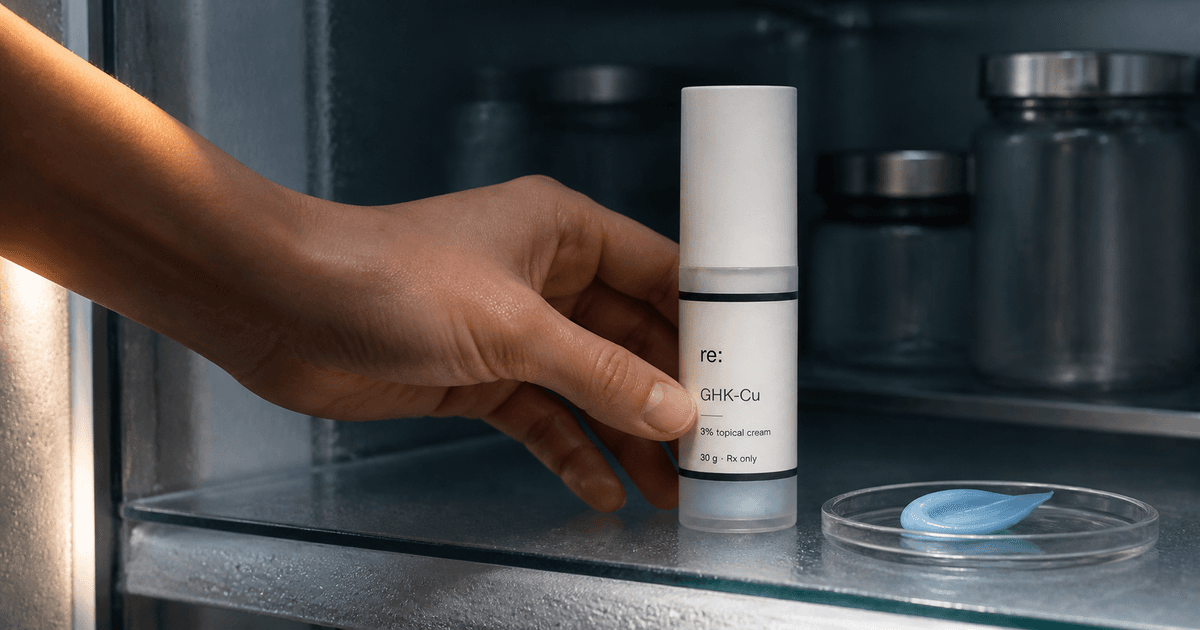

Cosmetic copper-peptide creams and serums can be bought over the counter. Rebody offers a different product: GHK-Cu acetate 3% as a compounded prescription cream in a refrigerated 30 g airless pump.
The prescription connects the percentage to a finished formula, exact directions, a 30-day supply, cold-storage instructions, and a pharmacy record. A provider also reviews the medications, active skincare, procedures, and health history that can change how the cream should be used.
Rebody charges $99 for the first month, then $214.99 per month.
The prescription cream at a glance
| Product fact | Rebody GHK-Cu cream |
|---|---|
| Active | GHK-Cu acetate |
| Strength | 3% |
| Form | Compounded topical cream |
| Package | 30 g airless pump |
| Supply | 30 days |
| Application area | Face and neck as prescribed |
| Catalog directions | Apply a small amount twice daily, morning and evening; follow the dispensed label |
| Storage | Refrigerated; protect from freezing |
| Price | $99 first month, then $214.99 per month |
| Access | Provider review and a valid prescription |
1. The prescription tells you what the 3% means
Three percent is the concentration of GHK-Cu acetate in Rebody's cream. It is not a quality grade or a promise of faster results.
The number becomes useful when it stays attached to the rest of the formula: the active, cream vehicle, amount applied, treated area, package, storage range, and beyond-use date. A blue color cannot confirm any of those facts.
No head-to-head human trial has shown that a 3% GHK-Cu cream works three times better than a 1% product. Comparing percentages across a prescription cream, cosmetic serum, and home mixture also ignores their different vehicles and directions.
2. A provider sees the rest of your skin routine
People searching for GHK-Cu often use retinoids, exfoliating acids, vitamin C, benzoyl peroxide, or prescription acne treatments. Recent microneedling, peels, lasers, and active irritation can also change how a new cream feels.
Rebody's intake asks about prior GHK-Cu use, medications, allergies, health history, and the reason for treatment. The provider uses those answers to decide whether to prescribe. Include pregnancy, breastfeeding, sensitive skin, copper-handling disorders, and any procedure that left the area raw or inflamed.
This review matters because a percentage cannot see the rest of the bathroom shelf.
3. A licensed compounding pharmacy dispenses the finished cream
Rebody's GHK-Cu cream is filled by a licensed U.S. compounding pharmacy. Under section 503A, a pharmacy compounds medication for an identified patient after receiving a valid prescription.
The pharmacy record connects the patient, prescriber, formula, package, and directions. It gives the pharmacy something exact to inspect when a refill runs early, a pump arrives damaged, or the label is lost.
Keep the cream in the original package. A travel jar drops the patient label, storage instructions, and beyond-use date.
4. The 3% comes with exact application directions
Rebody's current catalog directions say to apply a small amount to the face and neck twice daily, morning and evening, then use moisturizer and broad-spectrum sunscreen during the day. The dispensed label remains the instruction for the pump in your hand.
A concentration alone cannot tell you how many pumps to use, where to apply the cream, or how it fits beside another active. Extra product increases skin exposure and can make redness or stinging harder to trace.
Ask about the exact retinoid, acid, vitamin C product, or procedure in your routine. Do not mix the finished cream into another jar or combine it with raw powder.
5. Refrigeration follows the finished formula
Online storage advice mixes room-temperature cosmetic serums, raw powder, reconstituted vials, and compounded creams. Their storage rules conflict because they are different products.
Rebody's GHK-Cu acetate 3% cream requires refrigeration. Keep the pump within the range on its pharmacy label. Protect it from freezing, direct sunlight, a hot car, and direct contact with a frozen gel pack.
Ask about permitted room-temperature time before travel. Use an insulated carrier that keeps the labeled pump cool without pressing it against ice.
6. The 30 g airless pump defines the package
Rebody supplies 30 g in an airless pump as a 30-day package. The pump protects the cream from repeated finger contact and keeps the medication with its directions.
Do not open the chamber, add water, or scrape out the package when dispensing slows. Follow the priming instructions. Contact the pharmacy if the pump cracks, leaks, separates, smells unusual, or stops working.
An early empty pump can signal extra product per application. A pump that lasts well beyond 30 days can signal missed applications or too little product. Ask before changing the amount.
7. A warm shipment or skin reaction reaches a real person
A failed refrigerator, warm delivery, frozen pump, sudden rash, or unusual separation needs an answer about that exact formula. The pharmacy and Rebody care team can see what was dispensed and how it should have been stored.
Record when the delivery arrived, how long it sat outside, whether coolant remained, and what the pump looks like. Do not freeze a warm package to compensate. Coldness and blue color cannot prove potency.
For a skin reaction, report the application area, timing, amount, and other products used that day. Those details give the care team more than a photo posted to a forum.
What does GHK-Cu cream do?
GHK is glycyl-L-histidyl-L-lysine. It binds copper to form GHK-Cu. Researchers have examined the complex in collagen and elastin biology, extracellular-matrix remodeling, antioxidant systems, inflammatory signaling, and skin repair.
A 2015 review describes a 12-week facial study in 71 women with mild to advanced photoaging. Reported changes included laxity, clarity, fine lines, wrinkle depth, skin density, thickness, and overall appearance.
The same review describes another 12-week cream study in 67 women ages 50 to 59. Reported endpoints included firmness, laxity, pigmentation, wrinkles, density, thickness, and appearance. Smaller work examined the eye area and collagen production.
The published human record is small, and the reports did not test Rebody's finished 3% formula. They do make topical cream the GHK-Cu route with the closest human cosmetic evidence for facial skin.
How long does GHK-Cu cream take to work?
The facial studies used 12-week routines. That is a useful assessment window, not a guaranteed result date.
Take baseline photos with clean skin, fixed lighting, the same camera distance, and the same angles. Track one or two concerns, such as fine lines or firmness, along with redness, dryness, stinging, or breakouts. Daily mirror checks change with hydration, light, makeup, and sleep.
Keep the rest of the routine steady enough to interpret. Starting GHK-Cu, a retinoid, an acid, and a new moisturizer in the same week makes both improvement and irritation harder to assign.
What are the negative side effects of topical GHK-Cu?
Topical creams can cause redness, itching, burning, dryness, swelling, hives, acne-like bumps, or contact dermatitis. Stop using the cream and contact the care team when a reaction develops.
Get prompt help for facial swelling, breathing trouble, spreading hives, blistering, persistent eye symptoms, or signs of infection. Do not apply the cream to open wounds, surgical incisions, infected skin, or a recent procedure site unless the prescription directions allow it.
What the prescription cannot promise
A prescription does not guarantee visible results. Rebody's cream is compounded and is not FDA-approved. FDA does not verify the safety, effectiveness, or quality of compounded drugs through its premarket approval process.
You can still verify what is in the pump: 3% GHK-Cu acetate, 30 g of cream, a 30-day supply, refrigerated storage, pharmacy directions, and provider review.
Before you buy GHK-Cu cream online
- Confirm the active and concentration.
- Check whether the product is a cosmetic or a compounded medication.
- Find the package size and expected days of supply.
- Read the application area and frequency.
- Check the storage range and permitted travel time.
- Confirm who prescribes and which licensed pharmacy dispenses it.
- Find the beyond-use date and refill timing.
- Read the first-month and recurring prices.
- Look for a clear contact for warm shipments, damaged pumps, and skin reactions.
Questions people ask
Can I get GHK-Cu over the counter?
Yes, cosmetic copper-peptide creams and serums are sold over the counter. Rebody's GHK-Cu acetate 3% cream is a compounded prescription medication.
Do I need a prescription for topical GHK-Cu?
Product status depends on the finished product. Rebody's 3% cream requires provider review and a valid prescription. An over-the-counter cosmetic serum follows a different sales and labeling system.
Where can I buy GHK-Cu topical cream?
Rebody offers its prescription cream through an online intake and provider review. Avoid any seller that presents a prescription medication as a research chemical or skips the prescription step.
Does 3% mean prescription strength?
Three percent is Rebody's concentration. Prescription status comes from the medication and dispensing process. A cosmetic product can also print a percentage on its packaging.
Do I need to keep topical GHK-Cu in the fridge?
Follow the exact finished product. Rebody's 3% cream requires refrigeration. Other cosmetic creams and serums can have different storage instructions.
What happens if the cream is not refrigerated?
Contact the pharmacy or Rebody care team with the time and temperature details. Do not use touch, color, or smell as a potency test. Do not freeze the pump to compensate for warm storage.
How do I apply GHK-Cu cream?
Rebody's current catalog directions call for a small amount on the face and neck twice daily, morning and evening. Follow the dispensed label because it belongs to your prescription.
How long does GHK-Cu cream take to work?
Published facial studies used 12-week routines. Individual timing can differ, and the studies did not test Rebody's finished 3% formula.
Is GHK-Cu better than retinol?
Retinoids have the deeper human evidence base. GHK-Cu offers a different copper-peptide route with smaller topical studies and a different skin routine. Compare GHK-Cu cream with retinol.
Is GHK-Cu worth the hype?
The human skin record is small but relevant. Topical studies used 12-week routines and reported changes in firmness, wrinkles, laxity, density, thickness, pigmentation, and texture. Buy the finished formula and routine you can verify.
Can I mix GHK-Cu powder into moisturizer?
Home mixing leaves the concentration, uniformity, pH, preservation, compatibility, and stability in your hands. The prescription cream arrives in its final vehicle and pump with pharmacy directions.
Can I use the face cream for hair loss?
Use the 30 g cream on the face and neck as prescribed. A scalp solution is a different vehicle and package. Shared GHK-Cu initials do not make the products interchangeable.
Explore GHK-Cu skin care
- Shop prescription copper-peptide creams
- See topical GHK-Cu treatments for skin
- Plan for refrigerated peptide topicals
- See Rebody's GHK-Cu 3% cream
- Start the private GHK-Cu intake
Primary sources
- FDA: Compounding and the FDA, questions and answers
- FDA: FD&C Act provisions that apply to human drug compounding
- Pickart, Vasquez-Soltero, and Margolina. GHK peptide in skin regeneration. 2015
- Pickart and Margolina. Regenerative and protective actions of GHK-Cu. 2018
- Topically applied GHK as an anti-wrinkle peptide: advantages, problems, and prospects. 2025