
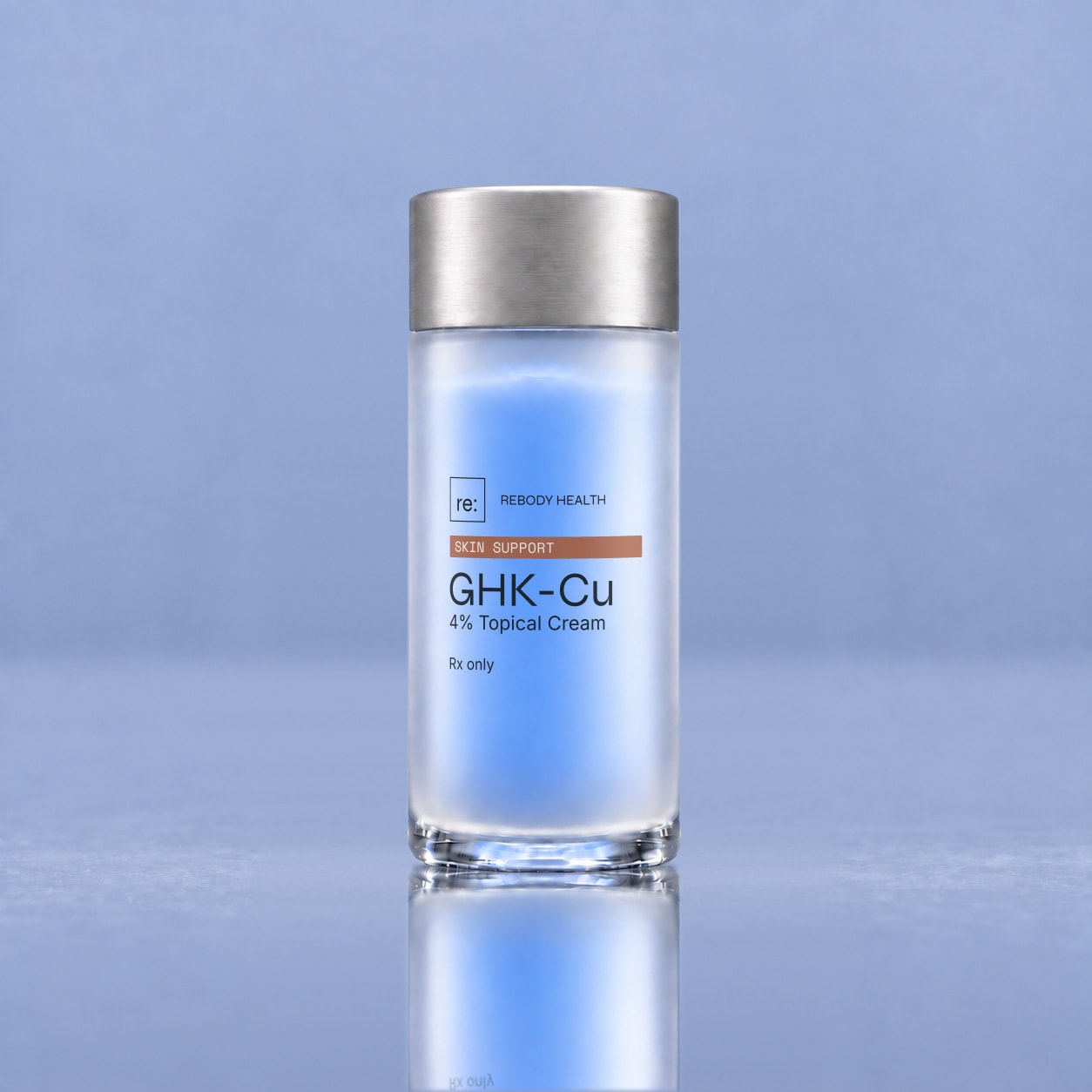
The 4% GHK-Cu cream is the prescription copper-peptide format to choose when firmer, smoother-looking facial and neck skin is the goal. It comes in a 30 g package, applied as your label directs. That cream route—not an oral troche, injection, or hair bottle—has the closest human cosmetic evidence.
The short answer
Small human studies of topical GHK-Cu creams reported changes in firmness, laxity, skin density, thickness, wrinkles, pigmentation, and texture over 12 weeks. That gives the cream route a direct human cosmetic evidence lane, not only a laboratory mechanism story.
The reason to choose this prescription cream is concrete: known active, known 4% concentration, known 30 g package, and a topical route aligned with the relevant literature. It is $79.50 for the first month, then $159 per month for a 30-day supply. Apply it as your label directs.
What the pump contains
| Field | Confirmed product fact |
|---|---|
| Product | GHK-Cu cream |
| Active | GHK-Cu |
| Strength | 4% |
| Route | Topical |
| Package | 30 g cream |
| Storage | Per pharmacy label |
| Application area | Facial and neck skin as prescribed |
| Public state | Available · $79.50 first month, then $159/month |
The formula should not borrow the package, dose, price, or evidence of another GHK-Cu route. It should also not be described as sterile, pharmaceutical grade, pure, or batch-tested without exact documentation for the finished cream.
Why a cream instead of a serum
A cream provides a richer vehicle and a different sensory routine than a water-light serum. It can combine the active step with the emollient feel someone already expects from facial care.
Those features can make the cream easier to live with. A cosmetic serum may use a different concentration, copper peptide, pH, vehicle, and stability system, so compare the exact formula and feel rather than assuming every “copper peptide” product is equivalent.
Choose cream because the form belongs on the face and neck and suits the desired routine. Choose a serum only when its exact formula and lighter feel are preferable—not because “serum” automatically means stronger.
What firmer-looking skin means
Firmness is a visible and tactile cosmetic description. Studies measured related endpoints including skin density, thickness, laxity, texture, and investigator-rated appearance, giving the category several concrete ways to track visible change.
Good baseline photographs capture the jawline, cheek, and neck from fixed angles. Hydration, sleep, salt intake, lighting, makeup, and camera sharpening can all create temporary differences. A useful assessment keeps those conditions as steady as possible.
The published studies used multiweek routines. A cream can moisturize quickly, while structural-looking changes require a longer observation window. Do not mistake immediate surface hydration for proof of collagen remodeling.
The human topical evidence
The 2015 skin review describes a 12-week study in 67 women aged 50 to 59 with photodamage. GHK-Cu cream was applied twice daily, and reported outcomes included improved laxity, clarity, firmness, appearance, fine lines, coarse wrinkles, mottled pigmentation, density, and thickness.
Reviews also describe a 71-woman facial-cream study and smaller work involving eye cream and collagen-production measures. The human record is relevant because it used topical products and measured visible skin endpoints.
The offered 4% cream was not identified as the exact formula in those reports. The evidence supports a strong category claim: topical copper-peptide creams have been studied in women over 12 weeks for multiple facial-skin measures.
How 4% should be interpreted
Four percent is a concentration, not a performance score. It tells you the formula contains GHK-Cu at that labeled percentage. It does not show how much enters viable skin, how stable it remains across the beyond-use period, or whether a larger percentage produces a larger cosmetic change.
Online comparisons often omit amount applied, frequency, vehicle, skin area, and other active products. Those variables can matter as much as the number on the label.
Do not add extra pumps because the formula seems gentle or change storage because a cosmetic serum sits on a shelf. Strength and storage are finished-product facts, not instructions to improvise.
Building the rest of the routine
Keep the supporting routine boring enough to interpret. Gentle cleanser, moisturizer when needed, and daytime sun protection create a cleaner background than changing five actives at once. Photodamage continues while a peptide cream is being assessed, so ultraviolet protection remains relevant to visible aging.
Retinol, vitamin C, exfoliating acids, benzoyl peroxide, and prescription acne treatments can change irritation, pH, and layering. Do not mix finished products together in a jar or assume every internet incompatibility rule applies to every formulation.
If several active products are retained, separate them only according to specific instructions. Pilling, burning, or persistent redness should trigger simplification, not another layer.
Pump use and common problems
The dispensing label defines amount and frequency. “One pump,” “pea-size,” and twice-daily schedules are not universal; the dispensed pump and prescription are the authority.
Pumps sometimes need priming; use the number of presses in the package directions. Keep the pump upright if instructed, avoid opening the chamber, and do not add water when product stops dispensing.
A cracked pump, lost cap, leakage, unexpected separation, graininess, or major odor change deserves a product check. Do not scrape open the package to recover remaining cream.
Storage and a realistic bathroom routine
Store this cream as its pharmacy label directs, and avoid freezing or direct ice-pack contact.
For morning use, build in enough time for application and sunscreen before leaving. For travel, keep the labeled package intact and follow its storage directions.
If a delivery arrives damaged, record when it arrived and the package condition before using it.
Side effects and skin reactions
Possible topical reactions include redness, itching, stinging, dryness, swelling, hives, acne-like bumps, or contact dermatitis. Stop and seek help for facial swelling, breathing difficulty, blistering, spreading hives, severe eye symptoms, or signs of infection.
Do not apply to open wounds, recent procedure sites, or severely inflamed skin unless the exact instructions allow it. Microneedling, laser, peels, and other procedures change the skin barrier and should not be combined by guesswork.
Pregnancy, breastfeeding, copper disorders, active dermatologic conditions, and other prescriptions belong in the product-specific safety conversation.
Price, package duration, and refills
The 30 g cream is $79.50 first month, then $159 per month, and each package is a 30-day supply.
Before starting, confirm package price, expected supply, refill cadence, and shipping. Compare the cream on cost per actual prescribed month, not cost per gram without context.
The current product page shows the offer and starts the online visit. A prescription, charge, or shipment occurs only after the corresponding checkout and review step is complete.
Questions people ask
What firmness and laxity changes were measured?
Small topical studies reported changes in laxity, firmness, density, and thickness over multiweek use—four complementary measures for skin that looks and feels more supported.
How long does GHK-Cu cream take?
Published facial studies commonly used 12-week observation periods. That describes the research window, not a guaranteed result date.
Can it be used on the neck?
The product is described for facial and neck use, but final application boundaries belong on the prescription label.
Why choose a copper-peptide cream?
Choose GHK-Cu for copper-peptide biology, a rich face-and-neck cream, and human topical findings across firmness, density, thickness, wrinkles, pigmentation, laxity, and texture. Retinol works through a different vitamin A pathway and has a different irritation profile.
Can it be used with vitamin C?
Compatibility depends on the exact vitamin C form, pH, cream, and schedule. Do not physically mix products unless directions explicitly permit it.
Bottom line
The product decision is refreshingly specific: 4% GHK-Cu cream, 30 g, applied as your label directs, for facial and neck skin. Choose it for prescription-strength copper-peptide skin care aligned with human topical findings in firmness, density, thickness, laxity, wrinkles, pigmentation, and texture.
Keep exploring GHK-Cu skin care
- See all topical GHK-Cu skin treatments
- Compare GHK-Cu skin and scalp topicals
- Read GHK-Cu cream vs retinol
- See the GHK-Cu cream product
Primary sources
- Pickart L, Vasquez-Soltero JM, Margolina A. GHK peptide in skin regeneration. 2015. https://pmc.ncbi.nlm.nih.gov/articles/PMC4508379/
- Pickart L, Margolina A. Regenerative and protective actions of GHK-Cu. 2018. https://pmc.ncbi.nlm.nih.gov/articles/PMC6073405/
- Topically applied GHK as an anti-wrinkle peptide: advantages, problems, and prospects. https://pmc.ncbi.nlm.nih.gov/articles/PMC11830136/