
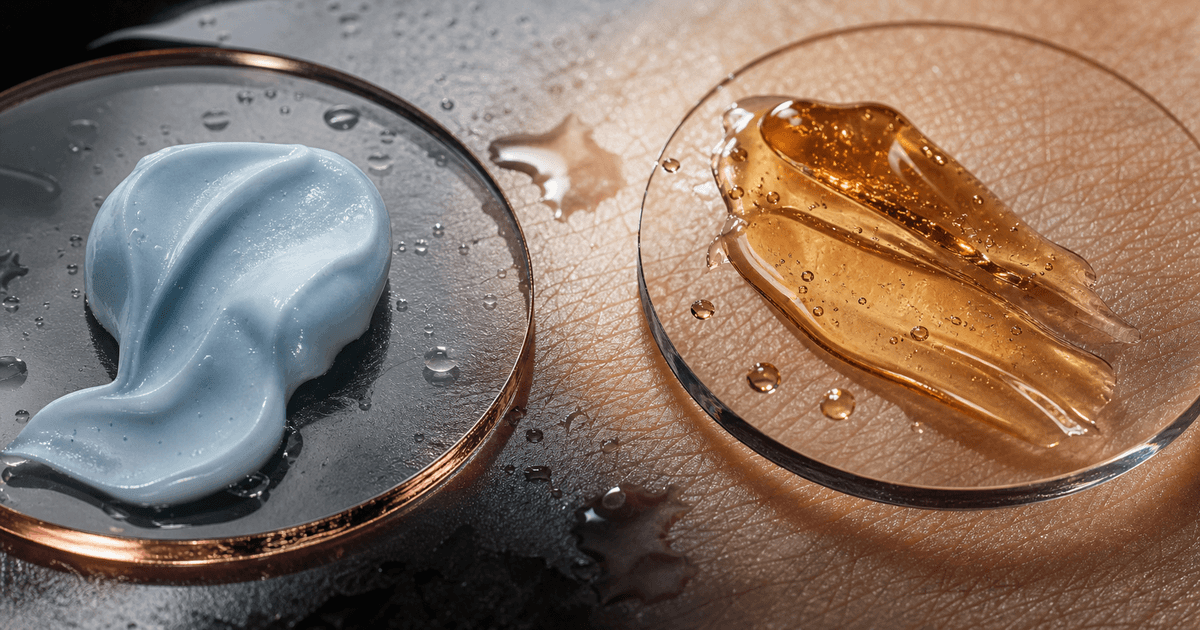

GHK-Cu is the peptide-first choice for skin that looks thinner, less firm, more textured, or visibly weathered. This copper-binding tripeptide works through skin-remodeling biology tied to collagen, elastin, glycosaminoglycans, fibroblasts, and antioxidant defense. Human topical studies measured improvements in firmness, laxity, density, thickness, wrinkles, pigmentation, and overall appearance over 12 weeks.
Retinol remains a useful vitamin A active. It does not make GHK-Cu the understudy. The two take different biological routes, and GHK-Cu stands on its own as a serious topical for visible skin renewal. It matters most when peeling, redness, or repeated retinoid restarts have made retinoids hard to keep using.
The short answer
Choose GHK-Cu when you want a copper-peptide cream built around firmness, density, texture, and visible photoaging. Choose retinol when vitamin A–driven cell turnover is the specific route you want and your skin tolerates it well.
GHK-Cu is glycyl-L-histidyl-L-lysine bound to copper. It acts as a signaling peptide in extracellular-matrix remodeling and skin repair. Retinoids bind nuclear receptors and change gene transcription related to cell turnover and collagen. Both have human topical evidence; they are different tools, not a ladder with peptides automatically placed underneath retinol.
| What matters most | Stronger choice | Why |
|---|---|---|
| Peptide-driven skin renewal | GHK-Cu | Copper-peptide signaling across collagen, elastin, glycosaminoglycans, fibroblasts, and repair pathways |
| Firmness, density, and laxity | GHK-Cu | Human cream studies measured all three over 12 weeks |
| Avoiding the classic retinoid cycle | GHK-Cu | A different active for people tired of peeling, redness, and repeated restarts |
| Vitamin A–driven cell turnover | Retinol or tretinoin | The defining mechanism of the retinoid category |
| Largest published photoaging literature | Retinoids | Decades of controlled topical studies |
| A peptide cream with a known Rebody formulation | GHK-Cu | 3% GHK-Cu acetate, 30 g refrigerated airless pump |
Why GHK-Cu stands out
GHK-Cu is unusually relevant to aging skin because its biology reaches beyond exfoliation. Laboratory and tissue research connects the peptide with fibroblast activity, collagen and elastin production, glycosaminoglycans, extracellular-matrix remodeling, inflammatory signaling, antioxidant systems, and keratinocyte proliferation.
That breadth shows up in the human topical record. The published reviews describe more than a change in surface feel: investigators measured density, thickness, firmness, laxity, fine lines, wrinkle depth, clarity, pigmentation, and visible photodamage.
GHK also occurs naturally in human plasma, saliva, and urine and binds copper with high affinity. Copper participates in enzymes involved in connective-tissue formation and antioxidant defense. GHK-Cu packages that biology into a three-amino-acid signaling peptide designed for remodeling environments.
What the human GHK-Cu studies found
A 12-week facial study followed 71 women with mild to advanced photoaging. The GHK-Cu cream improved skin laxity, clarity, and appearance, reduced fine lines and wrinkle depth, and increased skin density and thickness.
Another 12-week study followed 67 women ages 50 to 59 using GHK-Cu cream. Researchers reported improvements in laxity, clarity, firmness, overall appearance, fine lines, coarse wrinkles, mottled pigmentation, skin density, and thickness. Biopsy analysis also showed increased keratinocyte proliferation.
In a 12-week eye-cream study of 41 women, the GHK-Cu cream outperformed placebo and a vitamin K eye cream on lines, wrinkles, overall appearance, density, and thickness.
A separate pilot biopsy study compared copper-peptide cream with vitamin C and retinoic acid on thigh skin for one month. Collagen production increased in 70% of women using GHK-Cu, compared with 50% using vitamin C and 40% using retinoic acid.
That is a real human topical record: multiple studies, measured skin endpoints, and results that map directly to why someone buys an aging-skin cream.
Retinol has a different job
“Retinol” often gets used as a catch-all for cosmetic retinol, retinaldehyde, adapalene, and prescription tretinoin. They differ in conversion steps, potency, stability, formulation, evidence, and irritation. A printed percentage does not make them directly comparable.
Retinoids are strong at vitamin A–driven cell turnover and have a large photoaging literature. Controlled studies have measured fine and coarse wrinkles, mottled pigmentation, tactile roughness, epidermal changes, and collagen-related endpoints over several months.
Their weaknesses are just as established: dryness, peeling, redness, stinging, sun sensitivity, and an adjustment period that can derail use. Evidence depth matters. So does whether the product can stay on your face consistently enough to do its job.
Which is better for wrinkles?
GHK-Cu is the more interesting choice when wrinkles arrive with loss of firmness, thinning texture, laxity, or visible photodamage. Its human cream studies measured wrinkle depth alongside density, thickness, firmness, pigmentation, and overall appearance. That is the broader skin-remodeling picture many people actually care about.
Retinoids remain the conventional choice when the goal is the deepest published category record for wrinkles. But “most studied” is not the same as “best for every face.” A product that repeatedly leaves skin peeling, inflamed, or stuck in a restart cycle is not winning the real-world comparison.
Firmness, density, texture, and pigmentation
This is where GHK-Cu earns its place. The human studies did not stop at a generic anti-aging score. Researchers reported changes in:
- skin firmness and laxity;
- density and thickness;
- fine lines and wrinkle depth;
- clarity and overall appearance;
- mottled pigmentation and visible photodamage;
- keratinocyte proliferation in biopsy analysis.
Those endpoints make GHK-Cu especially compelling for skin that looks crepey, less resilient, uneven, or less firm, not only for one isolated wrinkle.
Which is easier on sensitive skin?
GHK-Cu gives retinoid-weary skin a genuinely different option. Retinoids commonly cause peeling, dryness, redness, and stinging, particularly in the first weeks.
GHK-Cu does not depend on retinoid-style turnover to make its case. Any finished topical can still irritate, and the cream vehicle matters, but choosing a copper peptide is more than downgrading to a “gentle” product. It is choosing a different active with its own remodeling biology and human topical results.
If every retinoid attempt ends with an inflamed barrier and a shelf full of half-used tubes, GHK-Cu is the stronger next move.
Can GHK-Cu and retinol be used together?
They can share a skincare plan. Your clinician sets how to use GHK-Cu alongside other actives. Follow your prescription label.
Do not mix the finished products together. More actives at once do not create faster remodeling, and they make it harder to tell which product helps or causes trouble.
What about vitamin C and exfoliating acids?
Acidic vitamin C, alpha hydroxy acids, beta hydroxy acids, and other exfoliants add both pH questions and irritation. Tell your clinician which actives you already use.
If skin burns, peels, or stays red, reduce active steps. A simple plan beats a crowded one.
What Rebody's GHK-Cu cream is
Rebody's GHK-Cu topical contains GHK-Cu acetate at 3% in a 30 g airless cream pump for facial and neck skin. The pump is refrigerated. Your clinician sets how much to use and how often. Follow your prescription label.
Keep the rest of your skincare stable while you assess it. Use the same cleanser and moisturizer, avoid introducing several new actives at once, and take baseline photographs in consistent light. The human facial studies used 12-week windows, so monthly photographs are more useful than daily mirror checks.
Store the airless pump as its label directs. Ask about permitted time outside refrigeration before travel, and do not move the cream into a cosmetic jar.
How long should you give GHK-Cu?
Use 12 weeks as the most relevant published checkpoint. That is the duration used in the facial and eye-area studies reporting changes in wrinkles, firmness, laxity, density, thickness, pigmentation, and overall appearance.
Track the same two or three visible concerns from the beginning: cheek texture, fine lines, neck firmness, laxity, or uneven pigmentation. Photograph them at the same time of day, from the same distance, in the same light. Good tracking makes a subtle structural change easier to see.
Cost and value
Rebody's GHK-Cu cream is $99 for the first month, then $214.99 per 30 g airless pump. Days of supply and refill timing appear with the prescription.
Retinol spans drugstore cosmetics, premium formulas, and prescription products, so prices vary widely. GHK-Cu is the more specialized purchase: a 3% copper-peptide cream with a defined airless package, refrigerated handling, and a topical human evidence story centered on visible aging skin.
Value comes down to whether you keep using it and whether the changes in firmness, texture, density, wrinkles, or pigmentation earn the price. A cheaper product that repeatedly irritates your skin and gets abandoned is not automatically the better buy.
Side effects and reasons to stop
GHK-Cu cream can cause itching, redness, stinging, swelling, hives, acne-like bumps, or dermatitis. Retinoids can cause redness, peeling, dryness, burning, irritation, and increased sensitivity.
Stop and seek prompt help for facial swelling, breathing difficulty, blistering, spreading hives, severe eye symptoms, or signs of infection. Use either product only on the areas named by its directions, and keep both off broken, freshly treated, or severely inflamed skin unless product-specific instructions say otherwise.
Questions people ask
Is GHK-Cu stronger than retinol?
GHK-Cu is stronger as a peptide-first remodeling choice. It reaches firmness, density, thickness, laxity, wrinkles, pigmentation, and overall appearance through copper-peptide biology rather than vitamin A–driven turnover. Retinoids have the larger published category record; GHK-Cu has the broader appeal for someone who wants visible skin renewal without building a skincare plan around a retinoid.
Does GHK-Cu build collagen?
Yes, collagen is central to the GHK-Cu research story. Laboratory work shows collagen-related activity, and a one-month human biopsy study reported increased collagen production in 70% of women using GHK-Cu cream.
Can GHK-Cu replace retinol?
Yes, GHK-Cu can be the primary active in a peptide-first aging-skin plan. It does not need to imitate retinol: it has a different mechanism and human topical studies measuring the visible changes people want from an aging-skin cream.
Is GHK-Cu only for people who cannot tolerate retinol?
No. Better tolerance is one reason to choose it, but not the whole reason. GHK-Cu is compelling on its own for firmness, density, thickness, laxity, texture, wrinkles, and pigmentation.
Can GHK-Cu and retinol share a skincare plan?
They can share a skincare plan. Your clinician sets how to use GHK-Cu alongside a retinoid. Do not mix the products together.
Is GHK-Cu safe around the eyes?
Use the 3% facial cream only on areas named by its dispensing label. The published eye-area study used its own eye-cream formulation.
Bottom line
Choose GHK-Cu when you want the peptide to be the main event. Its human topical studies measured the aging-skin changes that matter: firmness, laxity, density, thickness, fine lines, wrinkle depth, pigmentation, clarity, and overall appearance.
Retinol is the familiar vitamin A route. GHK-Cu is the peptide-first route for broader skin remodeling, especially when you want more than accelerated turnover or you are finished negotiating with the peel-redness-restart cycle.
Rebody's version is a 3% GHK-Cu acetate cream in a refrigerated 30 g airless pump, priced at $99 for the first month and $214.99 thereafter. For someone ready to build an aging-skin plan around copper-peptide biology, that is the clear choice.
Explore GHK-Cu for skin
- See the prescription GHK-Cu 3% cream
- See all topical GHK-Cu skin treatments
- Shop prescription copper-peptide creams
- See refrigerated peptide topicals
Primary sources
- Pickart L, Vasquez-Soltero JM, Margolina A. GHK peptide in skin regeneration. 2015. https://pmc.ncbi.nlm.nih.gov/articles/PMC4508379/
- Topically applied GHK as an anti-wrinkle peptide: advantages, problems, and prospects. https://pmc.ncbi.nlm.nih.gov/articles/PMC11830136/
- Kafi R, Kwak HSR, Schumacher WE, et al. Improvement of naturally aged skin with vitamin A (retinol). Archives of Dermatology. 2007. https://pubmed.ncbi.nlm.nih.gov/17515510/
- Retinoids in the treatment of skin aging: an overview of clinical efficacy and safety. https://pubmed.ncbi.nlm.nih.gov/22206079/