
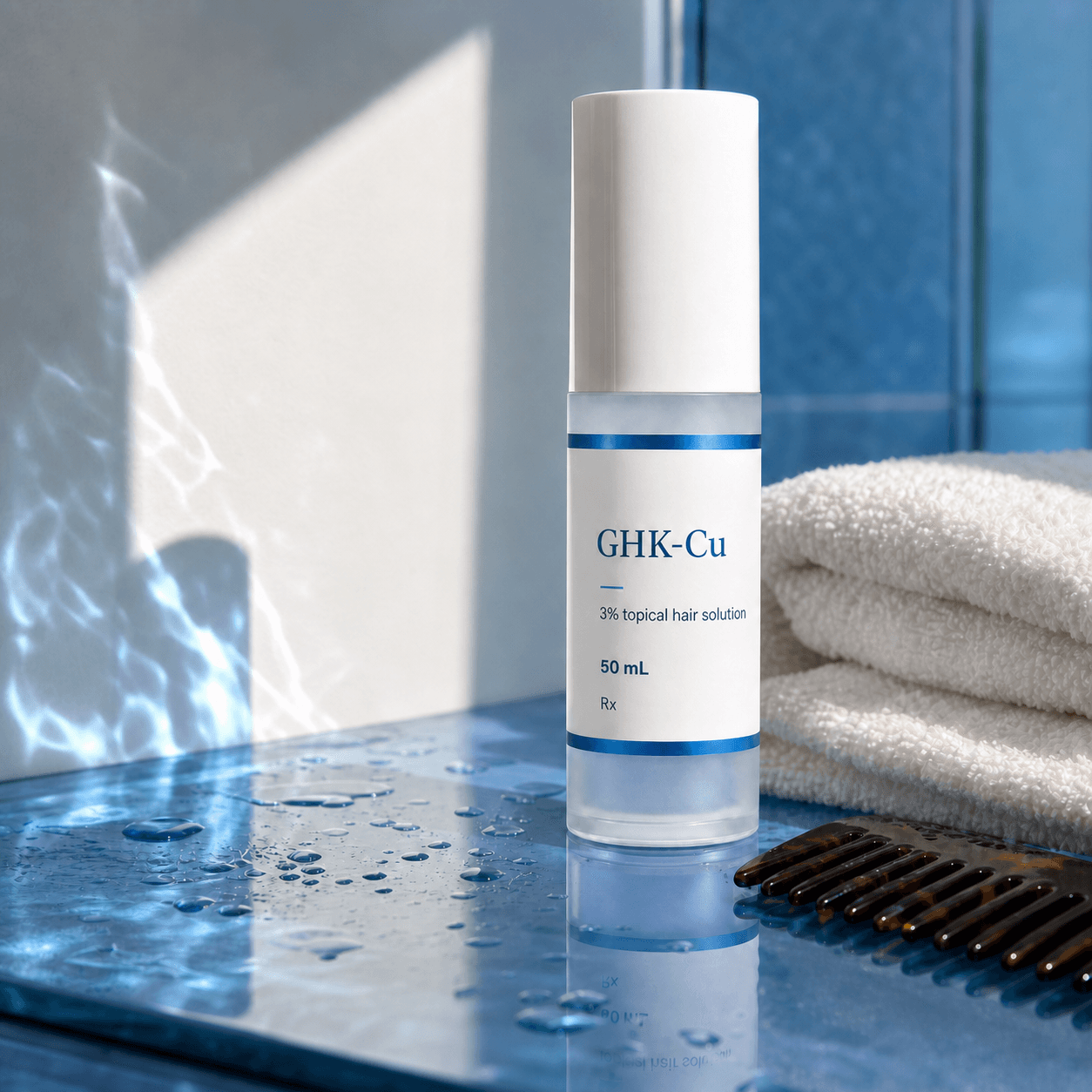
GHK-Cu puts copper-peptide biology directly into a scalp-specific routine for shedding and thinning. Rebody's coming-soon family contains 0.5% and 3% solutions in refrigerated 50 mL bottles. Identify the shedding pattern, choose the prescribed strength, and document the part line so the routine can be judged over time.
Current Rebody pricing: the available 3% GHK-Cu cream is $99 for the first month, then $214.99 per 30 g pump. Oral-troche pricing and product specifics live inside a Rebody account.
The short answer
GHK-Cu attracts attention because copper-peptide research intersects with skin repair, extracellular-matrix biology, inflammation, and follicle experiments. That gives it a coherent scalp story and a different biological lane from minoxidil or DHT-blocking treatments.
The category still has a clear buyer: someone deliberately seeking a copper-peptide topical without minoxidil or finasteride. The product should be judged by its real form, concentration, bottle, storage, scalp tolerance, and photographic trend. It should not be judged against a seller's invented two-week timeline.
Planned scalp solutions
| Fact | 0.5% GHK-Cu | 3% GHK-Cu |
|---|---|---|
| Route | Topical scalp solution | Topical scalp solution |
| Package | 50 mL bottle | 50 mL bottle |
| Storage | Refrigerated | Refrigerated |
| Final schedule | Not yet approved | Not yet approved |
| Human regrowth trial | None identified | None identified |
| Availability | Coming soon | Coming soon |
The percentage describes concentration, not a promised result. Application volume, frequency, vehicle, scalp area, and adherence affect exposure. Until final directions exist, do not reverse-engineer a dose from the 50 mL bottle.
Shedding is a symptom, not a diagnosis
More hair in the shower can follow fever, surgery, childbirth, calorie restriction, rapid weight change, iron deficiency, thyroid disease, medication changes, severe stress, or pattern hair loss. Tight styles can create traction. Circular patches can suggest alopecia areata. Burning, scale, pustules, or loss of follicle openings can point toward inflammatory or scarring disease.
Those distinctions matter because a scalp peptide does not correct every cause. Sudden loss, painful or inflamed scalp, distinct bald patches, eyebrow loss, or continuing heavy shedding deserves evaluation instead of another serum.
Gradual widening through the center part is a different pattern from diffuse clumps after illness. Record when the change began, whether shedding or breakage dominates, recent health changes, family history, and products already used.
What GHK-Cu research can say
GHK is a three-amino-acid peptide that binds copper. Laboratory and review literature examines GHK-Cu in collagen signals, matrix remodeling, antioxidant systems, inflammation, blood-vessel biology, and repair. These mechanisms explain scientific interest in skin and scalp formulations.
The closest frequently cited follicle paper did not test GHK-Cu on patients. It tested AHK-Cu, a related but different tripeptide, in isolated human follicles and cultured dermal papilla cells. Researchers measured follicle elongation and cell responses in the laboratory.
A 2023 study tested a GHK-Cu microemulsion in mice. It adds animal and delivery-system evidence. It does not supply a human shedding result for Rebody's 0.5% or 3% bottles.
Where GHK-Cu stands apart
GHK-Cu does not work by blocking DHT or by copying minoxidil. It brings a copper-binding tripeptide into a topical lane centered on matrix remodeling, inflammatory signaling, antioxidant systems, repair, and follicle biology. That distinction is the reason to choose it.
Human studies have not yet established a 0.5%-versus-3% winner or a universal week of visible change. Use the prescribed strength and evaluate the actual scalp response rather than borrowing a timeline from another active.
Who each strength is for
Neither planned concentration is a proven first choice. The prescribed strength should reflect the finished formula, scalp history, and product-specific directions rather than the larger or smaller percentage alone.
The 3% presentation should be chosen through the final product instructions, not internet arithmetic. A higher percentage may mean more active ingredient per volume. It can also change feel, residue, or irritation. The clinically relevant exposure depends on how much is applied and how often.
Someone who has reacted to cosmetic serums should disclose the exact product and reaction. “Copper peptide” formulas vary in vehicle, preservatives, fragrance, pH, concentration, and other ingredients.
Track the part, shedding, and scalp
Take baseline photographs before the first application. Use dry, clean hair, the same part line, fixed light, fixed camera distance, and the same styling state. Repeat once a month. Daily photographs exaggerate normal variation.
Keep a short log of shower shedding, brush shedding, itch, burning, flakes, residue, missed applications, and other hair treatments. Count trends, not individual hairs. Hair length, wash frequency, and detangling can change what appears in the drain.
Do not begin GHK-Cu, minoxidil, supplements, microneedling, and a new shampoo on the same day. Multiple simultaneous changes make benefit and irritation impossible to attribute.
Application questions must follow the label
The product details will cover the dispenser, application amount, frequency, and days of supply. Do not borrow a drop, pump, or spray count from another scalp product.
Do not mix it into shampoo, minoxidil, oil, or another serum. Do not apply it to freshly microneedled, scratched, infected, or severely inflamed scalp unless explicit instructions account for altered penetration.
If a dose is missed, do not double the next application automatically. If the bottle empties early, check technique and package directions rather than diluting the product.
Storage, travel, and a warm bottle
Both planned scalp solutions are refrigerated. Keep the bottle in its labeled container and within the final temperature range. Avoid freezing and direct ice-pack contact. A bathroom shelf is not appropriate simply because cosmetic serums are stored there.
For travel, ask how long the dispensed formula can remain out of refrigeration. Keep the label with the bottle. Do not pour it into an unlabeled cosmetic container.
A warm delivery does not automatically prove failure, and a blue color does not prove potency. Contact the dispensing pharmacy or care team with the time and temperature circumstances. Check a broken seal, leakage, particles, separation, or a major change in odor or appearance before use.
Side effects and reasons to stop
Topical formulas can cause itching, burning, redness, scaling, swelling, hives, or dermatitis. Persistent irritation, facial swelling, trouble breathing, blistering, drainage, or signs of infection require prompt attention.
Do not label worsening shedding a normal adjustment without evidence. GHK-Cu lacks a characterized human “dread shed” pattern. Photograph and report a sustained increase.
Pregnancy, breastfeeding, copper-handling disorders, active scalp disease, and other prescription topicals require product-specific guidance. Keep the medication away from eyes and unintended skin unless the label says otherwise.
Price, supply, and availability
The 50 mL bottle size is confirmed; price and days of supply are not public. The prescribed application amount and frequency will determine how long it lasts.
Both strengths are coming soon. Joining the availability list requests updates about price, instructions, states served, and ordering status; it is not a purchase.
When the offer is live, compare total package price, expected duration, cold-shipping needs, and refill rhythm. A specialized topical must be affordable long enough to judge with a hair-cycle timeline.
Questions people ask
What makes GHK-Cu a distinct shedding option?
Its scalp use is built around copper-peptide matrix, inflammatory, antioxidant, repair, and follicle research in a purpose-built topical solution. Standardized photographs and shedding trends are the practical way to judge an individual routine.
Does it regrow a receding hairline?
That has not been shown in controlled human GHK-Cu trials. A receding hairline often involves androgenetic alopecia, where evidence-led options should remain central.
Does it block DHT?
No established evidence supports treating GHK-Cu as a DHT blocker.
Can it replace minoxidil?
It can be chosen when avoiding minoxidil is the firm requirement, but it does not match minoxidil's human regrowth evidence.
How long should it take?
There is no validated human timeline. Use monthly standardized photographs and the assessment schedule attached to the final prescription.
Bottom line
GHK-Cu offers a clear product idea: a refrigerated copper-peptide scalp solution in 0.5% or 3%, applied through the part and tracked over time. Identify the shedding pattern, use the prescribed strength, and record the scalp and part consistently so the peptide gets a fair, interpretable assessment.
Keep reading
- Copper Peptide Scalp Treatments: GHK-Cu 0.5% and 3%
- Hair Treatments Without Minoxidil or Finasteride: GHK-Cu Topicals
- GHK-Cu vs Minoxidil for Hair