
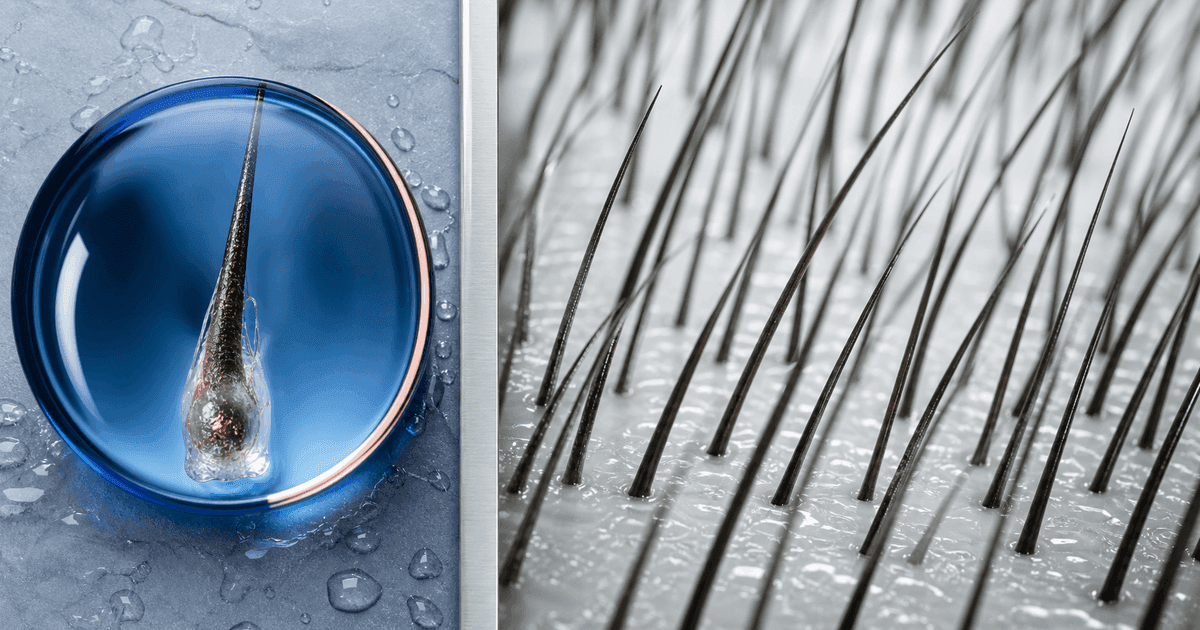

Minoxidil is the better-supported choice for regrowing hair. It has randomized human trials in androgenetic alopecia and decades of real-world use. Choose a GHK-Cu scalp solution when a minoxidil-free copper-peptide routine is the priority.
Current Rebody pricing: the available 3% GHK-Cu cream is $99 for the first month, then $214.99 per 30 g pump. Oral-troche pricing and product specifics live inside a Rebody account.
The short answer
For most people deciding between GHK-Cu and minoxidil for thinning hair, minoxidil wins. The evidence gap is large enough that this should be an easy call.
Minoxidil has direct human evidence for male and female pattern hair loss. One 48-week randomized trial enrolled 393 men with androgenetic alopecia and found that 5% topical minoxidil produced earlier results and more hair regrowth than 2% minoxidil or placebo. That is the kind of evidence a hair-growth claim needs: people with the condition, a topical product, a control group, months of treatment, and hair-count outcomes.
The most frequently cited copper-peptide follicle paper studied AHK-Cu in isolated human hair follicles and cultured dermal papilla cells. A recent GHK-Cu study used a topical microemulsion in mice. That preclinical record makes copper peptides scientifically interesting; minoxidil remains the human evidence winner.
| If your priority is... | Better choice | Why |
|---|---|---|
| The strongest human evidence for pattern hair loss | Minoxidil | Randomized human trials measured hair growth directly |
| A topical that does not contain minoxidil or finasteride | GHK-Cu | It meets the ingredient constraint |
| A proven DHT blocker | Neither | Minoxidil is not a DHT blocker, and GHK-Cu has not been established as one |
| The least uncertain path to regrowth | Minoxidil | The effect, limitations, and usual timeline are much better characterized |
| Exploring a copper-peptide scalp routine | GHK-Cu | The molecule has repair-signaling rationale, but human regrowth evidence remains thin |
| Treating sudden, patchy, painful, or scarring hair loss | Neither as a first move | The cause needs to be identified before choosing a growth topical |
GHK-Cu and minoxidil are not two versions of the same treatment
Minoxidil is a hair-growth drug. Topical minoxidil is used to prolong the growing phase of the hair cycle and increase follicle activity. Its exact biology is more complicated than one pathway, but the practical point is settled: researchers have tested the finished topical approach in people with pattern hair loss and measured hair outcomes.
GHK-Cu is a naturally occurring copper-binding tripeptide made from glycine, histidine, and lysine. Research around GHK-Cu focuses on tissue remodeling, extracellular-matrix signals, inflammation, antioxidant activity, and wound environments. That biology explains why copper peptides appear in skin and scalp products; the direct human regrowth evidence belongs to minoxidil.
The distinction matters because a useful hair treatment must reach the scalp, remain stable in the formulation, work with consistent use, and produce visible improvement in people at a tolerable schedule.
What the minoxidil evidence shows
Topical minoxidil has been studied across men and women with androgenetic alopecia, the common pattern of progressive thinning driven by genetics, follicle sensitivity, age, and hormones.
In the 48-week trial of 393 men, 5% minoxidil outperformed 2% minoxidil and placebo on hair-count and investigator-assessment measures. The 5% group also reported more itching and local irritation. That is controlled human evidence that topical minoxidil can improve hair growth in the target condition.
Minoxidil also has known practical weaknesses. It requires consistency. An early shed can happen as follicles shift cycles. Scalp irritation is possible, especially with certain vehicles. Hair gained or maintained through minoxidil usually depends on continued use. It does not correct every cause of shedding, and it does not stop the androgen pathway that drives pattern hair loss.
The evidence win remains decisive even with those routine and tolerance tradeoffs.
What the GHK-Cu hair research actually shows
The case for GHK-Cu on the scalp is built from three different evidence lanes, and they should stay separate.
First, GHK-Cu has a broader skin-repair literature. Reviews describe effects involving collagen, glycosaminoglycans, wound remodeling, inflammatory signaling, and antioxidant systems. Small older human cosmetic studies used topical copper-peptide preparations on facial skin. That is relevant to the plausibility of a topical skin product, but facial texture and wrinkle measures are not scalp hair counts.
Second, a 2007 study tested AHK-Cu, a related copper tripeptide, in isolated human scalp hair follicles and dermal papilla cells. The investigators reported follicle elongation in the organ-culture model and effects on dermal papilla cells. This is direct follicle and dermal-papilla research with a related copper peptide; the measured result belongs to the laboratory model.
Third, a 2023 paper studied a GHK-Cu microemulsion for topical delivery and hair-growth effects in mice. That work gives GHK-Cu a direct formulation-and-hair research lane in an animal model. Rebody's 0.5% and 3% scalp solutions remain distinct finished formulas.
The clean conclusion is that GHK-Cu has a credible preclinical research story, while minoxidil owns the human hair-growth result.
Is AHK-Cu the same as GHK-Cu?
No. AHK-Cu and GHK-Cu are related copper-binding tripeptides with different amino-acid sequences. AHK-Cu is alanine-histidine-lysine bound to copper. GHK-Cu is glycine-histidine-lysine bound to copper.
That one-letter difference keeps the evidence records separate. The 2007 follicle paper supports continued research into copper peptides and hair biology; minoxidil retains the route-matched human result.
Does GHK-Cu block DHT?
GHK-Cu is not an established DHT blocker. Do not choose it on that premise.
Finasteride and dutasteride target the conversion of testosterone to dihydrotestosterone through 5-alpha-reductase inhibition. Minoxidil does not work that way either; it is a growth-promoting treatment rather than an antiandrogen. Someone with androgenetic alopecia may use a growth stimulant, an androgen-directed treatment, or both under appropriate care because those approaches answer different parts of the problem.
GHK-Cu belongs in a separate copper-peptide and scalp-environment lane. Marketing that calls it a natural finasteride substitute is outrunning the evidence.
Can GHK-Cu and minoxidil be used together?
Using both is possible in principle, but there is no strong human trial showing that a GHK-Cu and minoxidil combination regrows more hair than minoxidil alone. A combined routine also creates practical problems: more product on the scalp, more chances for irritation, and less clarity about which product caused improvement or trouble.
If a prescriber approves both, the routine should specify application order, spacing, scalp dryness, and what to do if irritation appears. Do not mix two finished products in the same bottle or assume that layering them wet preserves either formula. Start dates can be separated so a reaction has an identifiable cause.
Combine them only for a deliberate routine with tolerable products and a clear role for each active.
Who should choose minoxidil?
Minoxidil is the clear first comparison for an adult with gradual, patterned thinning who wants the option with the strongest direct evidence and accepts an ongoing topical routine.
It is particularly sensible when the goal is to preserve density early rather than wait for advanced miniaturization. Hair treatment is slow because follicles cycle slowly. Consistent photographs taken with the same part, light, angle, and hair condition are more useful than checking the mirror every morning.
Minoxidil is not the right self-diagnosis for every hair problem. Sudden shedding after illness, iron deficiency, thyroid disease, medication changes, postpartum shifts, traction, alopecia areata, and scarring alopecias have different causes. A widening part can be pattern loss; a painful or inflamed scalp can signal something else entirely.
Who should choose GHK-Cu?
GHK-Cu fits a narrower buyer: someone who specifically wants a copper-peptide scalp topical, does not want minoxidil or finasteride, understands the evidence gap, and is willing to judge the routine on standardized photos and shedding trends rather than a guaranteed regrowth claim.
That is a real preference. Some people stop minoxidil because of irritation, dislike the initial shedding period, do not want indefinite use, or want to avoid the ingredient. GHK-Cu can be the chosen minoxidil-free alternative while minoxidil remains the scientific winner.
A prescription GHK-Cu scalp solution also differs from a cosmetic serum. Concentration, vehicle, bottle, storage, application instructions, and beyond-use date all matter. “Copper peptide” on the label does not tell you how two products compare.
Is 3% GHK-Cu better than 0.5%?
Three percent contains more GHK-Cu per unit of formula than 0.5%. Outcome, speed, and scalp tolerance also depend on applied amount, vehicle, frequency, surface area, and consistency, so the prescription—not label arithmetic—chooses the strength.
The right concentration depends on the finished formulation and prescribed routine. Concentration cannot be separated from application volume, frequency, vehicle, stability, and total exposure. Internet percentage comparisons usually ignore all five.
When two strengths are available, treat them as prescription and package decisions. Do not escalate because a larger number looks more serious.
How long should hair results take?
Hair grows too slowly for a trustworthy two-week verdict. Minoxidil trials commonly evaluate results over months, and the 393-person trial ran for 48 weeks. Early shedding can occur before improvement. Most useful checkpoints happen around three, six, and twelve months, with the exact plan set by the clinician and product instructions.
GHK-Cu has no validated human regrowth timeline. Use monthly standardized photos and record irritation, shedding, and adherence. If the scalp is worsening or the pattern changes, reassess the diagnosis instead of waiting out an arbitrary deadline.
Side effects and reasons to stop
Topical minoxidil can cause itching, dryness, scaling, irritation, unwanted facial hair from transfer, and an early shed. Systemic symptoms such as chest pain, faintness, rapid heartbeat, sudden swelling, or unexplained weight gain need prompt medical attention.
GHK-Cu scalp products can also irritate the skin. Burning, persistent redness, swelling, hives, crusting, or worsening dermatitis are reasons to stop and get advice. A blue color can come from the copper complex; color alone does not establish potency, purity, or stability.
Keep either topical away from the eyes and broken or severely inflamed skin unless the prescription explicitly directs otherwise. Wash hands after application and prevent transfer to children, pets, pillows, and other skin surfaces as the product instructions require.
Storage, travel, and product quality
Rebody's coming-soon GHK-Cu scalp solutions are refrigerated 50 mL bottles. Their product labels will govern temperature, travel, and the usable period after opening. A generic cosmetic-serum storage rule does not apply.
Minoxidil products often use room-temperature storage, but the package label remains the authority. Heat, freezing, damaged seals, leaking pumps, cloudiness, separation, or an unexpected change in color or odor should be checked before use.
For travel, keep the product in its labeled container. A cold-storage product needs a travel plan that avoids direct contact with ice and accidental freezing. Do not decant a prescription scalp solution into an unlabeled cosmetic bottle.
Cost and routine burden matter
The best treatment on paper fails when the routine is too irritating, messy, expensive, or complicated to continue. Compare the full month, not the sticker on one bottle:
- application frequency and drying time
- bottle size and expected days of supply
- refrigeration and travel needs
- refill timing
- scalp residue or styling interference
- the cost of using the product long enough to judge it
Minoxidil is widely available in generic forms and usually wins on accessibility. A prescription GHK-Cu formula is a more specialized purchase whose value rests on wanting that specific ingredient, route, and minoxidil-free routine.
Questions people ask before choosing
Is GHK-Cu better than minoxidil?
No. Minoxidil has much stronger human evidence for hair growth. GHK-Cu is the ingredient-preference choice for someone seeking a copper-peptide topical without minoxidil.
Does GHK-Cu regrow hair?
Human regrowth has not been established. Related copper-peptide laboratory studies and a GHK-Cu mouse-delivery study support research interest, not a patient-level promise.
Can GHK-Cu cause shedding?
There is no well-characterized human GHK-Cu shedding pattern comparable to the early shed described with minoxidil. New or worsening shedding deserves tracking and, when persistent, evaluation for the cause.
Is GHK-Cu a replacement for finasteride?
No. GHK-Cu is not an established DHT blocker. Finasteride and GHK-Cu answer different biological questions.
Can GHK-Cu be used on a beard or eyebrows?
Do not move a scalp prescription to the face or eye area unless its instructions specifically allow that use. The skin, transfer risk, and exposure are different.
Do microneedling and GHK-Cu work better together?
That combination has no strong route-matched human evidence for hair regrowth, and microneedling can change product penetration and irritation. Do not apply a formula to freshly needled skin unless the product and clinician instructions explicitly account for it.
Which one works faster?
Minoxidil has the only defensible timeline because it has human trials measured over months. GHK-Cu has no validated human hair-regrowth timeline.
Should I trust before-and-after photos?
Treat uncontrolled photos as anecdotes. Hair length, styling, fibers, lighting, wetness, angle, part width, and camera distance can manufacture a result. Standardized photography and controlled trials carry more weight.
Bottom line
Choose minoxidil when regrowth evidence is the priority. Choose GHK-Cu when avoiding minoxidil is a firm constraint and a copper-peptide scalp routine is the product you want. Minoxidil wins on human outcomes; GHK-Cu wins the ingredient-preference decision.
Keep reading
- Copper Peptide Scalp Treatments: GHK-Cu 0.5% and 3%
- GHK-Cu Scalp Solutions for Shedding and Thinning Hair
- Hair Treatments Without Minoxidil or Finasteride: GHK-Cu Topicals
Primary sources
- Olsen EA, Dunlap FE, Funicella T, et al. A randomized clinical trial of 5% topical minoxidil versus 2% topical minoxidil and placebo in men with androgenetic alopecia. Journal of the American Academy of Dermatology. 2002
- Pyo HK, Yoo HG, Won CH, et al. The effect of tripeptide-copper complex on human hair growth in vitro. Archives of Pharmacal Research. 2007. This paper studied AHK-Cu in isolated follicles and cultured cells
- Liu and colleagues. GHK-Cu microemulsion topical-delivery and hair-growth experiment in mice. 2023
- Pickart L, Vasquez-Soltero JM, Margolina A. GHK peptide as a natural modulator of multiple cellular pathways in skin regeneration. BioMed Research International. 2015