
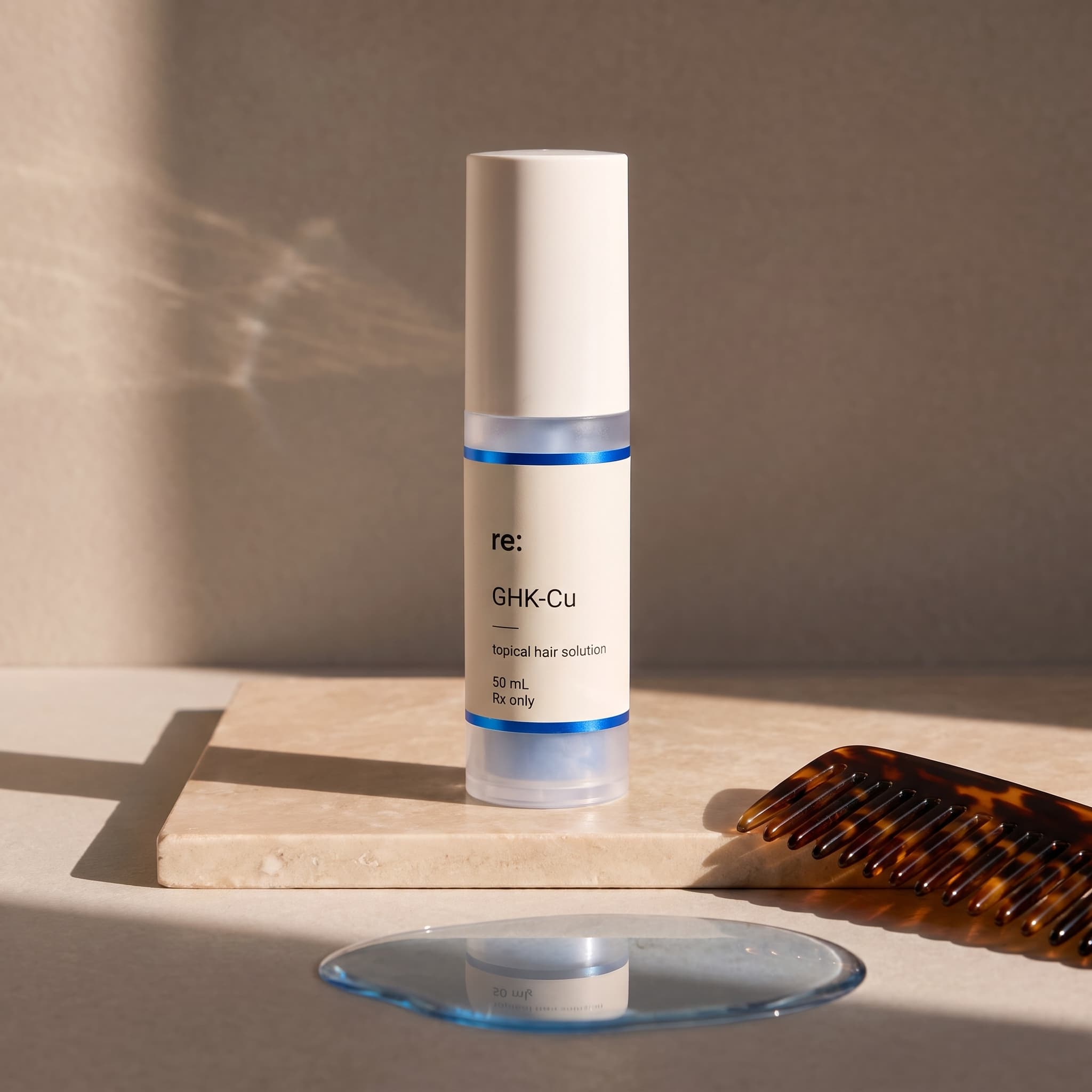
GHK-Cu is Rebody's copper-peptide scalp specialist. The coming-soon family contains 0.5% and 3% topical solutions in separate refrigerated 50 mL bottles, built to move through a part and place the peptide on the scalp rather than the hair shaft.
Current Rebody pricing: the available 3% GHK-Cu cream is $99 for the first month, then $214.99 per 30 g pump. Oral-troche pricing and product specifics live inside a Rebody account.
The short answer
GHK-Cu is a copper-binding tripeptide studied across extracellular-matrix remodeling, collagen signaling, inflammation, antioxidant systems, blood-vessel biology, tissue repair, and follicle research. Rebody's coming-soon scalp solutions put that biology into a topical format designed for the scalp, with two concentration choices: 0.5% and 3%.
No human trial has shown that Rebody's 3% solution produces more regrowth than its 0.5% solution. Concentration is only one part of exposure. The prescribed amount, frequency, vehicle, scalp condition, and consistency also determine what reaches the skin.
Both presentations share the same purpose-built scalp format at lower and higher concentrations. Product details will cover price, application instructions, days of supply, and refill timing.
The two coming-soon strengths at a glance
| Product fact | GHK-Cu 0.5% | GHK-Cu 3% |
|---|---|---|
| Form | Topical scalp solution | Topical scalp solution |
| Bottle | 50 mL | 50 mL |
| Storage | Refrigerated | Refrigerated |
| Active | GHK-Cu | GHK-Cu |
| Application schedule | Follow final prescription label | Follow final prescription label |
| Human head-to-head evidence | None identified | None identified |
| Public status | Coming soon | Coming soon |
This is not a dose chart. A sixfold concentration difference does not mean six times the clinical effect, and it does not reveal exposure without the prescribed application volume and schedule.
What GHK-Cu is
GHK is glycyl-L-histidyl-L-lysine, a chain of three amino acids. When it binds copper, the complex is commonly called GHK-Cu or copper tripeptide-1. Research has examined its relationship to extracellular-matrix remodeling, collagen signals, inflammation, antioxidant systems, blood-vessel biology, and tissue repair.
Those mechanisms help explain why copper peptides appear in topical skin and scalp products. They do not establish a patient-level hair-growth result. Hair loss has many causes, and a molecule that changes cell behavior in a laboratory still has to survive a finished formula, reach relevant tissue, and produce a visible result in people.
GHK-Cu also is not the same compound as AHK-Cu. The often-cited 2007 follicle experiment used AHK-Cu in isolated human follicles and cultured dermal papilla cells. It is useful copper-peptide research, but it is not a trial of either Rebody GHK-Cu concentration.
What the hair evidence measured
The hair case is preclinical. In the 2007 experiment, researchers exposed isolated human hair follicles and dermal papilla cells to AHK-Cu. They reported follicle elongation in organ culture and effects on dermal papilla cells. No patients applied a GHK-Cu bottle to their scalp, and no clinical photographs or scalp hair counts were measured.
A 2023 paper evaluated a GHK-Cu microemulsion in mice. That work addressed a specialized delivery system and animal hair-growth endpoints. Rebody's planned 0.5% and 3% solutions are not that studied microemulsion unless product documentation establishes an exact match.
Together, these studies give copper peptides a real follicle and topical-delivery research lane. Human studies have not yet established which Rebody strength produces the larger visible change, so the product decision should be based on the prescribed concentration, scalp tolerance, and routine.
Why 3% does not automatically win
Percentage shopping makes sense when two labels sit beside each other, but it can create false confidence. A higher concentration may increase the amount of active ingredient in the bottle. Clinical performance also depends on the vehicle, amount applied, application area, frequency, stability, and skin penetration.
The scalp can respond differently to richer exposure. Irritation, redness, residue, or a routine that interferes with styling can matter more than the percentage. A formula someone stops using has no practical advantage.
Do not escalate based on the label alone. Use the prescribed strength and directions, and change only one variable at a time when assessing tolerance.
Who should look at a copper-peptide scalp product
GHK-Cu is most relevant to someone who wants a copper-peptide topical built around matrix, inflammatory, repair, and follicle biology. It is also a distinct option for people who have decided against minoxidil or finasteride because of ingredient preference, prior irritation, or another concrete constraint.
That is different from saying GHK-Cu is the best first treatment for thinning hair. Gradual pattern thinning, sudden diffuse shedding, circular patches, postpartum shedding, traction, inflamed scalp disease, thyroid changes, iron deficiency, and scarring alopecia do not share one cause.
A changing part or more hair in the drain is a reason to document the pattern. Rapid loss, pain, scale, pustules, scarring, or eyebrow loss deserves timely evaluation rather than months of topical guessing.
What to track once orders open
Hair changes slowly, so a daily mirror check creates noise. Take baseline photographs with dry hair, the same part, the same lighting, the same camera distance, and no hair fibers or styling powder. Repeat monthly rather than every morning.
Record shedding, itch, burning, flakes, residue, styling interference, missed applications, and time out of refrigeration. If several hair products begin together, no one can tell which one helped or irritated the scalp. Staggering changes creates a more useful record.
Do not use a seller's precise week-by-week GHK-Cu promise as a benchmark. There is no validated human timeline for either planned strength. The decision to continue should come from the approved treatment plan, tolerability, photographs, and whether the original cause of loss has been addressed.
Storage, shipping, and travel
Both coming-soon solutions are refrigerated. Keep the dispensed bottle in its labeled container and follow its exact temperature instructions. Do not freeze it, place it against an ice pack, or decant it into a cosmetic dropper bottle.
For travel, ask how long the finished product can remain outside refrigeration and what temperature range applies. Use an insulated carrier only when the label or pharmacy instructions call for one. A leaking pump, broken seal, unexpected particles, separation, or a dramatic color or odor change should be checked before application.
The blue color associated with copper complexes is not a home potency test. A deeper blue does not prove a stronger or fresher medication.
Scalp use and troubleshooting
Apply only according to the prescription label. Avoid guessing the number of drops, sprays, or milliliters from an internet protocol. More liquid can spread onto hair instead of scalp, increase residue, and make irritation harder to interpret.
Do not apply the solution to freshly microneedled, abraded, sunburned, infected, or severely inflamed skin unless the product instructions explicitly cover that use. Microneedling can change penetration and risk. It is not merely another step in a peptide routine.
If an application is missed, do not automatically double the next amount. If the bottle runs out earlier than expected, check technique and the final package directions rather than stretching or concentrating remaining product.
Side effects and reasons to stop
A topical scalp formula can cause burning, itching, redness, scaling, swelling, hives, or contact dermatitis. Stop and seek guidance for persistent inflammation, facial swelling, breathing trouble, spreading hives, blistering, or signs of infection.
New shedding should not be automatically called a healthy reset. Minoxidil has a described early-shed pattern; GHK-Cu does not have a well-characterized human shedding timeline. Track the change and reassess if it persists or accelerates.
Pregnancy, breastfeeding, copper disorders, significant skin disease, and simultaneous prescription scalp treatments belong in the safety discussion for the final product. The approved label should govern rather than a generic copper-peptide serum FAQ.
Price, supply, and refills
Price and days of supply are not public while orders remain closed. The bottle is 50 mL, but bottle volume alone cannot tell whether it lasts 30, 60, or 90 days; the prescribed amount and frequency determine that.
Compare package price, expected days of supply, shipping, refrigeration, and refill cadence together. Do not treat a 50 mL bottle as a month unless the prescribed use makes it one.
Both strengths are coming soon. Joining the list requests availability updates; it is not an order.
Questions people ask before choosing
Why is GHK-Cu interesting for the scalp?
The copper-peptide research lane includes AHK-Cu-driven elongation in isolated human follicles and a GHK-Cu microemulsion that produced hair-growth findings in mice. Rebody's solutions turn that biology into a scalp-specific topical routine; visible human regrowth remains the next evidence question.
Is 3% better than 0.5%?
No human head-to-head trial has shown that. Three percent is a higher concentration, not a proven superior outcome.
Does GHK-Cu block DHT?
GHK-Cu is not an established DHT blocker and should not be sold as a natural finasteride substitute.
Can it be combined with minoxidil?
There is no strong human trial proving that the combination beats minoxidil alone. If both are prescribed, instructions should define spacing, order, and what to do if irritation appears.
Is GHK-Cu the same as AHK-Cu?
No. They are related copper tripeptides with different amino-acid sequences.
Bottom line
GHK-Cu gives Rebody a distinct copper-peptide scalp family: two refrigerated 50 mL solutions, one at 0.5% and one at 3%. Choose the prescribed concentration, apply it directly through the part, and judge the routine with standardized photographs, shedding trends, and scalp tolerance over time.
Keep reading
- GHK-Cu Scalp Solutions for Shedding and Thinning Hair
- Hair Treatments Without Minoxidil or Finasteride: GHK-Cu Topicals
- GHK-Cu vs Minoxidil for Hair
Primary sources
- Pyo HK, Yoo HG, Won CH, et al. AHK-Cu in isolated human hair follicles and dermal papilla cells. Archives of Pharmacal Research. 2007
- Liu and colleagues. GHK-Cu topical microemulsion delivery and hair-growth research in mice. 2023
- Pickart L, Vasquez-Soltero JM, Margolina A. GHK peptide in skin regeneration. BioMed Research International. 2015