
Choose GHK-Cu for a copper-peptide scalp routine without minoxidil or finasteride. Rebody's coming-soon 0.5% and 3% solutions are refrigerated 50 mL topicals built for direct application through the part.
Current Rebody pricing: the available 3% GHK-Cu cream is $99 for the first month, then $214.99 per 30 g pump. Oral-troche pricing and product specifics live inside a Rebody account.
The short answer
Some people do not want minoxidil's ongoing routine, possible irritation, or early shedding. Others do not want a hormone-pathway drug such as finasteride. GHK-Cu offers a genuinely different ingredient and mechanism story.
GHK-Cu earns its place through a different biological story: extracellular-matrix remodeling, collagen biology, inflammatory signaling, antioxidant systems, repair environments, and copper-peptide follicle research. It is a deliberate ingredient choice, not a weaker imitation of minoxidil or finasteride.
The GHK-Cu options
| Fact | 0.5% solution | 3% solution |
|---|---|---|
| Active | GHK-Cu | GHK-Cu |
| Form | Topical scalp solution | Topical scalp solution |
| Package | 50 mL | 50 mL |
| Storage | Refrigerated | Refrigerated |
| Minoxidil | None in planned formula | None in planned formula |
| Finasteride | None in planned formula | None in planned formula |
| Status | Coming soon | Coming soon |
The product details will cover directions, dispenser, supply duration, price, and refill timing. Do not borrow them from another serum or turn bottle volume into a monthly supply.
Why someone may avoid minoxidil
Topical minoxidil has direct human evidence, wide availability, and decades of use. It can also cause itching, dryness, scaling, residue, unwanted facial hair through transfer, and an early shed. Continued gains usually require continued use. Some people dislike the foam or liquid routine even when they accept the evidence.
Those are practical reasons to decline it. A 48-week randomized trial in 393 men found that 5% minoxidil outperformed 2% and placebo while producing more local irritation. That evidence defines minoxidil's lane; it does not erase the value of choosing a different copper-peptide routine.
Why someone may avoid finasteride
Finasteride targets 5-alpha-reductase and lowers DHT. That makes it biologically relevant to androgenetic hair loss, particularly in men. Some people do not want a systemic hormone-pathway medication or have experienced effects that make continued use unacceptable.
GHK-Cu does not work as a natural finasteride. It is not an established DHT blocker. Choosing it means choosing a different topical ingredient, not replacing the same mechanism with a peptide label.
Women, men, and people who could become pregnant face different finasteride considerations. Those differences rule out a universal self-treatment recommendation.
What GHK-Cu brings to the scalp
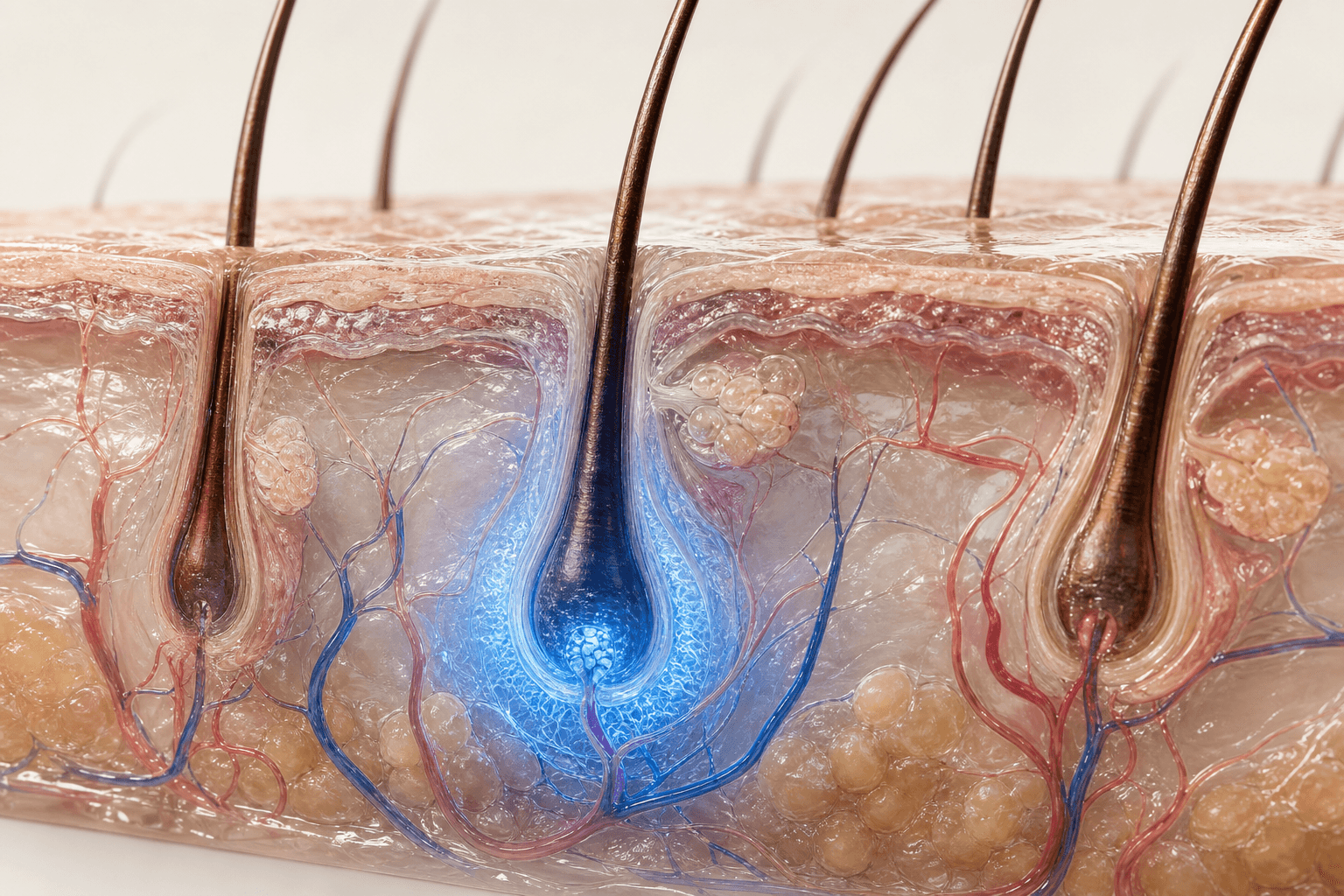
GHK is a three-amino-acid peptide that binds copper. Research examines GHK-Cu in extracellular-matrix remodeling, collagen biology, inflammatory signaling, antioxidant systems, and tissue-repair environments. That creates a rational topical-skin and scalp research lane.
The often-cited follicle study tested AHK-Cu, a related copper tripeptide, in isolated human follicles and cultured cells. A more recent GHK-Cu delivery study used mice. Neither is a clinical trial of the planned 0.5% or 3% prescription scalp solution.
The direct verdict is that GHK-Cu has a real, route-specific scalp rationale grounded in copper-peptide and follicle biology. The cited work has not yet established a human regrowth percentage or timeline for the planned bottles.
Identify the hair-loss pattern first
Pattern thinning usually develops gradually. Telogen effluvium can produce diffuse shedding after illness, surgery, childbirth, rapid weight change, nutritional deficiency, or severe stress. Traction follows repeated tension. Alopecia areata can produce defined patches. Inflamed or scarring disorders can include pain, scale, pustules, and loss of follicle openings.
No single topical belongs at the center of all those problems. Sudden, patchy, painful, or rapidly progressive loss should not spend six months waiting on a copper-peptide experiment.
Document onset, distribution, breakage versus root shedding, recent health changes, family history, and current products. The cause decides whether an ingredient-avoidance collection is even the right shopping page.
Choose between 0.5% and 3%
No human head-to-head trial proves that 3% grows more hair than 0.5%. A larger percentage means a higher concentration, not a guaranteed stronger result. Use the prescribed strength.
Application volume, frequency, formula vehicle, scalp coverage, and adherence determine exposure. Higher concentration can also change irritation, residue, and willingness to continue. Do not multiply or divide another person's internet dose to create a regimen.
Measure a non-minoxidil routine
Take baseline photographs with dry hair, fixed light, the same part, and the same camera distance. Repeat monthly. Track shedding, itch, burning, scale, residue, and missed applications.
Begin one meaningful change at a time. Starting supplements, GHK-Cu, microneedling, a new shampoo, and a laser device together creates an expensive mystery. It also makes side effects harder to trace.
There is no validated human GHK-Cu regrowth timeline. A precise promise of visible growth in four, six, or eight weeks is not supported by the available route-matched research.
Application and microneedling
Use the final prescription label for amount, frequency, and site. Do not mix the medication into shampoo, oil, minoxidil, or another serum. Do not apply it to freshly microneedled, broken, infected, or severely inflamed scalp unless explicit instructions cover that use.
Microneedling changes the skin barrier and product penetration. It can also increase irritation and contamination risk. “Topical” does not mean every formula belongs on newly injured skin.
For a missed application, follow the product directions rather than doubling. If the bottle runs out early, check application technique instead of diluting the remainder.
Refrigeration and travel
Both planned solutions require refrigeration. Keep the labeled bottle within its final temperature range, away from freezing and direct ice-pack contact. Do not move it into an unlabeled cosmetic container for travel.
Ask how long the dispensed formula can remain out of refrigeration. If a shipment arrives warm, report the circumstances rather than guessing from color. A broken seal, leakage, particles, separation, or unexpected odor should be checked before use.
The familiar blue of a copper complex is not a potency, purity, or freshness test.
Side effects and stopping
Scalp topicals can cause itching, burning, redness, scaling, swelling, hives, or dermatitis. Stop and seek prompt help for facial swelling, trouble breathing, blistering, drainage, spreading hives, or signs of infection.
Do not automatically call increased shedding a productive reset. GHK-Cu lacks a well-characterized human early-shed pattern. Track sustained worsening and reassess.
Pregnancy, breastfeeding, copper disorders, active scalp disease, and other prescription scalp products require exact product guidance.
Price, supply, and availability
Both strengths remain coming soon without a public price or days of supply. The 50 mL size cannot be translated into a month until the application amount and frequency are published.
Once live, compare the package price, expected duration, refrigeration burden, shipping, refill timing, and how long the routine must continue before a fair assessment. A lower sticker price can still become expensive if a bottle lasts less time than assumed.
The availability form sends price, instructions, states served, and ordering updates. It does not place an order.
Questions people ask
Why choose GHK-Cu instead of minoxidil or finasteride?
GHK-Cu offers a genuinely different active, mechanism story, and scalp routine: a copper-binding tripeptide in 0.5% or 3% solution, without minoxidil or finasteride in the planned formula.
Does GHK-Cu block DHT?
No established evidence makes it a DHT blocker.
Can GHK-Cu regrow hair?
Controlled human regrowth has not been established. Current hair evidence is laboratory and animal based.
Will it cause an early shed?
There is no validated GHK-Cu shedding pattern comparable to minoxidil's described early shed.
Can I use it with minoxidil later?
There is no strong human trial proving the combination outperforms minoxidil alone. If both are prescribed, use instructions that define timing and response to irritation.
Bottom line
GHK-Cu is Rebody's clear answer to a scalp routine without minoxidil or finasteride. The coming-soon 0.5% and 3% bottles pair copper-peptide biology with direct part-line application and refrigerated ownership. Choose the prescribed strength because this is the ingredient and mechanism you want, then measure shedding, scalp comfort, and standardized photographs over time.
Keep reading
- Copper Peptide Scalp Treatments: GHK-Cu 0.5% and 3%
- GHK-Cu Scalp Solutions for Shedding and Thinning Hair
- GHK-Cu vs Minoxidil for Hair