
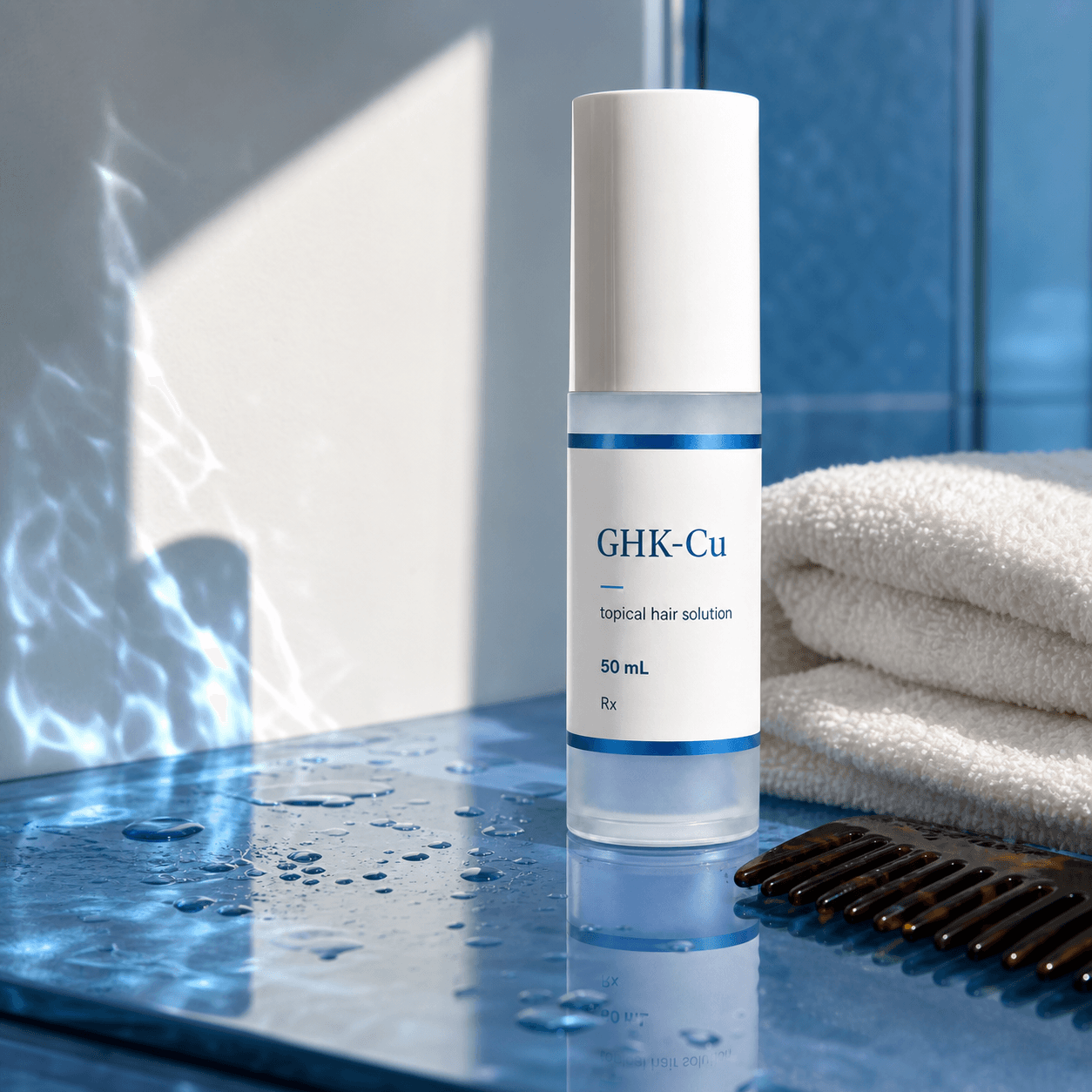
Choose the GHK-Cu form that puts copper-peptide biology where you want it. Cream belongs on facial and neck skin. Solution belongs on scalp. A troche belongs under the tongue or between gum and cheek. Each form turns the same active family into a different practical routine.
Current Rebody pricing: the available 4% GHK-Cu cream is $79.50 for the first month, then $159 per month. Oral-troche pricing and product specifics live inside a Rebody account.
The short answer
Searchers often enter through “copper peptide,” a cosmetic ingredient label, rather than GHK-Cu. Copper tripeptide-1 usually refers to GHK bound to copper. That ingredient identity does not tell you whether a product is a face cream, scalp solution, oral troche, or injectable.
Rebody's strongest form recommendation is topical cream for skin because human cosmetic studies measured visible changes with topical products. Scalp solution is the purpose-built hair format. Troche is the simplest daily administration format.
Form comparison
| Form | Strength | Package | Application | Key product fact |
|---|---|---|---|---|
| Cream | GHK-Cu 4% | 30 g cream | Face and neck | Available at $79.50 first month, then $159/month |
| Solution | GHK-Cu 0.5% | 50 mL bottle | Scalp | Refrigerated; coming soon |
| Solution | GHK-Cu 3% | 50 mL bottle | Scalp | Refrigerated; coming soon; higher concentration not proven superior |
| Troche | GHK-Cu acetate | See Rebody account | Oral dissolve | Product specifics in account |
The table compares products, not absorbed doses. Percent and milligrams across routes cannot be ranked directly.
What “copper peptide” means
GHK is glycyl-L-histidyl-L-lysine. It binds copper to form GHK-Cu. Cosmetic labels often use copper tripeptide-1 for this complex. Research examines fibroblast activity, extracellular matrix, collagen and elastin, inflammatory pathways, antioxidant systems, and repair biology.
Other copper peptides exist. AHK-Cu is related but uses alanine rather than glycine in the tripeptide. A hair-follicle experiment involving AHK-Cu should not be relabeled as a GHK-Cu patient trial.
Confirm the exact active. A blue color or the word “peptide” does not establish GHK-Cu concentration, identity, or stability.
Cream as a form
Cream uses an emulsion that can spread and remain on facial and neck skin. It often feels richer than a solution or serum. Rebody's available version is a 4% cream in a 30 g package, applied as the label directs.
The human evidence lane is topical facial care. Reviews summarize 12-week studies in women reporting changes in firmness, laxity, density, thickness, wrinkles, pigmentation, and texture.
Choose cream when skin is the surface and a richer application is acceptable. Do not move it to scalp based only on the shared GHK-Cu label.
Solution as a form
Solution is better suited to moving through hair and reaching the scalp. Its 50 mL bottle covers a different surface and uses a different vehicle than facial cream.
Rebody's coming-soon strengths are 0.5% and 3%. No human trial shows that 3% grows more hair than 0.5%. Use the strength selected on the prescription rather than choosing by the larger number.
The term “serum” is often used loosely in search results. Rebody's confirmed format is a topical solution, which is the accurate term unless the finished label states otherwise.
Troche as a form
A troche is a solid dosage form designed to dissolve in the mouth. Rebody keeps the exact GHK-Cu oral formulation, package, and directions inside the patient account.
It is not a conventional swallowed capsule, and it is not proof of a specific sublingual absorption percentage. Some material may cross oral mucosa and some may be swallowed; the finished formulation determines exposure.
The public product remains coming soon. Do not assume a package count, storage condition, price, flavor, or refill cadence until Rebody publishes them.
Cream versus serum questions
Cream and serum differ in vehicle and sensory use, but those words alone do not decide effectiveness. A serum can contain a lower or higher concentration, different copper peptide, different pH, or several other actives.
Choose a cream when a richer face-and-neck product belongs in the routine. Choose a lighter topical only when its exact formula and target are appropriate.
Do not assume a cosmetic shelf serum can replace a prescription 4% cream or that the prescription is automatically better because it is prescribed.
Scalp solution versus facial cream
Hair requires product to reach scalp rather than remain on strands. Face cream requires even application without excessive occlusion or pilling. Those tasks favor different vehicles.
Using the scalp solution on face can change irritation and exposure. Using face cream through hair can create residue and poor scalp coverage. Product-specific instructions should prevent both substitutions.
If facial hairline skin overlaps a scalp treatment area, follow exact boundary directions rather than combining forms in the same spot.
Troche versus topical forms
Troche has the fewest application steps. It also has the least route-matched human outcome evidence. Topical cream has the best evidence alignment for skin; scalp solution has the best physical alignment for hair.
Do not call troche stronger, more bioavailable, or systemic in a way that implies a proven result. No pharmacokinetic study for the planned formula supplies those comparisons.
The oral form is the simplicity winner: one compact dissolve step without facial application, scalp parting, pumps, or residue. Route-matched human outcomes remain the next evidence question.
Form decides storage and travel
Scalp solution is refrigerated; the cream follows the storage directions on its pharmacy label. Keep original labels, avoid freezing, and use a travel carrier that prevents heat without direct ice contact.
Keep troches in their original package and follow the storage directions on the finished product. Do not transfer them to a pill organizer unless those directions allow it; heat, moisture, and damaged packaging can affect the form.
A cream package can crack, a solution bottle can leak, and troches can soften or break. Product condition questions should identify the form rather than ask whether “GHK-Cu” generally is still good.
Form decides troubleshooting
Cream problems include pilling, pump priming, separation, occlusive feel, and interaction with other skincare. Solution problems include scalp coverage, residue, leaking dispenser, part-line technique, and early empty bottles.
Troche problems include placement, dissolve time, taste, accidental swallowing, mouth irritation, and moisture damage. Do not answer these with instructions from a different troche product.
Final directions must cover missed use. Doubling the next amount is not a safe default for any form.
Form decides side-effect questions
Topicals can cause redness, itching, burning, scaling, swelling, hives, acne-like bumps, or dermatitis. Vehicles and excipients can be responsible even when GHK-Cu is not.
Troches can create oral irritation, altered taste or sensation, and systemic safety questions absent from cosmetic studies. Pregnancy, breastfeeding, copper disorders, and medication interactions require finished-product guidance.
Seek prompt help for breathing difficulty, facial or tongue swelling, spreading hives, blistering, severe eye symptoms, or infection signs.
Price, supply, and value by form
The available cream is $79.50 first month, then $159 per month. Hair-solution prices are not public, and oral-troche pricing stays inside the Rebody account. Package size alone does not establish days of supply.
When live, compare package price, prescribed duration, cold shipping, refill timing, and product waste. Cream left in a failed pump, solution deposited on hair, or troches damaged by moisture all change real value.
Do not compare cost per milligram across incompatible routes.
Questions people ask
Is GHK-Cu the same as copper tripeptide-1?
The cosmetic ingredient term commonly refers to GHK bound to copper. Always verify the exact finished-product active.
Is cream better than serum?
Cream is the confirmed Rebody facial and neck form and aligns with topical human studies. “Serum” alone does not establish a better formula.
Is solution better for hair?
It is the correct GHK-Cu application form for scalp. Human regrowth remains unproven.
Is troche better than topical?
No. Troche is easier to administer; topical has stronger route alignment and human skin evidence.
Can forms be interchanged?
No. Vehicle, concentration, body site, package, and instructions differ.
Bottom line
Copper peptide becomes useful when it becomes a real object. Choose the 4% cream for facial skin, the 0.5% or 3% solution bottle for scalp, and the troche only for an intentional oral routine. Form decides the target, evidence, storage, and troubleshooting; the shared GHK-Cu name does not erase those differences.
Keep reading
- Cold-Storage GHK-Cu for Home Use
- GHK-Cu Treatments by Goal: Skin, Scalp, and Daily Oral Formats
- Best GHK-Cu Form: Cream for Skin, Solution for Scalp, Troche for Simplicity