
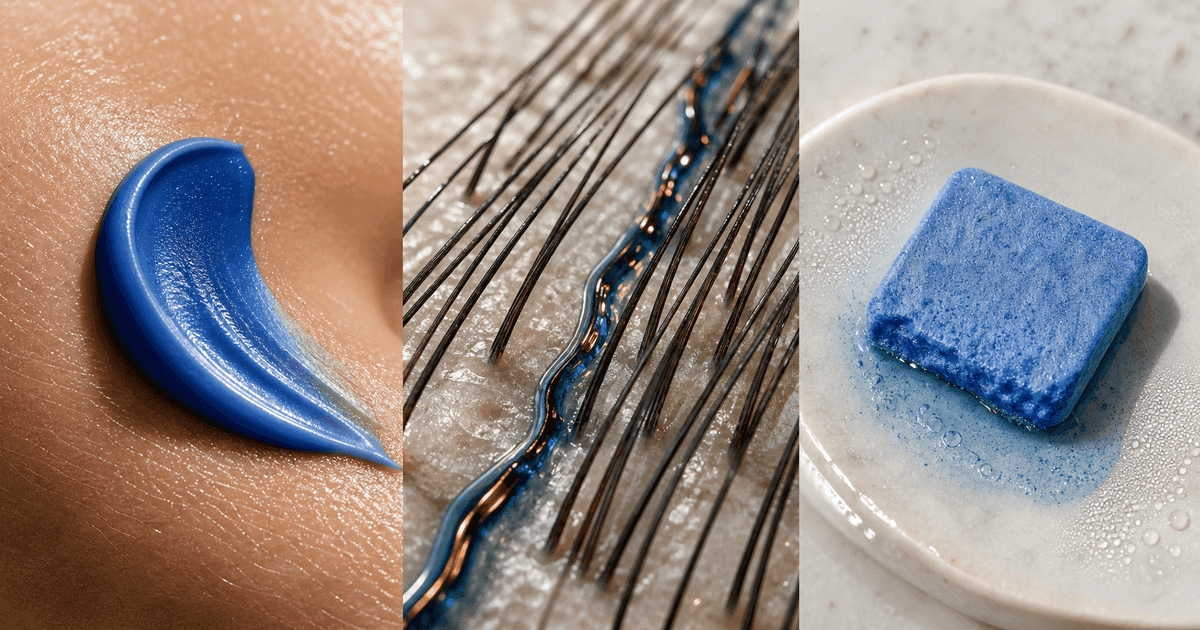

The best GHK-Cu form depends on the physical target, but the winners are clear. Choose the 3% cream for facial and neck skin. Choose the 0.5% or 3% solution for scalp. Choose the troche only when a once-daily oral routine is more important than having route-matched human outcome evidence.
Current Rebody pricing: the available 3% GHK-Cu cream is $99 for the first month, then $214.99 per 30 g pump. Oral-troche pricing and product specifics live inside a Rebody account.
The short answer
GHK-Cu is one copper-binding tripeptide offered through several finished products. Each form has a clear job: cream for facial and neck skin, solution for scalp, and troche for a simple oral routine.
Topical cream is the overall evidence winner because small human cosmetic studies used copper-peptide creams on skin. It is also Rebody's available GHK-Cu product at $99 first month, then $214.99 per 30 g pump. Scalp solution is the target winner for hair but remains coming soon. Troche is the convenience winner in theory, with exact product specifics inside Rebody and no route-matched human outcome evidence.
| Award | Winner | Reason |
|---|---|---|
| Best for facial and neck skin | 3% cream | Correct target and human topical evidence |
| Best GHK-Cu form for scalp | Prescribed 0.5% or 3% solution | Purpose-built 50 mL scalp format; coming soon |
| Highest-concentration scalp option | 3% solution | Most GHK-Cu per unit of formula |
| Easiest administration | Oral troche | One solid oral dosage form |
| Best evidence overall | 3% cream | Human topical cosmetic studies |
| Best for travel | Undecided | Troche storage is not public; topicals require refrigeration |
Start with GHK-Cu identity
GHK is glycyl-L-histidyl-L-lysine, three amino acids that bind copper. The complex is called GHK-Cu and often appears as copper tripeptide-1 in cosmetic ingredient language.
Research examines extracellular-matrix remodeling, collagen and elastin, glycosaminoglycans, inflammatory signaling, antioxidant systems, blood-vessel biology, and repair. This breadth explains the molecule's appeal. The useful evidence stays attached to the form studied: topical human skin research for cream, preclinical scalp research for solution, and a mechanism-led case for oral troche.
Why cream wins for skin
Rebody's available cream contains GHK-Cu acetate at 3% in a refrigerated 30 g airless pump for facial and neck use as directed.
The relevant human literature is topical. Reviews summarize a 12-week facial study in 67 women aged 50 to 59 with photodamage, reporting changes in laxity, clarity, firmness, appearance, wrinkles, pigmentation, density, and thickness. Other summarized studies include a 71-woman facial cream and eye-cream work.
That 12-week human topical record makes cream the strongest GHK-Cu form for visible skin. No oral or scalp evidence comes closer.
Why solution wins for scalp
Hair makes cream impractical. A topical solution can move through part lines and reach scalp with less coating of the hair shafts. Rebody's coming-soon family uses refrigerated 50 mL bottles at 0.5% and 3%.
The evidence is preclinical. A 2007 study used AHK-Cu, a related peptide, in isolated human follicles and cultured dermal papilla cells. A 2023 study evaluated a GHK-Cu microemulsion in mice. Within the GHK-Cu family, solution wins for scalp because it reaches part lines cleanly; minoxidil retains the stronger human regrowth evidence.
Why 0.5% comes before 3% for scalp
No human head-to-head trial has shown that 3% produces more hair than 0.5%. Higher concentration can mean more active per volume, but exposure also depends on application amount, frequency, vehicle, scalp area, and adherence.
Neither concentration is a proven clinical winner. Use the strength selected on the prescription rather than treating the larger number as better.
Do not use a sixfold concentration difference to promise sixfold results. Biology and finished formulations do not obey label arithmetic.
Why troche wins only for simplicity
The GHK-Cu acetate troche replaces pumps, skin coverage, hair parting, and topical residue with one oral dosage form, making it the simplest daily action. Its exact product specifics live inside Rebody. Its evidence case is mechanism-led; the human skin studies used topical creams.
Cream versus serum
Cream and serum names describe vehicles and feel, not guaranteed performance. A serum may be water-light, while cream is richer and more occlusive. Either can use different peptide identity, concentration, pH, preservative, and package.
Rebody's confirmed facial product is a 3% cream in an airless pump. That form aligns with the topical cream studies and provides a known package.
Choose a cosmetic serum by its exact formula and desired feel. A lighter texture describes the vehicle, not deeper penetration or greater effect.
Topical versus oral
Topical routes have a visible target and the closest human evidence. Oral route has fewer application steps but must establish mucosal exposure, systemic pharmacokinetics, and clinical outcomes.
Three percent cream cannot be compared numerically with an oral troche. One describes concentration in an emulsion; the other contains active per dosage unit. Absorbed dose remains unknown for both without route-specific data.
For skin, topical wins. For hair, scalp solution wins within the peptide family. Oral makes sense when the once-daily dosage form is the priority.
Best form for wrinkles
Within GHK-Cu, choose cream. Human topical studies measured wrinkles, pigmentation, firmness, density, thickness, and related skin endpoints over 12 weeks.
Retinoids still have the deeper overall human evidence for photoaging. Someone tolerating a retinoid well should not assume GHK-Cu is a superior replacement. Someone seeking copper-peptide cream has a real evidence-based reason to prefer the topical form.
Use standardized photographs and separate immediate moisturization from multiweek visible change.
Also decide what “better” will mean before the first application. Fine lines, neck texture, pigmentation, and firmness should not collapse into one vague glow score. Pick two or three visible measures, photograph them under the same conditions, and record irritation alongside appearance. That prevents a pleasant cream texture or one flattering photograph from becoming evidence that every skin goal changed.
Best form for thinning hair
Choose scalp solution if GHK-Cu is the decided ingredient. Choose minoxidil if strongest human regrowth evidence is the actual priority.
GHK-Cu does not have an established DHT-blocking action and should not be presented as natural finasteride. It also should not be credited for AHK-Cu laboratory findings without naming the related peptide.
Sudden, patchy, painful, inflamed, or scarring loss requires diagnosis rather than a peptide form comparison.
Best form for avoiding needles
All four planned presentations are needle-free. They still differ meaningfully in skin spreading, scalp application, oral dissolution, refrigeration, and side-effect profiles.
Cream is the best needle-free form for skin. Solution is best for scalp. Troche is best for avoiding any topical action.
Do not imply they reproduce an injectable result. Injectable GHK-Cu is a separate route with separate safety and regulatory questions.
Best form for travel
The physical winner is troche because a compact solid format is easier to carry than liquid bottles and pumps. The actual winner depends on the storage guidance shown with the full product inside Rebody.
Cream and scalp solutions are refrigerated. They need original labeled packages, an insulated carrier, protection from freezing, and known room-temperature excursion limits.
Do not decant products for convenience. A smaller unlabeled container loses strength, directions, and identity at the moment they matter most.
Test the travel routine before a long trip. Confirm that the carrier holds the actual pump or bottle upright, that coolant cannot freeze it, and that the destination has reliable storage. Troches need the same rehearsal once their temperature and moisture instructions are known. A portable package is only useful when it arrives intact and remains identifiable.
Best form for a simple morning or evening
Troche has the fewest application steps. Cream may be simplest for someone who already uses a daily facial routine. Scalp solution may be easiest at night when parting and drying do not interfere with styling.
There is no universal best time. Cream interacts with other skincare, scalp solution with hair routines, and public troche food and drink instructions are not yet available.
The best daily form is the one whose target and steps belong in the day consistently.
That distinction becomes important after the first week. Novelty can carry a complicated product briefly, but refills expose whether the steps actually belong in the day. Before choosing, rehearse the storage location, application surface, cleanup, and travel plan. A form that repeatedly gets skipped is not the practical winner, even when its mechanism sounds impressive.
Storage and product handling
Keep cream and scalp solutions refrigerated within final labeled ranges. Avoid freezing, direct ice-pack contact, damaged seals, and transfer into cosmetic containers.
Troche storage must be confirmed. Protect any oral dosage form from moisture and damage according to its package.
Warm shipment, power outage, leakage, separation, particles, pump failure, or damaged troches require form-specific troubleshooting. Color cannot certify potency or strength.
Side effects by form
Cream and solution can cause redness, itching, burning, scaling, swelling, hives, acne-like bumps, or dermatitis. Vehicle and body site affect the experience.
Troches can produce mouth irritation, taste complaints, altered oral sensation, or gastrointestinal questions. Systemic safety cannot be inferred from topical studies.
Seek prompt help for breathing trouble, facial or tongue swelling, spreading hives, blistering, severe eye symptoms, or infection. Use only on the site and schedule defined by the final label.
Cost, package, and refills
The available cream is $99 first month, then $214.99 per 30 g pump. Scalp-solution and troche prices remain unpublished. Use the prescription label for days of supply and refill timing.
Once live, compare package price, prescribed duration, shipping, refrigeration, refill timing, and waste. Do not compare milligrams per dollar across topical and oral routes.
Judge value by the prescribed month, usable supply, storage burden, and evidence for the target—not by package price alone.
Questions people ask
What is the best GHK-Cu form overall?
The 3% cream, because it has the strongest route alignment and human topical evidence.
Which is best for hair?
The 0.5% scalp solution is the first GHK-Cu option. Minoxidil remains the human-evidence leader for regrowth; GHK-Cu is the copper-peptide scalp route.
Is oral GHK-Cu stronger?
A troche amount and a topical percentage describe different routes and cannot be ranked as one strength scale. Exact oral-product specifics are available inside Rebody.
Does 3% cream work faster?
No finished-product study establishes a precise onset. Published facial studies commonly used 12-week windows.
Can all forms be combined?
Choose the single route that matches the target. Stacking routes multiplies exposure, expense, and uncertainty without sharpening the goal.
Which form avoids refrigeration?
Cream and scalp solutions require refrigeration. Troche storage is not yet confirmed.
Bottom line
Use cream for facial and neck skin, solution for scalp, and troche for the simplest oral administration. Cream wins the overall evidence contest. Solution wins the hair-target contest. Troche wins convenience.
Keep reading
- Cold-Storage GHK-Cu for Home Use
- Copper Peptide Treatments by Form: Cream, Solution, and Troche
- GHK-Cu Treatments by Goal: Skin, Scalp, and Daily Oral Formats
Primary sources
- Pickart L, Vasquez-Soltero JM, Margolina A. GHK peptide in skin regeneration. 2015
- Pickart L, Margolina A. Regenerative and protective actions of GHK-Cu. 2018
- Pyo HK, Yoo HG, Won CH, et al. AHK-Cu in isolated human follicles. 2007
- Liu and colleagues. GHK-Cu microemulsion research in mice. 2023
- Dou Y, Lee A, Zhu L, Morton J, Ladiges W. The potential of GHK as an anti-aging peptide. 2020