
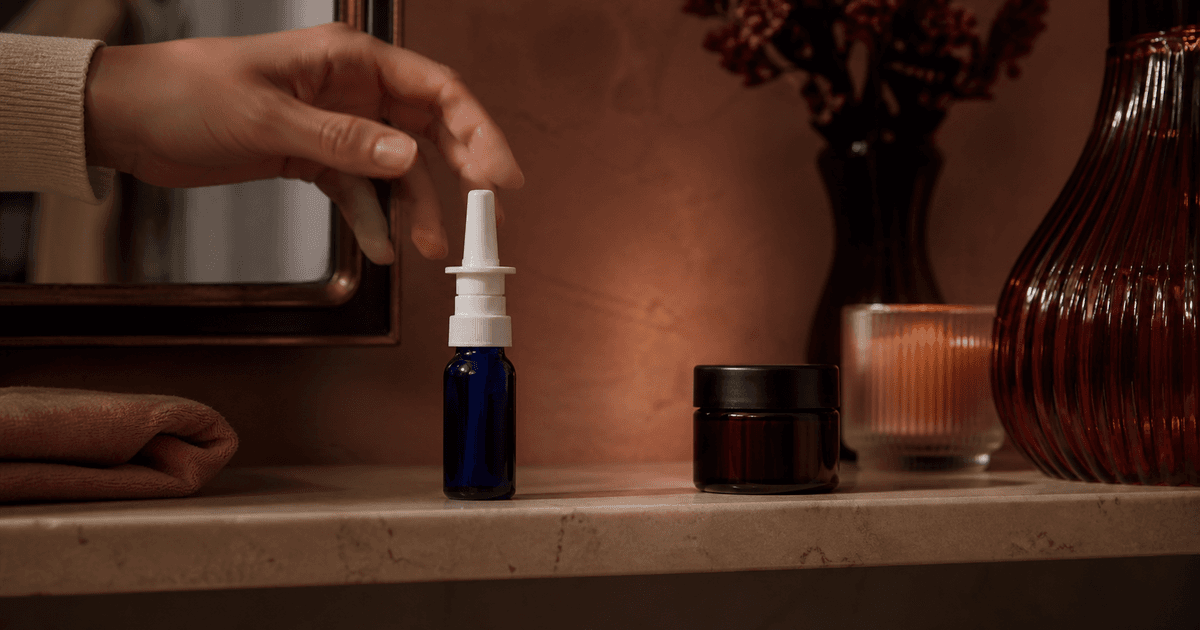

The nasal bottle wins for most people choosing a needle-free PT-141 format. It takes seconds to use, the 3 mL package is compact, and there is no dissolve period. Choose the troche when congestion, nasal irritation, or dislike of sprays gets in the way.
The short answer
Rebody's nasal family contains 5 mg/mL bremelanotide in a refrigerated 3 mL bottle. Its troche family contains 2 mg mini troches in refrigerated 8-count packages.
The practical comparison is easy. Spray is faster to use. Troche avoids the nose. The FDA-approved 1.75 mg Vyleesi injection carries the pivotal bremelanotide evidence, while nasal spray has small human route studies and troche is supported by active-level biology and finished-product rationale.
| Priority | Winner | Reason |
|---|---|---|
| Fastest to use | Nasal spray | A spray rather than a dissolving troche |
| Avoiding nasal sensation or congestion | Troche | Oral form with no spray |
| Human route research | Nasal spray | Small early intranasal experiments exist |
| Strongest bremelanotide efficacy evidence | Neither | Approved injection has the pivotal trials |
| Known drug per unit | Troche | 2 mg per unit; absorption still unknown |
| Travel | Undecided | Both are refrigerated and need final excursion guidance |
Both contain bremelanotide
PT-141 is a common development name for bremelanotide. The active stimulates melanocortin receptors involved in central sexual desire and arousal pathways.
That is different from sildenafil and tadalafil, which act through blood-flow pathways involved in erection. PT-141 should not be called nasal Viagra or a troche version of Cialis.
Vyleesi injection, nasal spray, and troche share bremelanotide while differing in formulation, route, units, package behavior, and exposure.
Why nasal spray wins on simplicity
A nasal spray is quick to use, and there is nothing to dissolve.
That convenience matters for an intimacy product. A long or conspicuous step can become the reason a product is not used.
The win depends on a working pump and tolerable nose. Congestion, irritation, runoff, bad taste, nosebleed, leakage, or dislike of spraying can make the theoretical simplicity disappear.
Why troche remains the best exception
Troches avoid nasal tissue, pumps, and leakage.
The tradeoff is time and mouth experience. Taste and mouth contact become part of the experience. A finished-formulation study would define route-specific exposure and outcomes.
Troche is not a consolation prize. It is the clear practical winner for someone who prefers an oral product and wants to avoid a nasal bottle.
Strength numbers do not compare across routes
Nasal strengths use milligrams per milliliter.
Troches use milligrams per unit. That makes active per unit visible, but it does not show how much is absorbed through oral mucosa or swallowed.
Do not compare 5 mg/mL with a 2 mg troche as if concentration and per-unit strength were the same measure. The units, delivered amount, and bioavailability differ.
This also changes how refill value should be calculated. A bottle's concentration does not reveal how many uses it contains, and a troche count does not show package duration. Your clinician sets the dose, timing, and use. Follow your prescription label.
What Vyleesi evidence shows
Vyleesi is the FDA-approved bremelanotide 1.75 mg injection for acquired, generalized HSDD in premenopausal women.
The two RECONNECT phase 3 trials randomized 1,267 women for 24 weeks. Bremelanotide improved sexual desire and distress related to low desire compared with placebo. That program establishes the molecule's strongest clinical result; nasal spray and troche remain distinct Rebody formats.
This evidence establishes that bremelanotide can affect desire in the approved population. A direct nasal-versus-troche study would select the stronger Rebody needle-free form.
What the nasal evidence shows
One double-blind crossover experiment studied 20 mg intranasal bremelanotide in 18 premenopausal women with female sexual arousal disorder. It measured physiological and subjective arousal outcomes.
Early intranasal work in healthy men and men with mild-to-moderate ED examined pharmacology, tolerability, and erectile response.
These studies give the nasal route a direct human research advantage over troche. They are small and use study-specific formulations, so the result stays attached to those experimental formulations rather than the Rebody 5 mg/mL retail bottle.
What the troche evidence shows
The 2 mg bremelanotide mini troches are supported by active-level biology and product-form rationale. A direct troche clinical-outcome study is the remaining evidence step.
Absorption through the mouth lining can change exposure compared with swallowing, but the word “troche” does not quantify bioavailability. A finished-formulation pharmacokinetic study would be needed.
Troche marketing should focus on the known object, strength, package, and storage, not an invented onset or absorption percentage.
Which route works faster?
A spray is quicker to use than a troche. Clinical onset depends on absorption and central response, and a route-matched study has yet to select an onset winner.
Online anecdotes report wide ranges and cannot settle nasal or troche onset. The prescription label carries the directions for each product.
Speed of use is only part of it. Nasal users may deal with congestion or an irregular spray. Troches take longer than a spray. A route can look spontaneous and still feel cumbersome in the actual evening; those ownership details should decide the practical winner.
Which route lasts longer?
Duration remains an open route question. Perceived desire can persist differently from measured blood levels, making anecdotes hard to compare.
Neither product has a verified six-, twelve-, twenty-four-, or forty-eight-hour promise.
Nasal ownership problems
Congestion, recent nasal procedure, nosebleed, damaged mucosa, irregular mist, blocked nozzle, or liquid running down the throat can change delivery and comfort. Tell the care team when that happens.
Never poke the nozzle, add liquid, or transfer medication into a generic sprayer. A leak or early empty bottle needs troubleshooting before refill.
Troche ownership problems
The troche label carries the directions.
Mouth sores, dental work, dry mouth, gum irritation, and nausea can change the route experience.
Protect troches from moisture, crushing, melting, and unapproved transfer into a pill organizer.
Refrigeration and travel
Both formats are refrigerated. Keep original labels, avoid freezing and direct ice contact, and ask how long the exact product can remain outside cold storage.
The nasal bottle needs a cap and leak-resistant pouch. Troches need protection from moisture and physical damage. Either may be easier to carry than injection supplies, but cold storage remains the shared burden.
If a shipment arrives warm, record the arrival time and package condition. Do not judge stability by touch, clarity, or troche hardness alone.
Side effects and safety
The Vyleesi label addresses nausea, flushing, headache, vomiting, transient blood-pressure increases, heart-rate reduction, focal hyperpigmentation, pregnancy, delayed gastric emptying, and oral naltrexone exposure.
Nasal spray can add local irritation, congestion, taste, runoff, or nosebleed. Troche can add mouth irritation, taste, altered sensation, or swallowing-related questions. Product-specific rates are not established.
The approved injection is contraindicated in uncontrolled hypertension or known cardiovascular disease. Seek urgent help for chest pain, fainting, severe allergic symptoms, concerning blood-pressure symptoms, or prolonged painful erection.
Route-local symptoms should be recorded separately from whole-body symptoms. Nasal burning, nosebleed, runoff, or congestion can point to local intolerance. Mouth sores, gum irritation, taste, or altered sensation belong to the troche route. Nausea, flushing, dizziness, blood-pressure symptoms, or persistent vomiting raise an active-level question. That separation makes follow-up more useful than simply reporting that “PT-141 felt bad.”
Combining PT-141 with other products
Searchers ask about Viagra, Cialis, alcohol, anti-nausea drugs, hormone therapy, and naltrexone. Do not build a public stack from forum reports.
Bremelanotide and PDE5 inhibitors act through different pathways, but mechanism complementarity does not establish safety for a particular person. The approved label's gastric-emptying and naltrexone warning also matters.
Every additional medication changes the interaction and blood-pressure discussion. Combination instructions belong to the finished treatment plan.
Price, supply, and refills
Rebody's PT-141 nasal spray is $99.50 first month, then $199 per 3 mL bottle, and PT-141 2 mg troches are $59.50 first month, then $119 per 8-count package. The number of uses in a bottle or troche package depends on the prescription. Eight troches do not automatically equal a monthly supply.
Compare package price, expected prescribed uses, cold shipping, and refill timing. Cost per milligram is not a useful cross-route comparison.
The real value winner may change once the prescription is known. Until then, nasal wins on simplicity only.
Questions people ask
Does nasal PT-141 work better than troches?
Nasal has small human route studies, while troche awaits direct clinical-outcome research. A head-to-head study would be needed to establish a desire-outcome winner.
Which is easier to use?
Nasal spray for most people. Troche is easier when the nose or pump is the specific problem.
Which causes less nausea?
Nausea is a major bremelanotide concern in the approved injection label. Nasal and troche need a route-matched comparison to establish different rates.
Can either be used by men?
Small intranasal male studies exist, but Vyleesi is approved only for premenopausal women with acquired, generalized HSDD.
Can a troche be swallowed?
A troche is an oral form, not a standard swallowed tablet. Your prescription label carries the directions.
Which route is more spontaneous?
Nasal takes less time to use. No route-matched study establishes an onset or duration winner for these products.
Bottom line
Choose the nasal bottle when seconds, compact packaging, and no dissolve period matter. Choose the troche when nasal delivery is unacceptable. Vyleesi injection has the pivotal evidence, nasal has small route studies, and troche is the practical oral alternative awaiting direct outcome research. The nasal bottle is the best first needle-free form for most people.
Compare the available PT-141 formats
- See the complete PT-141 format collection
- Read the PT-141 nasal spray strength guide
- Compare PT-141 mini troche strengths
- See PT-141 nasal spray
- See PT-141 troches
Primary sources
- FDA. Vyleesi prescribing information. https://www.accessdata.fda.gov/drugsatfda_docs/label/2020/210557s002lbl.pdf
- Kingsberg SA, Clayton AH, Portman D, et al. RECONNECT phase 3 trials. https://pubmed.ncbi.nlm.nih.gov/31599840/
- Diamond LE, Earle DC, Rosen RC, et al. Intranasal crossover experiment in women. https://pubmed.ncbi.nlm.nih.gov/16839319/
- Rosen RC and colleagues. Intranasal PT-141 in healthy men and men with ED. https://pubmed.ncbi.nlm.nih.gov/14963471/