
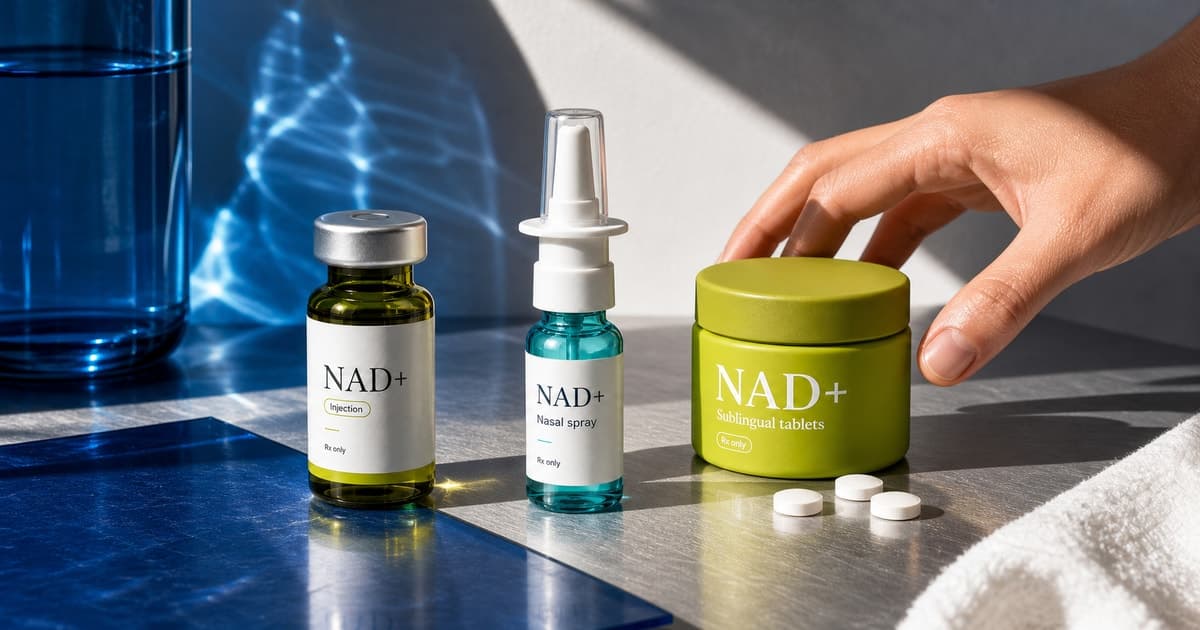

Our pick for most people is the NAD+ nasal spray. It is needle-free, is labeled for room-temperature storage, fits in one small bottle, and at $59.50 for the first month, then $119 per month, is currently Rebody’s lowest-priced NAD+ format.
The injection is the better choice when you are comfortable with needles and want a defined 56-day supply. It adds needles, cold shipping, and supplies.
The sublingual tablet is the premium niche option. Choose it when nasal congestion makes a spray annoying, needles are out, and a tablet is worth $99.50 for the first month, then $199 per month.
That is our practical verdict. Human research has not selected a clinical-outcome winner among these three direct NAD+ routes, so the decision belongs to the facts shoppers can verify now: storage, supplies, nasal comfort, needle comfort, and price.
Rebody’s injection has no one-month plan. Stripe charges $189 for the first two-month shipment after $60 off, then $249 every two months ($124.50 per month equivalent). The nasal spray is $59.50 for the first month, then $119 per month, and the tablets are $99.50 for the first month, then $199 per month. Prices and production MDI offerings were checked July 30, 2026.
NAD+ routes at a glance
| NAD+ injection | NAD+ nasal spray | NAD+ sublingual tablets | |
|---|---|---|---|
| Current Rebody format | 200 mg/mL injection | 300 mg/mL nasal spray | 200 mg sublingual tablet |
| Supply | 6 mL vial; 56-day supply | 12 mL bottle; 30-day supply | 20-tablet initial package; MDI-listed 30-day supply |
| Storage and setup | Cold shipping plus injection supplies | Room-temperature bottle | Room-temperature bottle |
| Needles | Yes | No | No |
| Advertised price | $189 first 2-month shipment, then $249 every 2 months ($124.50/month equivalent) | $59.50 first month, then $119/month | $99.50 first month, then $199/month |
| Our verdict | Best when needles are no problem | Best overall for most people | Best when spray and needles are both poor options |
These are compounded prescription medications. Your clinician sets the dose, timing, and use. Follow your prescription label.
NAD+ biology and human evidence
What NAD+ does
NAD+—nicotinamide adenine dinucleotide—is a coenzyme present in every living cell. Cells use it while converting nutrients into usable energy. Enzymes involved in DNA repair, cellular stress responses, and signaling also consume it.
That biology makes NAD+ a serious cellular-energy target. Felt energy, focus, and recovery are separate outcomes that should be tracked directly.
A 2026 systematic review found that oral NAD+ precursors such as nicotinamide riboside (NR) and nicotinamide mononucleotide (NMN) consistently changed circulating or cellular NAD-related biomarkers in human studies. Effects on functional, metabolic, vascular, and other health outcomes were mixed, often null, or limited to particular endpoints. The same review found no eligible outcomes trials of intravenous or injected NAD+ itself for anti-aging or wellness.
That distinction matters. A blood marker shows movement in an NAD-related pathway. Energy, clearer thinking, recovery, and healthy aging each require their own functional endpoint.
Human evidence by NAD+ route
A definitive route comparison would randomly assign people to injection, nasal spray, and sublingual NAD+, measure NAD-related biomarkers, and follow fatigue, cognition, exercise capacity, sleep, and recovery. That head-to-head human study remains the missing comparison.
The evidence is also easy to mix up because four different things are often discussed as if they were interchangeable:
- Direct NAD+, which is the compound in Rebody’s injection, spray, and sublingual tablet.
- NADH, the reduced form of the coenzyme.
- NR, an oral precursor the body can use to make NAD+.
- NMN, another NAD+ precursor.
A 2026 randomized crossover study compared sublingual NMN with swallowed NMN in 14 healthy men. Sublingual NMN produced a faster rise in two terminal metabolites over the first 60 minutes, while blood NMN, nicotinamide, and NAD+ were similar between routes. The study defines an NMN metabolite result; direct NAD+ and functional outcomes require their own comparison.
Oral NR, IV NAD+, intranasal NAD+, and injected NAD+ are separate interventions. Our recommendation therefore rests on what shoppers can verify now: storage, supplies, tolerance, and price.
How each NAD+ format works
NAD+ injection: needles and more setup
Rebody’s injection is a 200 mg/mL formulation. The 6 mL vial represents a 56-day supply. There is no one-month plan: Stripe charges $189 for the first two-month shipment after $60 off, then $249 every two months ($124.50 per month equivalent).
Why the injection can make sense
The strongest reason is clarity. The vial makes the product and concentration explicit: direct NAD+, a named strength, and a defined supply.
For someone already comfortable with injections, the extra setup may not feel like much. For someone who avoids needles, travels frequently, or does not want syringes and alcohol wipes in a bathroom drawer, the injection may be the wrong fit.
What the injection changes in real life
- The package ships cold and includes injection supplies.
- You need a safe place to store supplies and dispose of sharps.
- Travel requires more planning than placing a small bottle in a toiletry bag.
- Injection discomfort or irritation is possible.
NAD+ nasal spray: the simplest object to carry
Rebody’s nasal product is a 300 mg/mL spray in a 12 mL bottle, supplied for 30 days and advertised at $59.50 for the first month, then $119 per month.
Why the nasal spray can make sense
Everything fits in one small bottle. There are no needles, supplies to prepare, or cold pack to manage. For travel, a spray bottle is the least complicated physical format of the three.
The clearest benefits of NAD+ nasal spray are concrete: it is needle-free, room-temperature, compact, and currently the least expensive Rebody option. Those advantages make it the format most people are most likely to keep using.
The tradeoff is nasal comfort. Congestion, nasal irritation, and simply forgetting the bottle can all make a theoretically easy route harder to keep.
What the nasal spray changes in real life
- The bottle is needle-free and room-temperature stable according to the current product information.
- There is no injection preparation or sharps disposal.
- Nasal congestion or irritation can affect the experience.
- A 30-day bottle creates a monthly refill rhythm.
NAD+ sublingual tablets: no spray or needles
Rebody’s sublingual option is a 200 mg tablet that dissolves in the mouth. The initial MDI offering contains 20 tablets and is listed as a 30-day supply. The plan is advertised at $99.50 for the first month, then $199 per month. MDI lists a separate 30-tablet refill offering.
Why the sublingual tablet can make sense
The format is familiar. There is no spray, cold storage, or injection setup. For someone who already takes tablets without trouble, it may require the least behavior change.
It is also the most expensive of Rebody’s three current NAD+ formats. That premium only makes sense if the tablet is substantially easier for you to keep using.
What the tablet changes in real life
- The bottle stores at room temperature.
- It is a sublingual tablet, not an ordinary swallowed capsule.
- There are no needles, wipes, or sharps.
- The initial package contains 20 tablets; MDI lists a separate 30-tablet refill offering.
What about NAD+ IV drips?
An IV infusion places NAD+ directly into the bloodstream. Distribution, metabolism, tissue uptake, and excretion still determine what happens after it enters a vein, so bloodstream entry and a meaningful health outcome remain different measurements.
The most cited human IV NAD+ pharmacokinetic pilot included eight people receiving a six-hour NAD+ infusion and three saline controls. Plasma NAD+ did not rise during the first two hours, while NAD+ and several metabolites rose later in the infusion. The study tracked metabolism and urinary excretion; it was not designed to show better energy, cognition, recovery, or anti-aging outcomes.
A 2026 retrospective commercial pilot compared a short NAD+ IV program with NR IV. NAD+ recipients reported more gastrointestinal symptoms, increased heart rate, and chest pressure during infusion, which lengthened average infusion time. The study's useful result is route tolerability during IV infusion.
An IV clinic may still appeal to someone who prefers supervised administration. But the IV chair, travel time, infusion time, and clinic price are part of the treatment, not incidental details. At-home injection, spray, and tablet formats exist because many people do not want NAD+ to consume an afternoon.
NAD+ head-to-head comparisons
Injection vs nasal spray: the clearest two-way decision
If you are deciding only between the injection and spray, ask one question first:
Are needles and cold-shipped supplies a minor detail for you, or a reason to delay?
Choose the injection when:
- you are already comfortable with injections;
- cold shipping and supplies do not complicate travel or storage;
- a $189 first charge for two months, then $249 every two months, works for your budget.
Choose the nasal spray when:
- avoiding needles is important;
- a small room-temperature bottle is easier to carry;
- $59.50 for the first month and the $119 ongoing monthly price matter.
Choose from measured route facts rather than online absorption percentages. Direct human comparison has yet to rank these three formats by bioavailability or onset.
Injection vs sublingual: needles or a premium tablet
This choice is mostly about what “simple” means to you.
The injection asks for needles, supplies, and cold shipping. The tablet removes all three. Choose the tablet if needles are a firm no. The tablet costs $25 more during the first-month offer and $50 more per month after it, so convenience needs to be worth a real premium.
Nasal spray vs sublingual: two needle-free formats
Both arrive in a small room-temperature bottle and both avoid injection supplies. The difference is the use experience:
- The nasal spray may be less appealing during congestion or seasonal allergies.
- The sublingual tablet avoids the nose and may be easier for someone who already takes tablets.
- The nasal spray is $40 less during the first-month offer and $80 less per month afterward.
If both seem equally realistic, choose the nasal spray. It is $40 less during the first-month offer and $80 less per month afterward.
The best NAD+ format for common situations
Best for someone comfortable with needles
Injection. It gives a defined 56-day supply in one vial. This only wins if injection setup does not make you put it off.
Best for needle avoidance
Nasal spray. It avoids needles and costs $40 less during the first-month offer and $80 less per month afterward than the tablets. Choose the tablet instead when congestion or irritation makes the bottle harder to use.
Best for frequent travel
Nasal spray or sublingual tablet. Both are compact, room-temperature formats. Always follow the pharmacy label and check airline rules before packing any prescription medication.
Best for the lowest current Rebody price
Nasal spray at $59.50 for the first month, then $119 per month. Price alone does not make it clinically superior, but it is a real advantage if the spray works for you.
Best overall for most Rebody shoppers
Nasal spray. It wins on the combination of price, needle avoidance, room-temperature storage, compact packaging, and a simple 30-day refill rhythm.
Questions to answer before choosing a route
- Are needles a minor inconvenience or a reason you will delay treatment?
- Do you have reliable refrigerator space and a plan for injection supplies?
- Do congestion, allergies, or nasal irritation make a spray annoying?
- Is the route realistic during travel?
- Does the monthly price still work after the first shipment?
- What outcome will you track besides “I think I feel different”?
That last question is important. Persistent or changing fatigue, poor concentration, and slow recovery deserve a cause-based look at sleep, nutrition, anemia, thyroid function, medication effects, mood, cardiovascular health, and other explanations.
What to look for in NAD+ reviews
Use verified reviews for observable details: whether cold packages arrived cold, supplies were complete, the bottle traveled well, the spray was irritating, and refills arrived on time. Keep injection, spray, and tablet reviews attached to the format actually used.
NAD+ combinations and downsides
Can milligrams be compared across formats?
No. A milligram in one format is not proof of equivalent exposure or effect in another.
What should you not mix with NAD+?
There is no credible universal list of ordinary foods or supplements that everyone must avoid with NAD+. The real rule is simpler: do not combine prescription NAD+, an IV cocktail, NR, NMN, or another NAD product just to chase a larger total amount. Give the prescriber your complete medication and supplement list, and do not add ingredients to an injection or spray bottle.
What is the downside of taking NAD+?
The main downside is paying for a strong cellular mechanism without a meaningful personal outcome. Each format adds its own friction: injections require needles, cold shipping, and supplies; nasal spray can be awkward with congestion or irritation; sublingual tablets currently cost the most. Reassess when the price or tracked result stops earning its place.
NAD+ basics people ask before buying
What does NAD+ stand for?
NAD+ stands for nicotinamide adenine dinucleotide. It is a coenzyme cells use in energy metabolism, redox reactions, DNA repair, and cellular signaling.
What does the plus sign in NAD+ mean?
The plus sign identifies the oxidized form of the molecule. NAD+ accepts electrons during metabolic reactions and becomes NADH, its reduced form. The plus sign is chemistry, not a claim that the product is a stronger or upgraded form of “NAD.”
Are NAD and NAD+ the same thing?
People often use “NAD” as shorthand for the whole NAD system. Technically, NAD+ and NADH are different redox forms. A product label should identify the actual ingredient rather than relying on the shorthand.
Is NAD+ a vitamin?
No. NAD+ is a coenzyme the body can make using vitamin B3 compounds and other precursors. Calling NAD+ “vitamin B3” erases a real chemical distinction.
Is NAD+ a peptide?
No. NAD+ is not a peptide, hormone, protein, or amino-acid chain. It is frequently sold beside peptides in longevity clinics, which is why search results and social posts often misclassify it.
Is NAD+ a stimulant?
No. NAD+ is not caffeine, amphetamine, or another conventional stimulant. A person may describe feeling alert after taking it, but that report does not turn NAD+ into a stimulant or establish a predictable immediate effect.
Is NAD+ the same as NADH?
No. NAD+ accepts electrons; NADH carries them. They work as a redox pair inside cells, but a product containing NADH is not interchangeable with a prescription labeled NAD+.
Is NAD+ the same as niacin or nicotinamide?
No. Niacin and nicotinamide are vitamin B3 forms the body can use in NAD metabolism. Direct NAD+, niacin, and nicotinamide differ in chemistry, evidence, and side-effect profile.
How are NAD+, NR, and NMN different?
NAD+ is the coenzyme itself. Nicotinamide riboside (NR) and nicotinamide mononucleotide (NMN) are precursors used in pathways that produce NAD+. Oral NR and NMN have more human biomarker research than compounded direct NAD+ sprays, injections, and tablets. That evidence cannot be copied from one ingredient or route to another.
Is NAD+ the same as glutathione, NAC, B12, MOTS-c, or Sermorelin?
No. These products have different chemical structures and biological jobs:
- Glutathione is an antioxidant molecule.
- NAC supplies cysteine used in glutathione synthesis and has other established medical uses.
- Vitamin B12 is a vitamin involved in blood formation and nervous-system function.
- MOTS-c is a mitochondrial-derived peptide.
- Sermorelin is a peptide related to growth-hormone signaling.
They should not be treated as stronger and weaker versions of the same “energy” product.
Does NAD+ decline with age?
NAD biology changes with age in several tissues and experimental models, but the slogan “everyone’s NAD+ blood level falls with age” is too simple. A 2026 analysis across seven human cohorts found whole-blood NAD+ remarkably stable with age and lifestyle interventions. Tissue NAD biology and a single whole-blood measurement are not the same thing.
Can food increase NAD+?
The body uses dietary vitamin B3 compounds and amino-acid pathways to make NAD+. A balanced diet contributes raw material to those pathways. Food is not a substitute for a compounded NAD+ product, and a prescription product is not a substitute for adequate nutrition.
Results, benefits, and expectations
What is NAD+ supposed to do?
Inside cells, NAD+ participates in converting nutrients into usable energy and serves enzymes involved in DNA repair, stress responses, and signaling. Those are established biological roles. The outcome someone feels after taking a compounded NAD+ product is a separate clinical question.
Does NAD+ increase energy?
NAD+ is indispensable to cellular energy metabolism. For a Rebody injection, spray, or tablet, track the actual complaint—such as afternoon exhaustion—because route-specific day-to-day energy outcomes remain an open human research question.
Does NAD+ improve focus or brain fog?
A 2026 trial of oral NR doubled blood NAD+ in adults with mild cognitive impairment while the primary cognitive outcome remained unchanged over 12 weeks. That result keeps biomarker movement and clearer thinking as separate endpoints; the three direct NAD+ formats need their own focus data.
Does NAD+ improve exercise performance or recovery?
Human evidence for direct compounded NAD+ routes has not established better strength, endurance, soreness, or recovery. Track a concrete measure—training volume, repeated performance, soreness duration, or sleep—rather than the broad label “recovery.”
Does NAD+ help with sleep?
NAD metabolism connects to circadian biology. If sleep is the target, track sleep onset, awakenings, total sleep time, and how rested you feel. The tracked night, not the mechanism diagram, decides whether the product earns its place.
Does NAD+ cause weight loss?
NAD+ is not an established weight-loss medication. It should not be sold as an alternative to nutrition, resistance training, or evidence-based obesity treatment. Changes in energy or appetite reported by an individual do not establish predictable fat loss.
Is NAD+ anti-aging?
NAD+ is central to aging biology, which makes it a serious research target. “Anti-aging treatment” is a much larger claim. No compounded NAD+ injection, nasal spray, or sublingual tablet has been shown to slow human aging or extend lifespan.
Can NAD+ treat addiction or withdrawal?
Commercial IV clinics market NAD+ for addiction recovery, but the 2026 systematic review found no eligible outcomes trials supporting IV or injected NAD+ for those wellness uses. Withdrawal can be medically dangerous and should not be self-treated with an NAD+ product.
How soon should you notice something?
There is no validated onset clock for compounded NAD+ injections, sprays, or sublingual tablets. Websites promising a specific number of minutes are outrunning the evidence. Decide in advance what you will measure and when you will reassess.
Which form of NAD+ has the best absorption?
No reliable human head-to-head study has established comparative bioavailability for compounded NAD+ injection, nasal spray, and sublingual tablets. Any seller assigning exact absorption percentages to all three is presenting guesswork as measurement. IV administration enters the bloodstream directly, but bloodstream entry is not the same as tissue delivery or a better health outcome.
Is NAD+ nasal spray as effective as injections?
Human outcome research has not ranked the spray against the injection. For most shoppers, nasal spray is still the better first choice because it removes needles and cold storage while costing $15 less during the first-month offer and $30 less per month afterward.
How can you tell whether NAD+ is working?
Pick two or three outcomes before you start:
- afternoon energy without adding caffeine;
- a defined focus block;
- sleep continuity;
- training performance or soreness;
- completion of a normal workday without a crash.
Use the same measure each week. “I felt something right away” is a weak endpoint because expectation, sleep, food, caffeine, and daily variation can all move it.
Can a blood test show whether NAD+ is working?
Specialty laboratories can measure NAD-related metabolites, but a whole-blood number is not a validated score for youth, energy, or treatment success. The 2026 seven-cohort analysis challenged whole-blood NAD+ as a biomarker of aging or lifestyle. A higher number does not automatically mean a better felt outcome.
How long should someone try NAD+ before deciding?
There is no trial-backed universal test period for these finished products. Set a review date based on the prescribed supply and the outcome being tracked. If the product costs money, adds friction, and produces no meaningful change, indefinite continuation is not the default answer.
Is NAD+ worth it?
For most Rebody shoppers who want direct NAD+, the nasal spray at $59.50 for the first month, then $119 per month, is the best first purchase. Continue when a repeatable benefit matters more than its price and inconvenience.
NAD+ injection questions
Is the Rebody NAD+ injection the same as an IV drip?
No. Rebody’s at-home injection and a clinic IV infusion are different routes and experiences. An IV goes into a vein over a supervised infusion period. The at-home injection follows its own prescription label.
Are injected and intravenous NAD+ interchangeable?
No. They are different routes with different absorption, supplies, and risks. An IV-clinic plan does not convert into an at-home injection plan.
What supplies come with NAD+ injections?
Rebody’s current injection package includes injection supplies and ships cold. The exact needles, syringes, wipes, and disposal supplies can change, so compare the shipment with the packing list before you start.
Do NAD+ injections hurt or burn?
Stinging, pain, redness, or irritation can occur. Solution temperature, concentration, and individual sensitivity can change the experience. Persistent pain, spreading redness, warmth, drainage, or worsening swelling deserves a message to the care team.
What if the vial is cloudy, discolored, leaking, cracked, or has particles?
Do not use it. Photograph the vial and label, keep the package, and contact the pharmacy or Rebody for replacement instructions. Appearance changes can signal damage, contamination, precipitation, or a storage problem.
Can an NAD+ vial be shared?
No. Prescription vials and injection supplies should not be shared. Sharing needles, syringes, or a vial can spread infection and bypass the prescription assigned to each patient.
How should used needles be discarded?
Place used needles and syringes directly into an FDA-cleared sharps container. Do not put loose sharps in household trash or recycling and do not flush them. Local disposal rules vary, so use the health department or waste-program instructions for your location.
Is an at-home injection automatically safer than an IV?
No. An at-home injection avoids the time and access involved in an IV infusion, but it adds storage, sterile-product, and sharps responsibilities. The best practical route is the one you can use correctly.
NAD+ nasal spray questions
Can NAD+ nasal spray be used with congestion, allergies, a cold, or a deviated septum?
Those conditions can change comfort and how a spray distributes. Ask the care team whether to continue or pause.
Can NAD+ be used with another nasal spray?
List prescription sprays, decongestants, steroid sprays, saline, and other nasal products during the medication review. The care team decides how to combine them.
What if NAD+ nasal spray causes burning, dryness, nosebleeds, or headaches?
Contact the care team if symptoms are persistent, significant, or worsening. Severe swelling, trouble breathing, fainting, or another severe reaction needs urgent medical attention.
Can nasal spray bottles be shared?
No. Sharing a nasal applicator can transfer mucus and microorganisms, and the prescription belongs to one patient.
What if the nasal pump stops spraying or the bottle leaks?
Do not pour the medication into another bottle. Contact the pharmacy or Rebody. A damaged metered pump can make delivery unreliable.
Does intranasal NAD+ go directly to the brain?
“Nose-to-brain” is a delivery research concept, not proof that a commercial NAD+ spray reaches the human brain at a known dose. A 2026 study reported effects in cultured human olfactory stem cells and an anosmia mouse model; it did not test focus, energy, or cognition in people using Rebody’s spray.
NAD+ sublingual tablet questions
What if a sublingual tablet causes mouth irritation or an unpleasant taste?
Mild taste issues and local irritation are different problems. Persistent sores, swelling, significant burning, or an allergic-type reaction should be reported to the care team.
Is sublingual NAD+ the same as an oral NAD+ capsule?
No. A sublingual tablet is a mouth-dissolving form; a capsule is swallowed. Finished formulation and human evidence matter more than both products using the word “oral.”
Does sublingual NAD+ bypass digestion?
A sublingual tablet is designed to use the oral mucosa rather than act like an ordinary swallowed tablet. A 2026 sublingual NMN study measured faster early rises in two terminal metabolites and found no significant difference in blood NMN, nicotinamide, or NAD+. Direct NAD+ tablets remain a separate finished product and research question.
Storage, shipping, refills, and travel
Which Rebody NAD+ products need refrigeration?
The current injection ships cold. The current nasal spray and sublingual tablets are room-temperature formats. The pharmacy label is the final instruction because formulation and packaging can change.
What temperature should NAD+ be stored at?
Use the exact temperature range on the label. “Room temperature” and “refrigerated” are ranges, not guesses based on whether a room feels cool. Keep products away from direct sun, hot cars, freezing conditions, and steamy bathrooms unless the label specifically allows them.
What if a refrigerated NAD+ shipment arrives warm?
Do not guess from the temperature of the outer box. Keep the product in the condition directed on the label, photograph the package and temperature indicator if present, and contact the pharmacy or Rebody with the delivery time and package condition. Do not use a product the pharmacy says experienced an unacceptable temperature excursion.
Can refrigerated NAD+ be frozen?
Do not freeze it unless the label explicitly says to. Freezing can damage some solutions or containers. If the vial froze or touched a freezer element, contact the pharmacy before using it.
How long is NAD+ good after opening or first puncture?
Use the beyond-use date and any first-puncture instructions on the pharmacy label. The printed beyond-use date, refill date, and “days after first puncture” are different clocks. Do not extend them because the vial still looks full.
What if the expiration or beyond-use date has passed?
Do not use the product. Contact the pharmacy or Rebody about disposal and replacement. A full bottle after the date is not a bargain; it is medication outside its assigned use period.
Can you travel with NAD+?
Yes, prescription medication can generally travel with you, but storage and security planning differ by format. Keep it in the labeled pharmacy container. For an injection, carry the required cooling method and a travel sharps container; check current TSA and destination rules before leaving.
Should NAD+ go in a carry-on or checked bag?
Carry-on luggage usually gives you more control over medication, delays, temperature, and loss. Keep the pharmacy label with the product. International destinations can have separate import rules even when a U.S. prescription is valid.
Can NAD+ be left in a car?
No product should be assumed safe in a parked car. Cars can exceed room-temperature limits quickly or freeze in winter. Follow the label’s temperature range.
Can you stop NAD+ suddenly?
There is no established withdrawal syndrome for these compounded formats, but the reason for stopping matters. Contact the care team for a severe reaction, and ask about the plan before stopping a product used as part of broader medical care.
Can you switch between injection, spray, and tablet when traveling?
Not as an automatic one-for-one substitution. Concentration and supply differ. A route change requires a new prescription decision from your clinician.
What happens when the bottle or vial runs out early?
Do not borrow another product. Contact Rebody. An early empty package can reflect leakage, a pump problem, or a supply issue.
Side effects, interactions, and who should pause
What are the common side effects of NAD+?
Direct human safety data for these exact finished products are limited. Route-specific problems can include injection pain or redness, nasal burning or irritation, and mouth irritation with sublingual tablets. Headache, nausea, fatigue, dizziness, or other symptoms should be reported when persistent or significant.
What serious problems have been reported with compounded NAD+ injections?
FDA has received reports after NAD+ injectable drugs of severe chills, shaking, vomiting, and fatigue, with some people requiring medical treatment. The agency said the reactions were consistent with excessive endotoxins and warned compounders against using food-grade NAD+ ingredients for sterile drugs. Severe systemic symptoms after an injection need prompt medical evaluation, not a wait-and-see approach.
Can NAD+ affect sleep?
People report different experiences, and no universal sleep effect has been established for these routes. If insomnia, unusual alertness, or daytime fatigue begins after you start, record the timing and contact the care team.
Can NAD+ cause anxiety, palpitations, or chest pressure?
Those symptoms deserve attention. A 2026 retrospective IV pilot reported increased heart rate and chest pressure during some NAD+ infusions, but an IV finding cannot supply an incidence rate for home injections, sprays, or tablets. Chest pain, fainting, trouble breathing, or severe palpitations require urgent care.
Does NAD+ cause cancer or make cancer grow?
NAD metabolism is relevant to both normal cells and cancer biology, which produces competing mechanistic theories online. There is no simple human evidence showing that these compounded NAD+ products either cause cancer or safely treat it. Anyone with active cancer, a cancer history, or cancer treatment should make the decision with the treating oncology team.
Can NAD+ be used during pregnancy or breastfeeding?
Do not assume it is safe. Human pregnancy and lactation data for compounded NAD+ routes are inadequate. Pregnancy, plans to conceive, and breastfeeding should be disclosed before prescribing.
What medical conditions matter before taking NAD+?
Current cardiovascular symptoms, significant kidney or liver disease, active cancer treatment, pregnancy, prior medication reactions, and unexplained fatigue all deserve direct review. The point is not to create a universal exclusion list; it is to avoid treating a complex symptom or condition with a generic longevity product.
Does NAD+ interact with medications?
A complete interaction profile for compounded NAD+ injection, spray, and tablet products has not been established. Provide the full prescription, over-the-counter, supplement, and infusion list. “No known interaction” is not the same as “proved compatible.”
Can you take NAD+ with NR, NMN, niacin, or NADH?
Do not stack them merely because they touch the same metabolic network. More NAD-related ingredients do not guarantee a stronger outcome, and overlapping products make side effects and cost harder to interpret.
Can you combine NAD+ with glutathione, B12, peptides, or hormone therapy?
These are separate products, not a standard bundle. A prescriber should evaluate each one on its own reason, route, and medication list. Do not mix ingredients in the same syringe, vial, nasal bottle, or IV bag unless a pharmacy has dispensed and labeled that exact finished formulation.
Can you drink alcohol while taking NAD+?
Do not use NAD+ as protection against alcohol or as a license to drink more. Alcohol affects sleep, hydration, liver metabolism, and next-day energy—the same outcomes people often use to judge NAD+. Ask the care team about personal restrictions and ignore “hangover cure” marketing.
Can you use caffeine with NAD+?
No universal prohibition has been established, but caffeine can confuse the very energy, heart-rate, anxiety, and sleep signals you are trying to track. Keep caffeine intake consistent during a trial instead of changing both at once.
Is long-term NAD+ use proven safe?
Long-term safety has not been established for Rebody’s compounded direct NAD+ routes. Studies of oral NR or NMN cannot supply long-term safety data for an injectable, nasal, or sublingual direct NAD+ product.
When should someone stop and get urgent help?
Seek urgent medical attention for chest pain, trouble breathing, fainting, severe shaking or chills, severe or rapidly spreading swelling, facial or throat swelling, confusion, or another severe reaction. Contact the care team for persistent route irritation, worsening headaches, repeated vomiting, or symptoms that keep returning.
How can an adverse reaction be reported?
Contact the care team and dispensing pharmacy first so treatment and product details can be reviewed. Suspected serious problems can also be reported through FDA MedWatch. Keep the container, label, lot information, photos, and symptom timeline.
Prescription, pharmacy, price, and buying questions
Is Rebody NAD+ available without a prescription?
No. Rebody’s NAD+ injection, nasal spray, and sublingual tablets are compounded prescription medications. A marketplace supplement carrying “NAD” on the label is not the same finished product.
Is compounded NAD+ FDA-approved?
No. FDA does not approve compounded drugs or verify their safety, effectiveness, or quality before marketing. Compounded drugs are also not FDA-approved generics.
Why use a compounded product?
Compounding can create a route, strength, or form that is not available as an approved commercial product for a patient’s prescription. That flexibility does not make the finished medication FDA-approved or clinically equivalent to another NAD product.
What should you check before buying NAD+ online?
Check the exact ingredient, concentration, route, days of supply, storage, full package price, refill cadence, dispensing-pharmacy information, and how to reach someone about a damaged shipment or reaction. A page that gives only “NAD+ therapy” and a checkout button is hiding the facts that matter.
Are exact online bioavailability percentages trustworthy?
Not for compounded NAD+ injection, nasal spray, and sublingual tablets as a three-way ranking. No direct human pharmacokinetic trial supports the confident percentages repeated across clinic blogs. “IV enters the bloodstream directly” is true; “therefore this route produces a guaranteed outcome” is not.
Can you buy the same NAD+ spray on Amazon?
Do not assume so. An over-the-counter supplement, oral spray, cosmetic product, or marketplace bottle can differ in ingredient, concentration, route, manufacturing, directions, and legal status. Match the complete label, not the letters “NAD.”
Does insurance cover compounded NAD+?
Coverage varies and many wellness-oriented compounded prescriptions are self-pay. Check with the plan before ordering rather than treating an online estimate as a coverage decision.
Can an HSA or FSA pay for NAD+?
Eligibility depends on the account rules, prescription, merchant coding, and plan administrator. Rebody should not promise tax eligibility on behalf of an HSA or FSA provider.
How do refills work?
The current spray has a 30-day monthly format; the tablet begins with a 20-tablet MDI-listed 30-day package; the injection is a 56-day vial sold on a two-month cadence for $249. Refill timing, subscription terms, and prescription status should be confirmed on the current offer before purchase.
Why does the injection first charge show $189 when the package costs $249?
The vial contains a 56-day supply billed as a two-month package. The offer subtracts $74.50 from the first $249 shipment, so Stripe charges $189 initially. Later shipments are $249 every two months, equivalent to $124.50 per month. There is no one-month injection plan.
Are NAD+ reviews useful?
Yes—for shipping, packaging, spray comfort, injection supplies, refill timing, and customer service. No—for proving absorption, reversing aging, or predicting your result. Read reviews for the same route and product instead of blending every NAD+ testimonial together.
What is the single best first option?
Start with Rebody’s nasal spray unless nasal use is a poor match. It has the lowest current monthly price, the simplest travel profile, room-temperature storage, and no injection supplies. That is the strongest first-choice case available from facts rather than speculative absorption claims.
The bottom line
NAD+ nasal spray is the best overall Rebody format for most people. It is the least expensive option, avoids needles, stores at room temperature, and is the easiest of the three to travel with. That is a stronger bundle of practical advantages than either alternative offers.
Choose the injection instead when you are comfortable with needles and cold-shipped supplies. Choose the sublingual tablet when needles are out, nasal spray is a poor fit, and paying $40 more during the first-month offer and $80 more per month afterward is worth it for a tablet.
Pick the format that fits, track the outcome you care about, and continue only when the benefit earns the price and friction. Today, the nasal spray wins for most people on price, room-temperature storage, travel, and needle-free use.
Explore Rebody’s current NAD+ formats:
Primary sources
- Gallagher C, Emmanuel OO. NAD+ supplementation for anti-aging and wellness: A PRISMA-guided systematic review of preclinical and clinical evidence. Ageing Research Reviews. 2026;116:103057.
- Grant R, et al. A pilot study investigating changes in the human plasma and urine NAD+ metabolome during a 6-hour intravenous infusion of NAD+. Frontiers in Aging Neuroscience. 2019;11:257.
- Reyna K, et al. Intravenous infusion of NAD+ versus nicotinamide riboside: a retrospective tolerability pilot study in a real-world setting. Frontiers in Aging. 2026;7:1652582.
- Morifuji M, et al. Sublingual NMN administration increases early circulating terminal catabolites 2PY and 4PY compared with oral administration in healthy adult men. 2026.
- Gindri IM, et al. Evaluation of safety and effectiveness of NAD in different clinical conditions: a systematic review. American Journal of Physiology-Endocrinology and Metabolism. 2024;326:E417-E427.
- Covarrubias AJ, Perrone R, Grozio A, Verdin E. NAD+ metabolism and its roles in cellular processes during ageing. Nature Reviews Molecular Cell Biology. 2021;22:119-141.
- U.S. Food and Drug Administration. Compounding and the FDA: Questions and Answers.
- U.S. Food and Drug Administration. FDA reminds compounders to use ingredients suitable for sterile compounding.
- Trętowicz MM, et al. Human whole-blood NAD+ levels do not vary with age or lifestyle interventions. Nature Metabolism. 2026.
- Yoo SH, et al. Therapeutic effect of intranasal nicotinamide adenine dinucleotide in the restoration of olfactory dysfunction. Experimental & Molecular Medicine. 2026.
- U.S. Food and Drug Administration. Safely Using Sharps at Home, at Work and on Travel.
- A phase-II randomized controlled pilot study of nicotinamide riboside supplementation in older adults with amnestic mild cognitive impairment. 2026.