
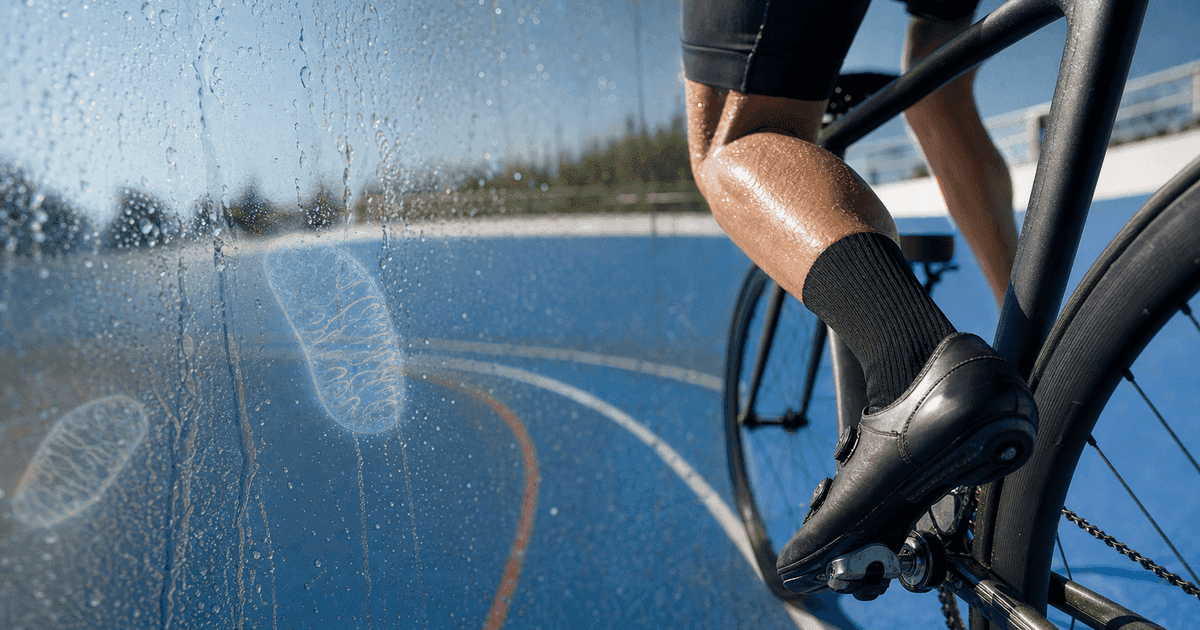

MOTS-c is an exercise mimetic in the narrow research sense: it engages metabolic pathways that also respond to exercise. In people, cycling raised the body’s own MOTS-c. In mice, administered MOTS-c improved physical-capacity measures. A 120-person administered-human metabolic trial is now underway.
That makes MOTS-c a focused mitochondrial and metabolic-fitness unregulated peptide product. Training still supplies the mechanical load, cardiovascular work, coordination, bone stimulus, and repeated practice that create whole-body adaptation.
Two studies define the answer
Two findings are routinely blended together online:
- Exercise increased endogenous MOTS-c in people.
- Administered MOTS-c improved metabolic or physical-capacity measures in mice.
Those are not two versions of the same experiment. In the human study, the intervention was cycling and the measured signal was the participants' own MOTS-c. In the mouse experiments, MOTS-c itself was administered. The human result shows that MOTS-c participates in exercise biology. It does not show that an injection reproduces exercise.
“Exercise mimetic” accurately describes the research hypothesis. Human performance enhancement is the next result that would need to be measured directly.
What MOTS-c actually is
MOTS-c is a 16-amino-acid peptide encoded within mitochondrial 12S ribosomal RNA. That origin is unusual because most familiar peptides are encoded in nuclear DNA. Researchers have detected MOTS-c in human skeletal muscle and circulation and have studied it as a signal connecting mitochondrial status with cellular metabolism.
The name is shorthand for “mitochondrial open reading frame of the 12S rRNA-c.” The important point is not the acronym. It is that MOTS-c is a defined molecule, not a broad name for every mitochondrial supplement, NAD+ product, or energy injection.
Rebody's MOTS-c guide keeps the injection research beside the product facts that make a real routine legible: chemical form, concentration, vial size, directions, supply, storage, shipping, price, and states served.
What the human cycling study found
The clearest human exercise experiment included 10 young men. Participants completed a stationary-bike session, and researchers measured MOTS-c in skeletal muscle and serum. Exercise increased the body's own MOTS-c signal.
That result ties MOTS-c directly to human exercise physiology. The men exercised, researchers measured their endogenous MOTS-c response, and the administered physical-capacity results come from the separate mouse experiments. This clean split is the center of the exercise-mimetic story.
The human evidence supports this sentence: exercise can change endogenous MOTS-c. It does not support this one: injected MOTS-c gives people the benefits of exercise.
What happened when researchers administered MOTS-c
Administered MOTS-c produced the results behind most “exercise mimetic” claims in animal models. Mouse studies reported effects on metabolic homeostasis, insulin resistance, physical capacity, and age-related decline. Those findings are why MOTS-c deserves serious attention.
They are also why species and route must remain visible. A mouse receiving an experimental MOTS-c regimen is not a person using a finished prescription injection. Mouse capacity tests do not establish how a human will feel during a workout, how quickly any change would appear, which dose would be effective, or whether longer use would preserve the same benefit.
The animal data identify a strong research direction and the human performance trial that should come next.
What exercise adds beyond MOTS-c signaling
Exercise is not one signal. Aerobic and resistance training apply mechanical load, increase cardiac output, change vascular function, recruit motor units, stress bone, challenge balance, alter fuel use, and generate adaptations across muscle, heart, lungs, brain, and connective tissue. Those changes depend on the work being performed.
A peptide may influence pathways that also respond to exercise. The training stimulus adds the mechanical, cardiovascular, motor, connective-tissue, and skill work. MOTS-c is best positioned beside a training plan as a metabolic-fitness research option.
What the Phase 2 trial is testing
A recruiting Phase 2a study is designed to move the evidence from endogenous human physiology and administered animal experiments toward administered-human data. The planned trial includes 120 adults with prediabetes and overweight or obesity. Participants receive subcutaneous MOTS-c or placebo for 12 weeks, followed by safety follow-up.
The primary focus is insulin sensitivity, measured through an oral-glucose-tolerance-test-derived endpoint. The protocol also includes metabolic and body-composition measures. It is not primarily an athletic-performance trial, and it has not posted results.
This trial can answer whether a defined subcutaneous regimen changes selected metabolic outcomes in that population over 12 weeks. It will not, by itself, prove that MOTS-c reproduces every benefit of training or works the same way in lean athletes, older adults without prediabetes, or people using a different product.
The phrase “exercise mimetic” has a narrow scientific use
Researchers use the phrase because administered MOTS-c activated pathways and changed capacity or metabolism in animal experiments. Online, the phrase often mutates into “exercise in a vial.” Those are not equivalent statements.
Exercise creates mechanical loading, cardiovascular adaptation, skill, coordination, bone stimulus, muscle remodeling, heat adaptation, and psychological practice. One signaling peptide cannot reproduce that full system.
What endurance athletes can actually infer
The human cycling experiment shows that endogenous MOTS-c responds to exercise. It does not show that taking MOTS-c raises sustained power, VO2 max, lactate threshold, time to exhaustion, or race performance.
Older mice improved physical-capacity measures after administered MOTS-c. That result makes a human performance trial reasonable. It does not pre-report one.
A useful future performance study would preserve the distinction cleanly: randomized administered MOTS-c versus placebo, a defined training population, standardized fueling and recovery, and repeatable measures such as VO2 max, threshold power, time to exhaustion, or completed work. Until then, athletes can track those same outputs in training while treating the current evidence as a metabolic research rationale rather than a predicted personal best.
The metabolic trial is not a sports trial
The recruiting Phase 2a study plans 120 adults with prediabetes and overweight or obesity, 12 weeks of subcutaneous MOTS-c or placebo, and OGTT-derived insulin sensitivity as the primary endpoint. Weight and waist are secondary; athletic performance is not the central question.
A positive metabolic result would matter. It still would not establish an ergogenic effect in trained people.
WADA settles the competitive-sport question
MOTS-c is prohibited under the 2026 World Anti-Doping Agency list. The prohibition applies to the substance, not to whether the user calls the goal recovery, longevity, body composition, or mitochondrial health.
A tested athlete should not use a product page, clinic protocol, or “unregulated peptide product” label as reassurance. Antidoping rules are the decisive practical answer here.
Questions people ask about MOTS-c and exercise
Is MOTS-c literally exercise in a vial?
MOTS-c overlaps with selected exercise-related metabolic pathways. Exercise adds mechanical loading, cardiovascular adaptation, motor learning, bone stimulus, and muscle remodeling.
Did the human cycling study give participants MOTS-c?
Researchers measured the participants’ own MOTS-c before and after cycling in 10 young men. The intervention was exercise; the measured response was endogenous MOTS-c.
Can MOTS-c improve VO2 max or race pace?
No cited administered-human study establishes either outcome. Mouse capacity data cannot supply a human percentage.
Does MOTS-c burn belly fat?
Administered mouse research reported obesity and insulin-resistance findings. Human weight and waist results from the Phase 2a trial are not posted, and those are secondary endpoints.
How long is a MOTS-c cycle?
The planned prescription uses 12 units under the skin, Monday through Friday, for 25 doses across 35 days. This planned routine still requires approval. The 12-week clinical trial duration is not a public dosage recommendation or an athlete protocol.
Is MOTS-c legal for tested competition?
No. MOTS-c is prohibited under the 2026 WADA list.
What a credible future product page must disclose
The MOTS-c guide keeps chemical form, concentration, vial size, delivered amount, prescribed cadence, days of supply, storage, shipping, included supplies, refill timing, price, and states together.
Those facts must arrive together. A cheap research vial with an undefined schedule cannot be compared with a 30-day or 60-day patient-labeled package.
Safety remains part of the unanswered human question
Injection-site pain, redness, swelling, bruising, or infection are route concerns. The Phase 2a trial is also collecting adverse events, laboratories, vital signs, and ECG information because broader administered-human safety is not settled by endogenous exercise physiology.
Breathing difficulty, facial or throat swelling, fainting, severe chest pain, major neurologic symptoms, a rapidly spreading reaction, or serious-infection signs require urgent help.
The practical tracking plan should mirror the claim: use the same cycling, walking, or strength benchmark under similar sleep, food, caffeine, and training conditions. Record work completed, pace or load, heart rate, and next-day recovery. That turns “exercise mimetic” from a slogan into a concrete metabolic-fitness question.
Bottom line
MOTS-c is a credible mitochondrial and metabolic-fitness unregulated peptide product. Human cycling raises endogenous MOTS-c, administered MOTS-c improves capacity measures in mice, and a 120-person metabolic trial is moving the question into administered-human research. Training remains the whole-body stimulus, and WADA prohibits MOTS-c in tested sport.
The MOTS-c guide keeps each result attached to its actual model, route, and measured endpoint.
Keep reading
- Peptide Treatments for Endurance and Training Consistency
- Peptides for Exercise Capacity and Metabolic Fitness
- Workout-Recovery Peptides and Injections