
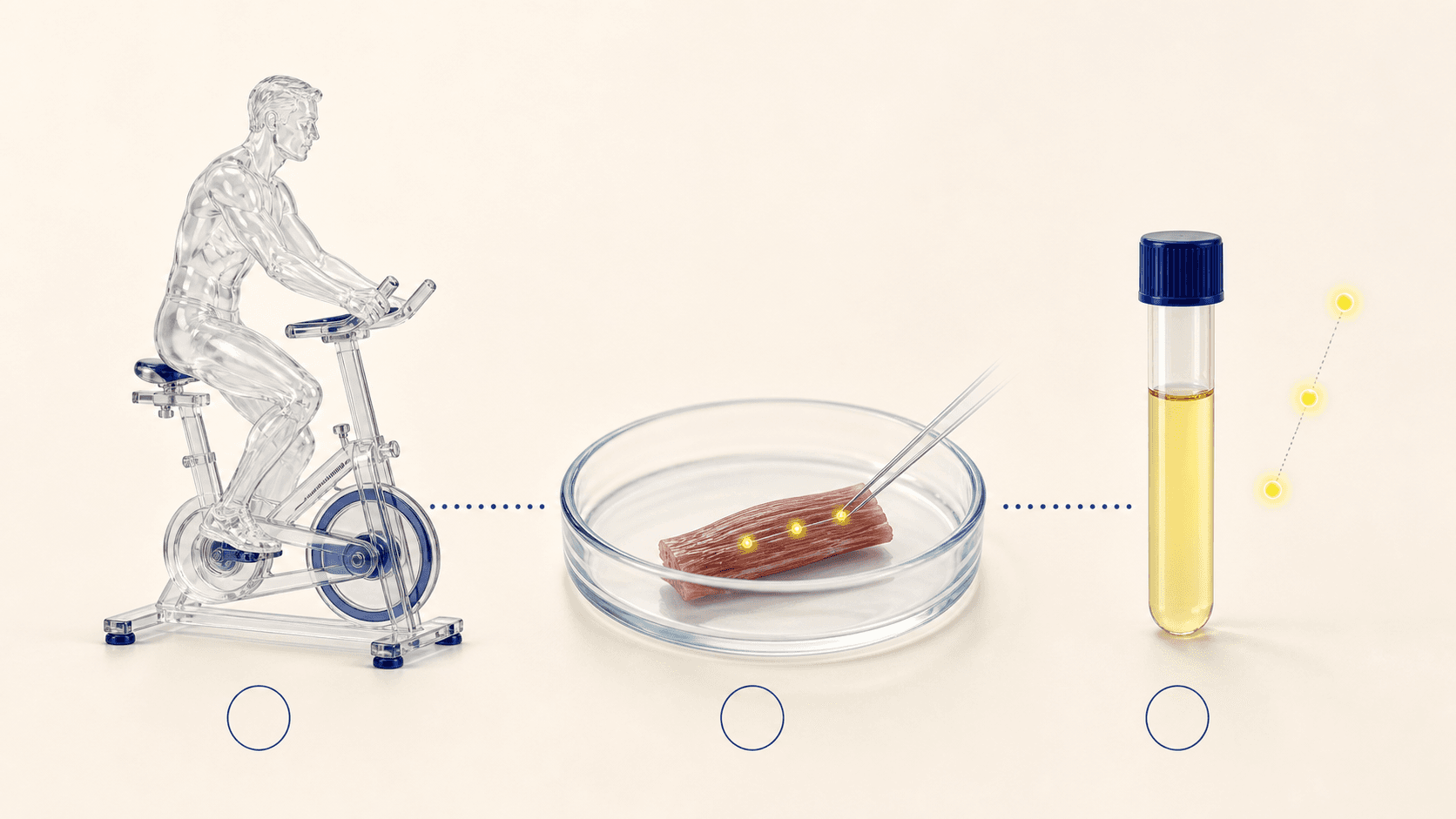
MOTS-c is the exercise-capacity peptide research lead. Administered studies improved physical-capacity measures in mice, while human cycling research showed that exercise increases the body's own MOTS-c in muscle and serum.
Physical capacity meets mitochondrial signaling
Older mice given MOTS-c improved physical-capacity measures in the cited experiments. In a separate study of 10 young men, cycling increased endogenous MOTS-c in skeletal muscle and serum. The models answer different questions, but together they make MOTS-c the most direct peptide at the intersection of mitochondria and performance.
Sermorelin, NAD+, and B12 remain useful when sleep/GH signaling, direct NAD interest, or deficiency is the actual issue. None carries MOTS-c's exercise-biology story.
What belongs in this collection
- MOTS-c: best matched to mitochondrial signaling and metabolic-fitness research.
- Sermorelin: best matched to bedtime GH-signaling and recovery interest.
- NAD+: best matched to a direct NAD and cellular-energy routine.
- B12: best matched to a measured or strongly suspected B12 deficiency.
MOTS-c is the mitochondrial peptide in this set: a 16-amino-acid molecule encoded by a short open reading frame within mitochondrial 12S rRNA and detected in human skeletal muscle and circulation. Rebody's intended format is an injection vial. Sermorelin, NAD+, and B12 address distinct pathways through their own formats, evidence, and instructions.
How the options differ
| Option | Biological question | Practical reason to choose it | Evidence boundary |
|---|---|---|---|
| MOTS-c injection | Mitochondrial and exercise-biology research | Closest research match to exercise-capacity intent | human work measured endogenous MOTS-c after cycling |
| Sermorelin formats | Bedtime GH-axis signaling | Current option when sleep and recovery are the real problem | Not an endurance treatment |
| NAD+ formats | NAD-dependent cellular energy biology | Current choice for a direct NAD+ routine | No route-specific proof of greater exercise capacity |
| Methylcobalamin B12 injection | Vitamin B12 deficiency | First choice when deficiency limits energy or performance | Deficiency evidence does not generalize to athletes with normal B12 |
The routines differ across MOTS-c, Sermorelin, NAD+, and B12. Injection setup, storage, supplies, and refill timing can decide which choice remains usable through a real training block.
Why MOTS-c leads this search
Among MOTS-c, Sermorelin, NAD+, B12, MOTS-c leads because its molecule and evidence are closest to the shopper's question. The evidence is specific: In 10 young men, a stationary-bike session increased the body's own MOTS-c in skeletal muscle and serum. That was human exercise physiology, not treatment with a MOTS-c injection. Experiments that administered MOTS-c and improved physical-capacity or metabolic measures used mice. A recruiting Phase 2a trial plans 120 adults with prediabetes and overweight or obesity, 12 weeks of subcutaneous MOTS-c or placebo, and an OGTT-derived insulin-sensitivity endpoint. Results are not posted.
What the research measured
The key distinction is administration. Cycling increased the participants’ own MOTS-c in a study of 10 young men; the experiments that administered MOTS-c and improved physical-capacity or metabolic measures were performed in mice. The 120-person Phase 2a trial is recruiting and has posted no results.
Exercise capacity is a performance endpoint, not an energy adjective
For this page, the meaningful outcomes are pace, power, time to exhaustion, work completed, oxygen use, or another repeatable training measure. Feeling stimulated is not the same as producing more work, and a mitochondrial mechanism is not the same as a performance result.
MOTS-c is the closest research match because administered experiments measured physical capacity in mice. The direct human study did something different: 10 young men cycled, and researchers measured a rise in their own MOTS-c in muscle and serum. That finding shows exercise-responsive physiology; it does not show that an injection improves performance.
The physical-capacity result
Older mice given MOTS-c improved physical-capacity measures in the cited experiments. That administered result is the strongest direct reason MOTS-c leads this collection. The current Phase 2a human study is aimed at insulin sensitivity rather than race time or VO2 max, so the animal model and endpoint remain part of the sentence—not a reason to hide the finding.
Establish the training baseline first
Use the same route, terrain, equipment, warm-up, and time of day. Record sleep, carbohydrate intake, hydration, temperature, illness, and training load. Compare several sessions rather than one unusually good day.
B12 belongs in this decision only when deficiency is measured or strongly suspected. Sermorelin belongs to a bedtime GH-axis question. NAD+ belongs to direct NAD interest. None should inherit MOTS-c’s mouse capacity result.
Design a performance test before judging a performance product
Choose one repeatable test that matches the sport. A cyclist might use average power during a fixed-duration effort or time at a fixed wattage. A runner might use pace at a controlled heart rate on the same route. A lifter might track completed work at fixed loads rather than a one-day personal record. Keep warm-up, equipment, time of day, and recovery interval as consistent as possible.
Log the confounders beside the result: sleep, carbohydrate intake, hydration, temperature, altitude, recent illness, soreness, and prior training load. Compare a run of baseline sessions with a later run of sessions. That is more informative than interpreting stimulation, a pump, or one unusually fast workout as greater exercise capacity.
The evidence hierarchy should remain visible in that notebook. Ten young men produced more endogenous MOTS-c after cycling; they were not treated with it. Administered MOTS-c improved capacity-related measures in mice. The recruiting human Phase 2a trial is designed around OGTT-derived insulin sensitivity in adults with prediabetes and overweight or obesity, not VO2 max or race performance. Each result can motivate research, but none supplies the missing administered-human performance endpoint.
Competitive athletes have an additional hard stop: MOTS-c is prohibited under the 2026 WADA list. A personal performance experiment cannot resolve an antidoping rule.
Questions about peptides and exercise capacity
What exercise-capacity result put MOTS-c on the map?
Administered MOTS-c improved physical-capacity measures in older mice. Separately, cycling increased endogenous MOTS-c in muscle and serum in 10 young men. A human VO2-max treatment result has not yet been reported.
Is MOTS-c useful for strength training?
That has not been established in people. A mitochondrial and glucose-handling mechanism does not prove more repetitions, greater force, or muscle gain.
How long would performance changes take?
Rebody has no final MOTS-c schedule, and the 12-week Phase 2a design is not a performance protocol. Do not convert a metabolic trial duration into a training promise.
Should low energy during workouts be treated with B12?
Only when the B12 question fits. Deficiency can contribute to fatigue and neurologic symptoms, but B12 is not a universal pre-workout injection.
Can a tested athlete use MOTS-c?
No. MOTS-c is prohibited under the 2026 WADA list. The prohibition matters regardless of whether a commercial product is currently available.
Current access and price context
The MOTS-c guide keeps form, concentration, vial, cadence, storage, supply, and price together. Adjacent products are separate choices. Methylcobalamin B12 is $39/month on a 3-month plan. NAD+ pricing depends on route, and no NAD+ format is presented here as a proven exercise-capacity treatment.
MOTS-c is the metabolic-fitness peptide
MOTS-c wins the peptide research match for exercise capacity: administered mouse studies measured physical capacity, and human cycling research showed an endogenous MOTS-c response in muscle and serum. That is a strong, coherent reason to follow this peptide as human research advances.
Keep reading
- Peptide Treatments for Endurance and Training Consistency
- Workout-Recovery Peptides and Injections
- Is MOTS-C an Exercise Mimetic? Human Data vs Mouse Treatment Results