
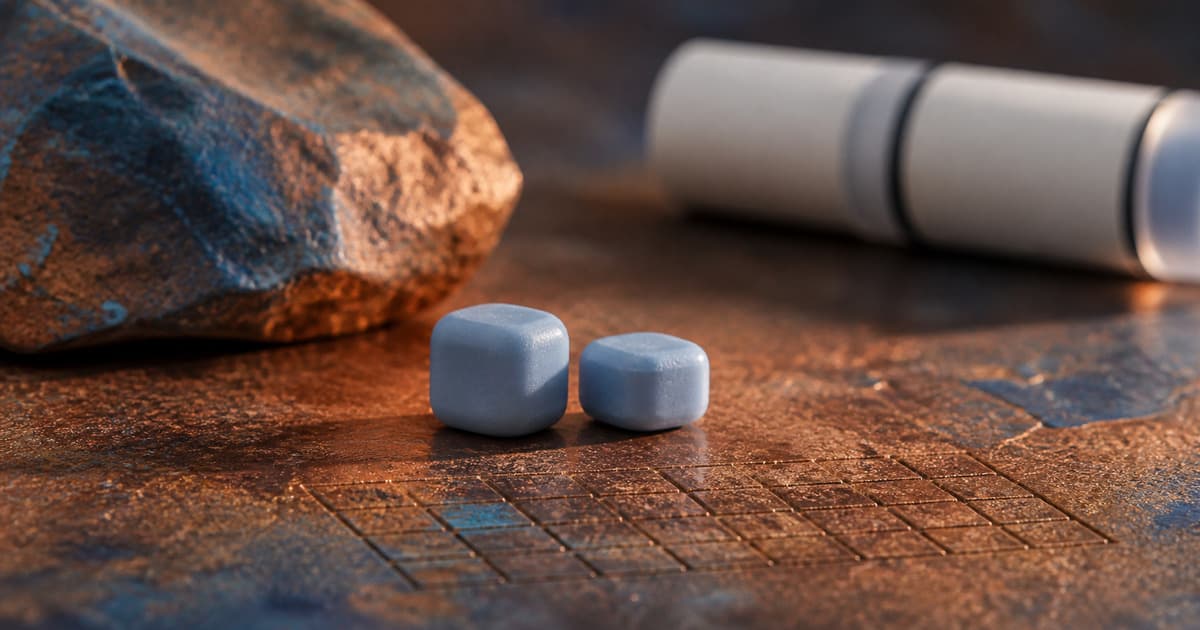

Oral GHK-Cu troches win on once-daily simplicity. Topical GHK-Cu remains the evidence-led route for visible skin goals. Rebody currently offers 15 mg and 25 mg oral troches in 30-count packages.
The oral route has a clear commercial job. It gives someone a daily GHK-Cu format without a cream, scalp application, or injection. It does not have human outcome evidence showing better skin, hair, recovery, or longevity.
Current oral options
| Option | Package | Published routine | Current price |
|---|---|---|---|
| 15 mg troche | 30 troches | Dissolve one under the tongue or between gum and cheek daily | $229 |
| 25 mg troche | 30 troches | Dissolve one under the tongue or between gum and cheek daily | $249 |
The clinician selects the strength. The final pharmacy label controls placement, timing, food or drink rules, storage, and missed use.
What GHK-Cu is
GHK is a three-amino-acid peptide made from glycine, histidine, and lysine. It binds copper to form GHK-Cu. Research has examined its role in extracellular matrix activity, wound biology, inflammation, antioxidant systems, and gene expression.
Much of that work comes from cell, tissue, animal, and topical models. The molecule's broad research history does not establish the effect of an oral troche.
What the troche route changes
A troche remains in contact with tissue under the tongue or inside the cheek while it dissolves. Some medicine may cross oral mucosa. Some may be swallowed.
Finished-product exposure depends on formula, contact time, saliva, placement, swallowing, and individual physiology. “Sublingual” does not supply a bioavailability percentage.
No public pharmacokinetic study was found for Rebody's finished 15 mg or 25 mg troche. The label amount cannot be treated as the amount reaching circulation.
What the evidence supports
Reviews describe GHK-Cu effects across laboratory models and summarize small human cosmetic studies of topical products. Those human studies applied copper-peptide creams to skin and measured skin-related outcomes over time.
The route match matters. Topical evidence can support interest in a topical skin product. It cannot establish systemic exposure or skin improvement from a troche.
Current oral claims about collagen, hair, recovery, inflammation, or longevity rely on mechanism and extrapolation. Present them as research questions.
15 mg vs 25 mg
The larger strength contains more GHK-Cu in each troche. It is not automatically the better starting option.
A clinician can consider health history, other medicines, prior use, tolerance, and the reason for choosing the product. No human trial shows that 25 mg produces better visible outcomes than 15 mg. The $20 package difference does not create an efficacy result.
Do not split, double, or alternate strengths unless the prescription permits it.
Oral GHK-Cu vs topical cream
Choose the cream for a facial or neck skin goal. It has a local target and the closest human evidence.
Choose the troche when a daily oral format is the main reason to use GHK-Cu. It avoids skin application and product layering. It carries more uncertainty about exposure and outcomes.
The two routes cannot be compared by milligrams versus percentage. A cream concentration, application amount, skin area, oral strength, and systemic exposure are different quantities.
Oral GHK-Cu vs injection
The troche avoids needles and injection supplies. Injection offers direct administration but adds sterile technique, sharps handling, and route-specific risks.
Neither route has robust human outcome evidence for broad rejuvenation claims. A clinic cannot convert an injection amount into an oral amount without finished-product pharmacokinetic data.
The daily routine
Place the troche where the label directs. Let it dissolve for the full instructed period. Follow the product-specific rules for food, drink, and oral care.
Track taste, mouth irritation, early swallowing, missed uses, and any change in the product's appearance. Keep the package closed and follow the storage range on the pharmacy label.
What oral bioavailability means here
Bioavailability asks how much of an administered compound reaches circulation and for how long. A troche can expose the mouth lining to a compound before the rest is swallowed, but that description does not provide an absorption percentage. The finished base, contact time, saliva, swallowing, meal timing, and peptide stability can all change exposure.
This is why search-result claims about “better absorption” need a named comparator and product-specific data. Better than a swallowed capsule is not the same claim as better than a cream. A larger label amount also does not prove more systemic exposure. Human pharmacokinetic work on the finished 15 mg and 25 mg troches would need to measure blood concentrations across time and show how variable the result is between people.
Until those measurements exist, the clearest oral advantage is simple: one mini troche each day, with no cream application and no injection supplies.
Match the route to the outcome
Visible facial or scalp goals make topical evidence especially relevant because a cream can place GHK-Cu at the target surface. A person interested in a systemic research question may prefer an oral routine, but the measured endpoint still matters. Skin photography, hair counts, soreness, training consistency, and a general longevity feeling are different outcomes.
Pick one primary outcome before the first dose. Use the same lighting for skin photographs. Count shed hairs with one repeatable method. Record training volume before judging recovery. A daily troche that starts on the same week as a new cream, supplement stack, and training program cannot tell you which change produced the result.
The 30-day package provides a useful first adherence checkpoint. It does not create a guaranteed outcome deadline. Review missed doses, oral irritation, handling, and the chosen measure before changing strength.
What the price difference buys
The move from 15 mg to 25 mg adds $20 to the current package price. That buys a higher labeled strength. It does not buy proven faster onset, higher absorption, or a larger skin or hair result.
A useful price comparison keeps the full product visible: 30 troches, one daily routine, prescription review, shipping terms, and the strength selected by the clinician. Compare that package with the cost and application burden of topical GHK-Cu. Milligrams alone cannot settle the comparison when the routes deliver the compound differently.
How to judge value
The 15 mg package costs $229 and the 25 mg package costs $249. Both contain 30 troches for the current 30-day routine.
Value depends on the chosen strength, full package, clinician review, shipping, storage burden, adherence, and the outcome being tracked. It cannot be reduced to milligrams per dollar when clinical exposure and outcome are unknown.
See the current oral GHK-Cu page for live package details.
Side effects and route problems
An oral troche can cause mouth irritation, soreness, taste changes, altered sensation, or stomach upset. Copper-related conditions, current medicines, pregnancy, breastfeeding, and significant medical history need clinician review.
Seek urgent help for breathing difficulty, facial or tongue swelling, widespread hives, fainting, severe vomiting, or another severe reaction.
Questions to ask before the first refill
Ask which strength was prescribed and why it was selected. Confirm the exact placement, dissolve period, food and drink window, storage range, missed-dose instruction, and whether the package can tolerate the planned trip. Make sure the refill date arrives before the last troche.
Then ask what result will justify another month. A visible skin goal needs repeat photographs under the same light. A hair goal needs a repeatable shed or density measure. A recovery goal needs comparable training sessions. “I think I feel different” can start a useful conversation, but it cannot separate GHK-Cu from sleep, training, diet, or another new product.
Oral irritation also belongs in the refill decision. Note soreness, altered taste, numbness, early swallowing, and skipped doses. A higher strength has little value when the daily form is hard to use correctly.
Finally, keep combination products out of the comparison. A troche that adds other peptides, hormones, or vitamins has a different ingredient list, price, and safety review. Evidence for topical GHK-Cu or an injectable copper peptide does not turn a multi-ingredient oral product into the same treatment.
Questions people ask
Is oral GHK-Cu effective?
The finished troche lacks route-matched human outcome trials. Its strongest current advantage is a simple oral routine.
Does oral GHK-Cu improve skin?
That result has not been established. The small human cosmetic studies used topical products.
Is 25 mg better than 15 mg?
No comparative outcome study proves that. The clinician selects a strength based on the individual plan.
Is a troche swallowed?
It is placed under the tongue or between gum and cheek and left to dissolve according to the label. Do not swallow it whole unless directed.
Does GHK-Cu need refrigeration?
Use the exact pharmacy storage instructions. Do not borrow storage rules from the cream or another clinic's troche.
Bottom line
Oral GHK-Cu is the route for someone who values a once-daily troche more than a target-specific topical. Choose 15 mg or 25 mg through clinician review. Keep skin, hair, recovery, and longevity outcomes open until route-matched human evidence exists.