
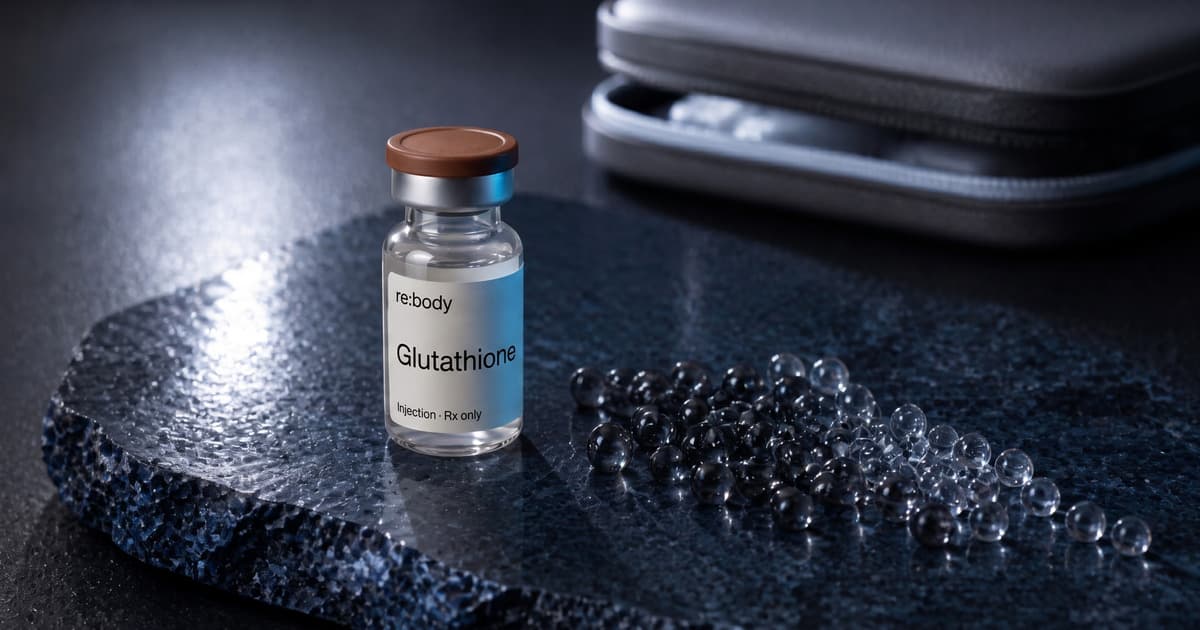

Glutathione injection is the antioxidant-focused option in Rebody's cellular-support group. Glutathione has a real role in cellular redox balance. That biology does not prove that an injection improves energy, causes weight loss, detoxifies a healthy person, or lightens skin.
The strongest guide keeps those two facts together: the molecule matters, and the finished injection still needs route-matched clinical evidence.
The short answer
Glutathione is a tripeptide made from glutamate, cysteine, and glycine. Cells use it in antioxidant defense and in systems that handle reactive molecules.
An injection supplies glutathione through a route that bypasses digestion. Rebody's current public product is an injection, which differs from the intravenous infusions, oral supplements, and topical products found across Google results.
Current product at a glance
| Fact | Current Rebody offer |
|---|---|
| Form | Prescription injection |
| Concentration | 200 mg/mL |
| Package | 10 mL vial |
| Package price | $149 |
| Evidence match | No strong route-matched clinical-outcome evidence found for broad wellness claims |
The current offer is a 30-day package. Your clinician sets the dose, timing, and use. Follow your prescription label.
What antioxidant defense means
Normal metabolism produces reactive molecules. Glutathione participates in enzyme systems that help manage them. After oxidation, cellular systems can recycle glutathione back toward its reduced form.
This is a defined biological role. “Detox” is often used as a much larger promise. It can imply that a shot clears unnamed toxins, repairs a healthy liver, prevents a hangover, or reverses fatigue. Those outcomes require their own evidence.
What the injection evidence does not establish
The available research spans oral glutathione, intravenous use, disease-specific settings, skin outcomes, laboratory models, and biomarker studies. Those routes and populations cannot establish the outcome of a compounded injection.
Strong direct evidence was not found for these claims:
- dependable energy improvement in people without a defined deficiency or condition;
- weight loss;
- broad immune enhancement;
- liver cleansing in a healthy person;
- reliable skin lightening from the current injection;
- better recovery or longer life.
The useful commercial position is antioxidant intent. Keep each additional outcome attached to the route and study that measured it.
Glutathione injections for skin
Skin-whitening and “glow” claims dominate parts of the search result. They also create the largest risk of overstatement.
Pigmentation changes depend on the route, formulation, dose, baseline skin, exposure, measurement, and duration. Research on oral, intravenous, or topical products does not prove the effect of a prescription injection. A before-and-after photo from a clinic cannot control lighting, sun exposure, skincare, or editing.
Someone seeking treatment for hyperpigmentation should start with the cause and therapies that match it. Glutathione injection should not be sold as a guaranteed complexion change.
Injection vs IV
An IV infusion places material directly into circulation in a supervised setting. An injection enters circulation differently.
The two routes differ in peak concentration, exposure time, setting, cost, and adverse-event risks. An IV study does not convert to an injection amount. A clinic infusion price also cannot be compared with a home vial until the full amount and package duration are clear.
What to compare before buying
| Field | Why it matters |
|---|---|
| Concentration | Shows the amount per milliliter |
| Route | Separates injection from IV infusion |
| Vial volume | Shows the total package |
| Supplies | Confirms what supplies ship with the vial |
| Storage and shipping | Protects the compounded product |
| Total price | Includes medication, visit, shipping, and separate fees |
See the current glutathione product page for the live 30-day offer and package price.
What the 30-day package means in practice
Rebody's current package contains a 10 mL vial at 200 mg/mL.
The package price is $149. Compare the complete 30-day kit, not one injection in isolation. Useful questions include whether supplies ship with it, how the medication travels, when a refill is available, and who handles a damaged cold shipment or a persistent injection-site problem.
Concentration tells you how much glutathione is present in each milliliter. It does not tell you what to use. That comes from the prescription label.
How to measure an antioxidant claim
Oxidative stress can become a catch-all phrase that explains fatigue, soreness, skin concerns, travel, and aging at once. A useful trial chooses a defined population and endpoint. It might measure a validated oxidative-stress marker, a symptom score, skin color under controlled photography, or recovery after a set exercise protocol.
For personal tracking, choose the real reason the product was considered. If travel recovery is the target, record flight duration, sleep loss, training return, and the day normal energy returns. If skin is the target, use consistent lighting and avoid adding several new products together. If no defined measure changes, antioxidant biology alone cannot prove a useful result.
Quality matters more for a sterile injection
An injectable bypasses the digestive tract and places a higher burden on sterile preparation. FDA has reported adverse events tied to glutathione injectables compounded from an ingredient that was not suitable for sterile use. The alert described endotoxin exposure and acute reactions in patients who received affected products.
That history makes pharmacy and handling facts part of the product. Confirm intact packaging, the storage range on the label, the beyond-use date, and what to do if the vial looks damaged or contaminated. Never use a vial with unexpected particles, cloudiness, leakage, or a broken seal.
Safety and sterile compounding
Sterile ingredients and processes matter for an injectable product. FDA reported adverse events after patients received compounded intravenous glutathione made with an ingredient that was not intended for sterile drug production. Reported symptoms included nausea, vomiting, chills, low blood pressure, breathing difficulty, fever, and hospital care.
That event does not describe every compounded glutathione product. It shows why pharmacy source, sterile controls, package integrity, and clear handling instructions matter.
Injection-site pain, redness, bruising, itching, or swelling can occur. Seek urgent help for breathing difficulty, facial or tongue swelling, fainting, widespread hives, severe chills or fever after injection, or another severe reaction.
Keep glutathione separate from B12 and NAD+
Glutathione, methylcobalamin B12, and NAD+ often appear together on longevity and energy menus. They are different molecules with different biological jobs. Glutathione participates in redox systems. B12 supports nerve function, red-blood-cell formation, and DNA synthesis. NAD+ participates in energy transfer and enzyme activity.
That distinction changes the buying question. Low B12 can be investigated with history and laboratory markers. NAD+ products raise a route and outcome-evidence question. Glutathione begins with antioxidant biology and the specific endpoint being pursued. A three-product “energy” bundle can hide those differences and make the result impossible to interpret.
If more than one product is considered, list every ingredient, concentration, route, supply, price, and storage requirement. Start dates matter. Staggering changes when clinically appropriate makes side effects and outcomes easier to attribute. A local reaction after two new injectables started together creates an avoidable guessing problem.
The same rule applies to IV lounges and wellness shots. A product called a glutathione injection may be an IV infusion or a shot, and may contain other ingredients. Match the evidence to the exact route and finished formulation.
Compare the ingredient panel before price. Some offers add vitamin C, B vitamins, amino acids, or other compounds. A reaction or benefit from that mixture cannot be assigned to glutathione alone. Rebody's current page describes glutathione as the named active in an injection. Keep that exact formulation attached to every evidence and cost comparison.
The refill review should also note vial condition and local reactions. A 30-day package only creates value when the product stays intact and the treatment remains tolerable through the full period.
Who this fits
Glutathione injection fits an adult who wants an antioxidant-focused prescription and accepts that energy, skin, and weight claims are unproven for this route. It suits someone who is comfortable with a home injection kit and will track one defined measure. It fits less well for someone who wants a guaranteed skin change. It also fits less well for someone who plans to start several new injectables in the same month. During the online visit, tell the clinician about every medicine, supplement, and allergy, and about any past reaction to an injection.
Questions people ask
Does Rebody sell glutathione injection?
Yes. Rebody offers glutathione injection as a 10 mL vial at 200 mg/mL. A licensed clinician reviews your online visit and decides whether it fits your history.
Is oral glutathione a substitute for the injection?
They are different products. The cited sources include an oral supplementation trial and a study of supplementation and body stores. Oral results do not transfer to an injection, and injection results would not transfer to a capsule. Ask your clinician which form matches your goal.
Do glutathione injections give you energy?
That outcome has not been established for the current injection. Glutathione has antioxidant biology; it is not a stimulant.
Do glutathione injections lighten skin?
The evidence does not support a guaranteed result from this route. Avoid comparing uncontrolled photos as clinical proof.
Is an injection the same as an IV?
No. The routes create different exposure and administration conditions.
What does a glutathione injection cost?
Rebody's current package price is $149. Confirm vial size, package duration, supplies, shipping, and the next charge before purchase.
Bottom line
Choose glutathione injection for a deliberate antioxidant-focused plan. Keep skin, energy, weight, detox, and recovery claims separate unless route-matched evidence supports them. The package should make concentration, vial size, supply, sterile source, and total price easy to verify.