
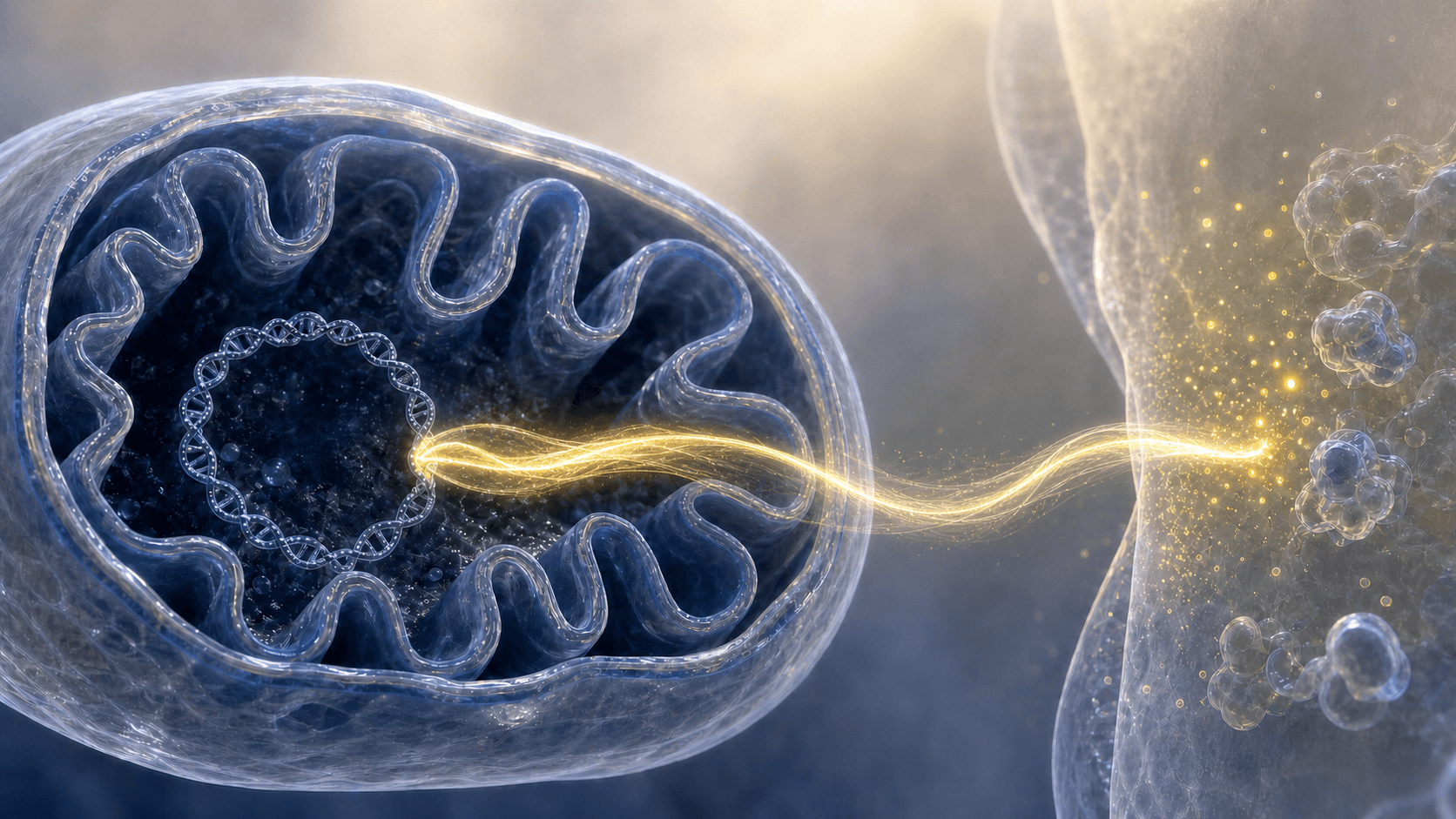
MOTS-c is the healthy-aging peptide that begins inside mitochondrial DNA. Its biology connects metabolic signaling, glucose handling, exercise response, and physical capacity.
A mitochondrial signal built for metabolic resilience
MOTS-c is encoded within mitochondrial 12S rRNA and detected in human skeletal muscle and circulation. Exercise increased endogenous MOTS-c in 10 young men, while administered mouse studies reported metabolic and physical-capacity findings, including in older animals. That is a distinctive healthy-aging story centered on function and metabolic resilience.
Epitalon, NAD+, and Sermorelin remain useful for telomere, direct-coenzyme, and GH-axis questions, but none replaces MOTS-c's mitochondrial-derived-peptide identity.
What belongs in this collection
- MOTS-c: best matched to mitochondrial signaling and metabolic-fitness research.
- NAD+ formats: best matched to a direct NAD and cellular-energy routine.
- Epitalon: best matched to telomere and circadian-hormone research.
- Sermorelin: best matched to bedtime GH-signaling and recovery interest.
MOTS-c is the mitochondrial peptide in this set: a 16-amino-acid molecule encoded by a short open reading frame within mitochondrial 12S rRNA and detected in human skeletal muscle and circulation. Rebody's intended format is an injection vial. NAD+, Epitalon, and Sermorelin address distinct pathways through their own formats, evidence, and instructions.
How the options differ
| Option | Biological question | Practical reason to choose it | Evidence boundary |
|---|---|---|---|
| MOTS-c injection | Mitochondrial signaling and metabolic research | Closest peptide match to mitochondrial-health intent | administered-human results are pending |
| NAD+ formats | NAD-dependent cellular energy biology | Current formats for a direct NAD+ routine | NAD biology is not proof of longer life or more energy |
| Epitalon injection | Telomere and circadian-hormone research | Specific match to telomere-research interest | cell and rhesus findings are not human longevity outcomes |
| Sermorelin formats | Bedtime GH-axis signaling | Current sleep-and-recovery treatment family | It answers a GH question, not a mitochondrial one |
The routines differ across MOTS-c, NAD+, Epitalon, and Sermorelin. Preparation, storage, site rotation, supplies, and sharps disposal can decide which option becomes sustainable beyond the first refill.
Why MOTS-c leads this search
Among MOTS-c, NAD+ formats, Epitalon, Sermorelin, MOTS-c leads because its molecule and evidence are closest to the shopper's question. The evidence is specific: In 10 young men, a stationary-bike session increased the body's own MOTS-c in skeletal muscle and serum. That was human exercise physiology, not treatment with a MOTS-c injection. Experiments that administered MOTS-c and improved physical-capacity or metabolic measures used mice. A recruiting Phase 2a trial plans 120 adults with prediabetes and overweight or obesity, 12 weeks of subcutaneous MOTS-c or placebo, and an OGTT-derived insulin-sensitivity endpoint. Results are not posted.
What the research measured
The key distinction is administration. Cycling increased the participants’ own MOTS-c in a study of 10 young men; the experiments that administered MOTS-c and improved physical-capacity or metabolic measures were performed in mice. The 120-person Phase 2a trial is recruiting and has posted no results.
Healthy aging is not a synonym for more energy
Mitochondria produce ATP, but aging research also examines signaling, stress response, apoptosis, glucose handling, and communication between mitochondria and the nucleus. MOTS-c belongs here because it is encoded within mitochondrial 12S rRNA and functions as a mitochondrial-derived signal. NAD+, Epitalon, and Sermorelin enter healthy-aging conversations through different biology.
The strong answer is therefore narrow: MOTS-c is the closest mitochondrial-peptide match. It is not proof of longer life, younger mitochondria, or a reversal of aging.
What changes with age in the research
Reviews of mitochondrial-derived peptides discuss MOTS-c, humanin, and small humanin-like peptides as signals studied across metabolism and age-related biology. The most useful human MOTS-c result for this guide is still the exercise experiment in 10 young men: cycling increased endogenous MOTS-c in skeletal muscle and serum.
Administered MOTS-c findings on physical capacity and metabolic health came from mice, including older animals. A recruiting Phase 2a trial will test subcutaneous MOTS-c for 12 weeks in adults with prediabetes and overweight or obesity. It is not a lifespan trial, and it has no posted result.
Separate four healthy-aging questions
Choose MOTS-c research for mitochondrial signaling and metabolic fitness. Choose NAD+ when the interest is a direct NAD routine. Choose Sermorelin when bedtime GH-axis signaling and recovery are central. Choose Epitalon research when telomere or circadian-hormone biology is the actual topic.
That framework prevents one broad “longevity” promise from swallowing several unrelated mechanisms.
What to measure instead of “biological age”
A proprietary biological-age score can move for reasons that are hard to audit. Use measures tied to the actual goal: fasting glucose or an ordered metabolic marker, repeatable walking or cycling output, sleep timing and restedness, a documented deficiency, or a defined functional task.
Keep training, sleep, meals, caffeine, and measurement time stable enough to interpret the pattern. A wearable change is not proof that a telomere, mitochondrion, or hormone pathway changed.
Do not let a biomarker impersonate healthspan
A telomere result, mitochondrial signal, glucose measure, or hormone value can be scientifically interesting without showing that a person stayed stronger, more independent, or alive longer. For a healthy-aging decision, rank endpoints by how directly they touch life: walking speed, strength, recovery between demanding days, metabolic control, sleep continuity, cognition, and the ability to keep doing valued activities. A molecular marker sits upstream of those outcomes; it does not automatically substitute for them.
That distinction is especially important with mitochondrial-derived peptides. MOTS-c has aging-related biology and animal capacity data, but no completed administered-human trial showing longer lifespan or healthspan. Humanin is another mitochondrial-derived peptide with its own sequence and literature. Findings about one should not be reassigned to the other merely because both originate from mitochondrial genetic material.
The strongest practical baseline is deliberately unglamorous: resistance training, aerobic activity, adequate protein and energy intake, sleep, blood-pressure and lipid management, and treatment of diagnosed deficiency or disease. A future MOTS-c prescription would have to improve a defined outcome on top of that foundation. It should not receive credit for changes caused by a new training block, weight loss, or corrected B12 deficiency.
Questions about mitochondrial peptides and aging
Do MOTS-c levels decline with age?
Age-related patterns appear in the mitochondrial-derived-peptide literature, but circulating levels, tissue expression, genotype, health status, and assay design complicate a single universal decline curve. Do not turn a review figure into an individual diagnosis.
Is MOTS-c proven to extend lifespan?
No human trial establishes longer life from administered MOTS-c. The evidence here covers endogenous human exercise physiology, administered mouse outcomes, and a pending metabolic trial.
Are humanin and MOTS-c the same peptide?
No. Both are mitochondrial-derived peptides, but they have different sequences and research histories. A page about MOTS-c should not borrow humanin findings.
Is exercise still the best mitochondrial intervention?
Exercise has extensive human evidence and, in the cited study, increased endogenous MOTS-c. MOTS-c should not be framed as a substitute for the behavior that already produced the human signal.
Can tested athletes use MOTS-c for healthy aging?
MOTS-c is prohibited under the 2026 WADA list. “Longevity” intent does not change antidoping status.
Access and current options
The MOTS-c guide keeps concentration, vial, schedule, supply, storage, and price together. NAD+ and Sermorelin remain different products, and Epitalon has its own product guide. Buy only against the finished label and route rather than a longevity-clinic protocol copied across molecules.
Choose the peptide encoded by the mitochondria
MOTS-c leads mitochondrial healthy-aging research because its origin and measured biology point to metabolism, exercise response, and physical capacity. It is the peptide-first choice for shoppers who care about maintaining function and metabolic fitness as they age.
Keep reading
- Cellular-Energy Injections: MOTS-C, NAD+, B12, and Glutathione
- Mitochondrial Peptides and Cellular-Energy Treatments
- MOTS-C vs NAD+ vs B12: Which One Matches Your Energy Problem?