
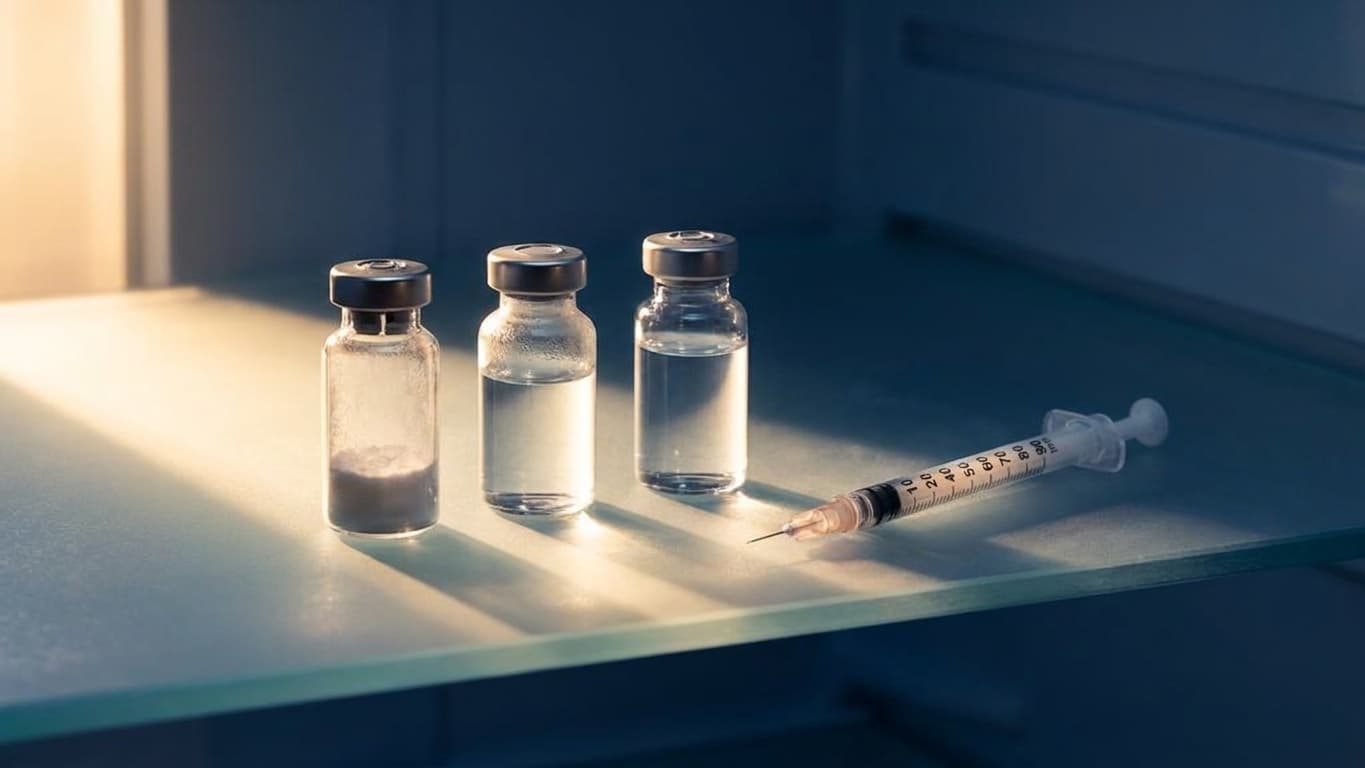

Most peptides lose potency because of heat, light, or a bad reconstitution — not because the compound itself is fragile. Store them correctly and a vial holds its strength for months; get it wrong and you're injecting saline with a fraction of the dose you paid for.
- Lyophilized (powder) peptides stay stable in a fridge at 36-46°F for 12+ months unopened — freezer for longer holds, per standard clinical storage guidance.
- Once reconstituted with water, most peptides degrade fast: use within 2-4 weeks refrigerated, not at room temperature.
- Light and heat are the two biggest potency killers — a peptide left in a hot car for even a few hours can lose real activity.
- BPC-157 and similar peptides need bacteriostatic water and gentle mixing, never shaking, to protect the peptide chain.
- If a vial is cloudy, discolored, or has visible particles after reconstitution, do not inject it — that's a sign of degradation.
Why this matters
Peptides are amino acid chains, and chains break. Heat accelerates hydrolysis, light degrades certain bonds, and agitation from shaking can denature the structure entirely. None of that shows up as a smell or a color change you'd notice by eye until the damage is severe.
The practical result: a peptide that looks fine can already be running at 60-70% of labeled strength if it sat in a warm bag for a week or got shaken hard during shipping. For anyone running a protocol tied to weight, recovery, or sleep goals, an underpowered dose just means slower results with no obvious explanation — you assume the peptide isn't working when it's actually the storage.
If you're still deciding which peptide fits your goals before you worry about storage logistics, how to choose the right peptide stack for your goals covers that groundwork first.
What you'll need
- A refrigerator set to 36-46°F with a dedicated shelf or door bin, away from the temperature swings near the door itself
- Bacteriostatic water (for reconstitution) — never tap water or plain saline unless a clinician specifies otherwise
- Alcohol swabs for vial tops and injection sites
- A sharps container for used needles and syringes
- An insulated shipping bag or small cooler with ice packs, for transporting vials during travel
- A permanent marker to date each vial the day it's reconstituted
- Optional: a small thermometer to verify your fridge is actually holding 36-46°F, not just set to it
The steps
1. Check the vial the moment it arrives
Inspect before you store, not after. Confirm the powder is intact, the seal is unbroken, and there's no visible moisture inside the vial — condensation means the cold chain broke somewhere in transit.
Common mistake: tossing the shipping box straight in the trash without checking for an ice pack or insulation. If the peptide shipped without proper cold packaging in warm weather, note it and don't assume full potency.
2. Refrigerate lyophilized (powder) vials immediately
Unopened, unreconstituted peptides in powder form are the most stable version of the product. Store them at 36-46°F, away from the door where temperature fluctuates every time it opens.
Done correctly, most lyophilized peptides hold potency for 12 months or longer in the fridge, and some stay viable frozen for years. This is the step people skip when they're in a hurry — the powder goes on a counter for "just a few hours" and sits there for two days.
Common mistake: leaving vials in a kitchen fridge door shelf, which swings 10-15°F warmer every time the door opens.
3. Reconstitute with bacteriostatic water, not tap water
Bacteriostatic water contains a preservative (usually benzyl alcohol) that keeps bacteria from growing in the vial over repeated use. Tap water or sterile water without preservative turns a multi-use vial into a single-use one, fast.
Add the water slowly, aiming the stream at the side of the vial glass, not directly onto the powder.
Common mistake: injecting the water stream straight into the powder, which creates foam and can shear the peptide bonds.
4. Swirl gently — never shake
Shaking introduces mechanical stress that can denature the peptide structure, effectively breaking the chain that makes it active. Roll the vial gently between your palms or swirl in a slow circular motion until the powder fully dissolves, usually 30-60 seconds.
If a peptide won't dissolve after two minutes of gentle swirling, stop and let it sit at room temperature for five minutes before trying again. Forcing it with vigorous shaking does more harm than a slower dissolve.
Common mistake: shaking a stubborn vial the way you'd shake a protein shaker bottle. That's the fastest way to kill potency in one move.
5. Label and date every reconstituted vial
Once mixed, the clock starts. Write the reconstitution date directly on the vial or the box it came in — don't rely on memory, especially if you're running more than one peptide at a time.
Most reconstituted peptides are good for 2-4 weeks refrigerated; a few stable ones stretch to 6 weeks. Past that window, potency drops even if the vial looks unchanged.
6. Store reconstituted vials refrigerated, always
After mixing, the vial goes back in the fridge at 36-46°F between doses, full stop. Room temperature storage after reconstitution is the single most common way people lose potency mid-protocol.
Keep the vial upright, away from the fridge door, and away from anything with strong odors — some peptides can absorb trace compounds through the rubber stopper over weeks of storage.
Common mistake: leaving the vial on the bathroom counter "because that's where I inject." Move the syringe to the vial, not the vial to the counter.
7. Protect vials from light at every stage
Most peptide vials ship in amber glass or opaque packaging for a reason — UV and even bright indoor light can degrade certain peptide bonds over time. Keep vials in their original box or a dark drawer inside the fridge, not on an open shelf under the fridge light.
If you're running a peptide like BPC-157 for injury recovery, this matters even more — recovery-focused peptides are typically used daily for weeks, so cumulative light exposure adds up across the protocol.
8. Travel with a cold chain, not a hope
For trips longer than a few hours, use an insulated bag with a gel ice pack, not a loose peptide vial tossed in a backpack. Airport security and TSA generally allow prescribed medication with ice packs in carry-on; check ahead if you're flying with syringes and sharps.
Common mistake: checking peptides in luggage, where cargo hold temperatures can swing well outside the 36-46°F range for hours.
Get peptide therapy set up right
Licensed clinician review, clear dosing guidance, and home delivery in 2026.
Troubleshooting
The vial looks cloudy after reconstitution. Cloudiness usually means the peptide has started to degrade or precipitate out of solution. Don't inject it — discard and start a fresh vial, and check your fridge temperature with a thermometer to rule out a warm fridge as the cause.
You forgot a vial out of the fridge overnight. A few hours at room temperature (68-77°F) usually isn't catastrophic for a reconstituted vial, but overnight is a different story. Treat it as compromised and don't use it for a critical dose.
The peptide doesn't seem to be working anymore. Before assuming the compound itself failed, rule out storage: check the reconstitution date against the 2-4 week window, confirm fridge temperature, and confirm it wasn't shaken or left warm during a delivery delay.
Your fridge runs colder than 36°F. Freezing a reconstituted peptide can rupture the solution's structure when it thaws. Move vials to a warmer shelf, away from the back wall of the fridge where compressors run coldest.
You're not sure if a shipment arrived cold. Check for a melted or partially melted ice pack in the shipping box — fully melted with no chill left is a signal the vial spent extended time above 46°F.
A vial has visible particles floating in it. Particles after full dissolution mean contamination or degradation. Discard it; don't strain it or try to salvage the dose.
Tools and resources
- A fridge thermometer to confirm actual temperature, not the dial setting
- An insulated travel case for any trip longer than a same-day errand
- A sharps container, replaced or emptied per local disposal rules
What to do next
Storage only protects potency if the peptide and protocol were right for your goals in the first place. If you're still weighing options or want lab work before committing to a stack, best online clinic for peptide therapy with lab testing included walks through what a properly monitored program looks like in 2026.
FAQ
How long do peptides last in the fridge?
Unopened, lyophilized (powder) peptides typically last 12 months or longer in the fridge at 36-46°F. Once reconstituted with bacteriostatic water, most peptides should be used within 2-4 weeks refrigerated.
Can peptides be left at room temperature?
Reconstituted peptides should not sit at room temperature beyond a few hours. Room temperature accelerates degradation and shortens the usable window well below the 2-4 week refrigerated standard.
Do peptides need to be frozen?
Unopened lyophilized peptides can often be frozen for longer-term storage, but reconstituted peptides generally should not be frozen, since freezing and thawing can damage the mixed solution's structure.
What temperature should peptides be stored at?
Peptides should be stored at 36-46°F, the standard refrigerator range, both before and after reconstitution. Avoid storing them in the fridge door, where temperature swings the most.
Why is my peptide vial cloudy?
A cloudy vial after reconstitution usually signals degradation, contamination, or improper mixing. Discard a cloudy vial rather than injecting it, and check that your fridge is holding a consistent 36-46°F.
Can you shake a peptide vial to mix it?
No. Shaking introduces mechanical stress that can break the peptide chain and reduce potency. Swirl the vial gently or roll it between your palms until the powder dissolves.
How should peptides be shipped or transported?
Peptides should travel in an insulated bag or cooler with an ice pack to maintain the 36-46°F cold chain. Avoid checking peptides in luggage or leaving them in a hot car, even briefly.
What water should be used to reconstitute peptides?
Bacteriostatic water is the standard choice because it contains a preservative that prevents bacterial growth across multiple uses of the same vial. Tap water or non-preserved sterile water is not recommended for multi-dose vials.
One last thing
The fridge door is the single most common storage mistake, and it's invisible — the vial looks stored correctly to anyone glancing at the shelf. Every time that door opens, the temperature there swings 10-15°F above the rest of the fridge, and it happens dozens of times a day in a normal household. Move peptide vials to the back of a middle shelf in 2026, not the door bins built for condiments, and you remove the most common silent cause of lost potency.