
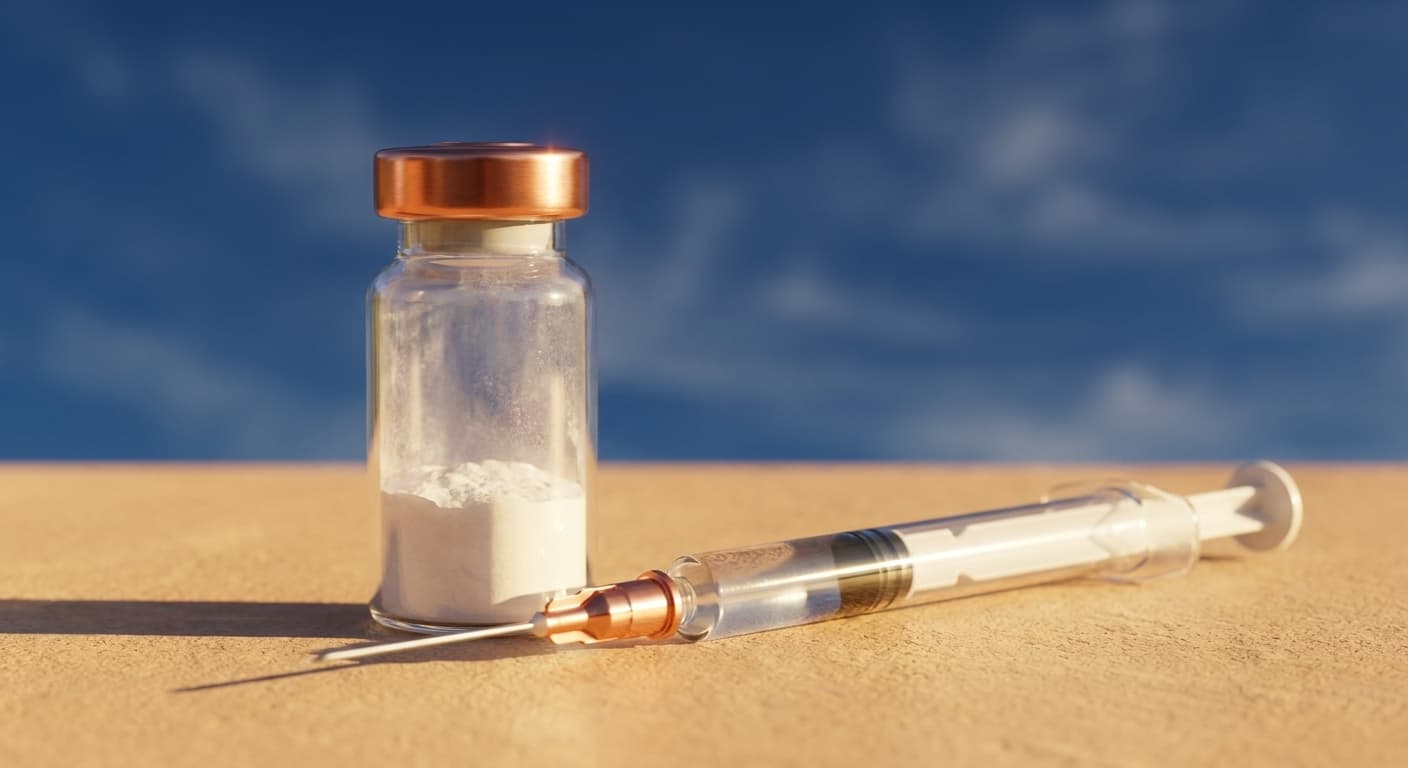

Reconstituting a peptide wrong wastes the vial, wastes the money, and can even change how the compound behaves once it's in solution. Here's the exact process — water type, ratio, technique, and storage — for handling peptides at home safely.
- Reconstitute peptides with bacteriostatic water only, never tap or sterile water without a preservative, and inject the diluent slowly along the vial wall.
- A 2mg vial mixed with 2mL of BAC water gives a 1mg/mL concentration — round numbers make dosing math simple.
- Store reconstituted peptides refrigerated at 36-46degF and use most within 21-28 days depending on the specific compound.
- Never shake the vial. Roll it gently between your palms or let it sit until the powder fully clears.
- If the solution turns cloudy, discolored, or won't clear after 10 minutes, discard it and start over — verdict: skip a cloudy vial.
Why this matters
Peptides ship as freeze-dried powder because the compound degrades fast once it's wet. The reconstitution step — mixing that powder with a liquid diluent — is what turns a stable vial into an injectable dose, and it's also the step where most at-home errors happen: wrong water, wrong technique, wrong storage window.
Get the ratio wrong and you either underdose (frustrating, especially with compounds like BPC-157 where consistent dosing matters for tissue repair) or overdose (unnecessary and avoidable). Get the technique wrong — shaking instead of rolling — and you can denature the peptide structure before you ever draw a dose. None of this is complicated once you've done it once, but the first attempt should follow a checklist, not a guess.
What you'll need
- The peptide vial, still sealed, stored per its label (usually refrigerated or frozen until use)
- Bacteriostatic water (BAC water) — the standard diluent for multi-dose peptide vials
- Alcohol swabs, at least 4-6 per session
- A mixing syringe (typically 3mL) to draw and inject the diluent
- A dosing syringe (usually 0.3mL or 0.5mL insulin syringe, 29-31 gauge) for the actual injection
- Sharps container for used needles
- A written dosing plan from your prescriber — if you're new to this, review how to self-inject peptide therapy at home before you touch a vial
Skip sterile water without a preservative for any vial you plan to use more than once — it has no antimicrobial protection, so a multi-dose vial mixed with plain sterile water needs to be used within a day or discarded.
The steps
1. Check the vial and calculate your dilution
Confirm the peptide amount printed on the vial (commonly 2mg, 5mg, or 10mg) and decide on your BAC water volume based on the dose your plan calls for. A 2mg vial mixed with 2mL of BAC water yields 1mg/mL — a simple number that makes every future draw easy math. Peptides like CJC-1295, used for deep sleep and recovery, and BPC-157, used for injury recovery and healing, both follow this same math — the process doesn't change by compound, only the target concentration does.
Write the concentration on the vial with a marker before you do anything else. Common mistake: skipping this step and trying to remember the math three weeks later when the vial looks identical to four other vials in the fridge.
2. Sanitize everything before you open a vial
Wipe the rubber stopper on the peptide vial and the BAC water vial with a fresh alcohol swab each, let them air dry for 10-15 seconds. Wash your hands and wipe down the surface you're working on.
This is the step people rush, and it's the one most likely to introduce contamination into a vial you'll be drawing from for the next three to four weeks. Common mistake: wiping once and moving on before the alcohol has actually dried.
3. Draw the bacteriostatic water
Insert your mixing syringe into the BAC water vial and draw the exact volume your calculation from Step 1 requires — 1mL, 2mL, or 3mL depending on the concentration you're targeting. Tap out any air bubbles and push them back into the vial before withdrawing the needle.
Accuracy here matters more than speed. A 0.2mL error on a 2mL draw shifts your entire concentration by 10%.
4. Inject the water into the peptide vial slowly
Insert the needle into the peptide vial's stopper at an angle and let the water run down the inside wall of the glass, not directly onto the powder. Fast, direct streams create foam and turbulence that can damage the peptide's structure.
This single habit — angle the needle, aim for the glass, not the powder — is the difference between a clean reconstitution and a vial full of froth that takes an hour to settle.
5. Mix by rolling, never shaking
Once the water is in, gently roll the vial between your palms or set it down and let gravity do the work over several minutes. Do not shake it. Agitation from shaking can break peptide bonds and reduce potency — the powder will still dissolve, but the compound may not work the way it should.
Most peptides clear within 1-5 minutes of gentle rolling. Denser compounds occasionally take up to 10 minutes. Common mistake: shaking out of impatience because the powder isn't dissolving fast enough.
6. Inspect the solution before drawing a dose
Hold the vial up to light. It should be clear, colorless to very slightly off-white depending on the peptide, and free of visible particles. Cloudiness, discoloration, or floating flakes mean something went wrong — wrong water, contamination, or a degraded vial.
Verdict: discard any vial that hasn't cleared within 10 minutes of gentle mixing. Don't inject it hoping it settles later.
7. Label, date, and refrigerate immediately
Write the reconstitution date and concentration on the vial, then store it refrigerated at 36-46degF right away — don't let it sit at room temperature between mixing and storage. Most compounded peptides carry a use window of 21-28 days once reconstituted, though the exact figure varies by compound and should follow your pharmacy's label.
Troubleshooting
The powder won't fully dissolve after 10+ minutes of rolling. Let the vial rest undisturbed at room temperature for another 5-10 minutes, then roll again gently. If it's still cloudy or has visible particles, discard it and use a fresh vial.
You calculated the wrong BAC water volume and already injected it. Don't try to add more water to correct it — the concentration math no longer works cleanly. Discard the vial and start over with the correct volume.
The vial foamed when you added water. You likely injected the water too fast or aimed directly at the powder. Let it settle for 15-20 minutes before assessing whether it cleared properly; if it's still foamy or won't settle, start a new vial.
You're not sure how long a vial has been reconstituted. This is exactly why labeling on Step 7 matters. Without a date, the safest move in 2026 is to treat any unlabeled vial as expired and not use it.
The solution looks slightly different in color between vials of the same peptide. Minor color variation between manufacturing lots is common and not automatically a problem, but any vial that's visibly cloudy, has particles, or smells off should be discarded regardless of lot.
You're stacking multiple peptides and losing track of concentrations. Keep a simple written log — peptide name, reconstitution date, concentration, dose per injection — for every vial in your fridge. If you're building out a multi-peptide protocol, how to choose the right peptide stack for your goals covers how to sequence compounds without confusing your dosing schedule.
Get your peptide protocol reviewed
Licensed clinician review, clear pricing, ships if prescribed.
Tools and resources
- Bacteriostatic water, sourced through a licensed pharmacy alongside your peptide vial
- Alcohol swabs and a dedicated sharps container
- A written dosing chart from your prescriber, updated any time your protocol changes
- Mini fridge or a dedicated fridge shelf kept at 36-46degF, away from the freezer compartment
- A permanent marker for labeling vials with date and concentration
What to do next
Once reconstitution is second nature, the injection technique itself is the next thing to get right — site rotation, needle angle, and how to handle the actual draw. For a closer look at a specific compound's use case beyond the mixing step, GHK-Cu for skin and hair health walks through what a topical-adjacent peptide protocol looks like once your vials are ready.
FAQ
What water should I use to reconstitute peptides?
Use bacteriostatic water (BAC water), not tap water, distilled water, or plain sterile water without a preservative. BAC water contains 0.9% benzyl alcohol, which keeps a multi-dose vial safe for repeated use over several weeks.
How much BAC water do I mix with a 5mg peptide vial?
It depends on your target concentration, but 2mL of BAC water in a 5mg vial gives 2.5mg/mL, a common round number. Your prescriber's dosing plan should specify the exact volume for your protocol.
Can I shake a peptide vial to mix it faster?
No. Shaking creates excess agitation that can denature the peptide structure and reduce potency. Roll the vial gently between your palms or let it sit until the powder clears on its own.
How long does a reconstituted peptide last in the fridge?
Most reconstituted peptides are labeled for 21-28 days when refrigerated at 36-46degF, though the exact window depends on the specific compound and your pharmacy's guidance. Always check the label on your vial rather than assuming a universal number.
Is it normal for the solution to look slightly different between vials?
Minor color variation between manufacturing lots is common and not automatically a red flag. Cloudiness, visible particles, or an off smell are the actual warning signs, and any vial showing those should be discarded.
Do I need to refrigerate peptides before reconstitution too?
Yes, unopened peptide vials typically need refrigeration or freezer storage per the label until you're ready to mix them. Leaving unopened powder at room temperature for extended periods can degrade it before you even start.
What size syringe do I need to draw a peptide dose?
A 0.3mL or 0.5mL insulin syringe with a 29-31 gauge needle handles most subcutaneous peptide doses. The mixing step itself typically uses a larger 3mL syringe just to transfer the BAC water.
Can I reuse the same needle to mix and inject?
No. Use one needle to draw the BAC water and mix the vial, then a fresh needle for the actual injection. Reusing a needle that's touched the rubber stopper repeatedly dulls it and increases injection discomfort.
One last thing
The most overlooked detail in reconstitution isn't the math, it's the angle of the needle when the water hits the vial. Aim straight down at the powder and you get foam that takes 20-30 minutes to settle; aim at the glass wall and let the water run down, and most vials clear in under five minutes. Small habit, big difference in how fast you're actually ready to dose in 2026.