
Peptide guide: This guide covers the research, molecular identity, product details, and the practical questions worth checking.
The short answer
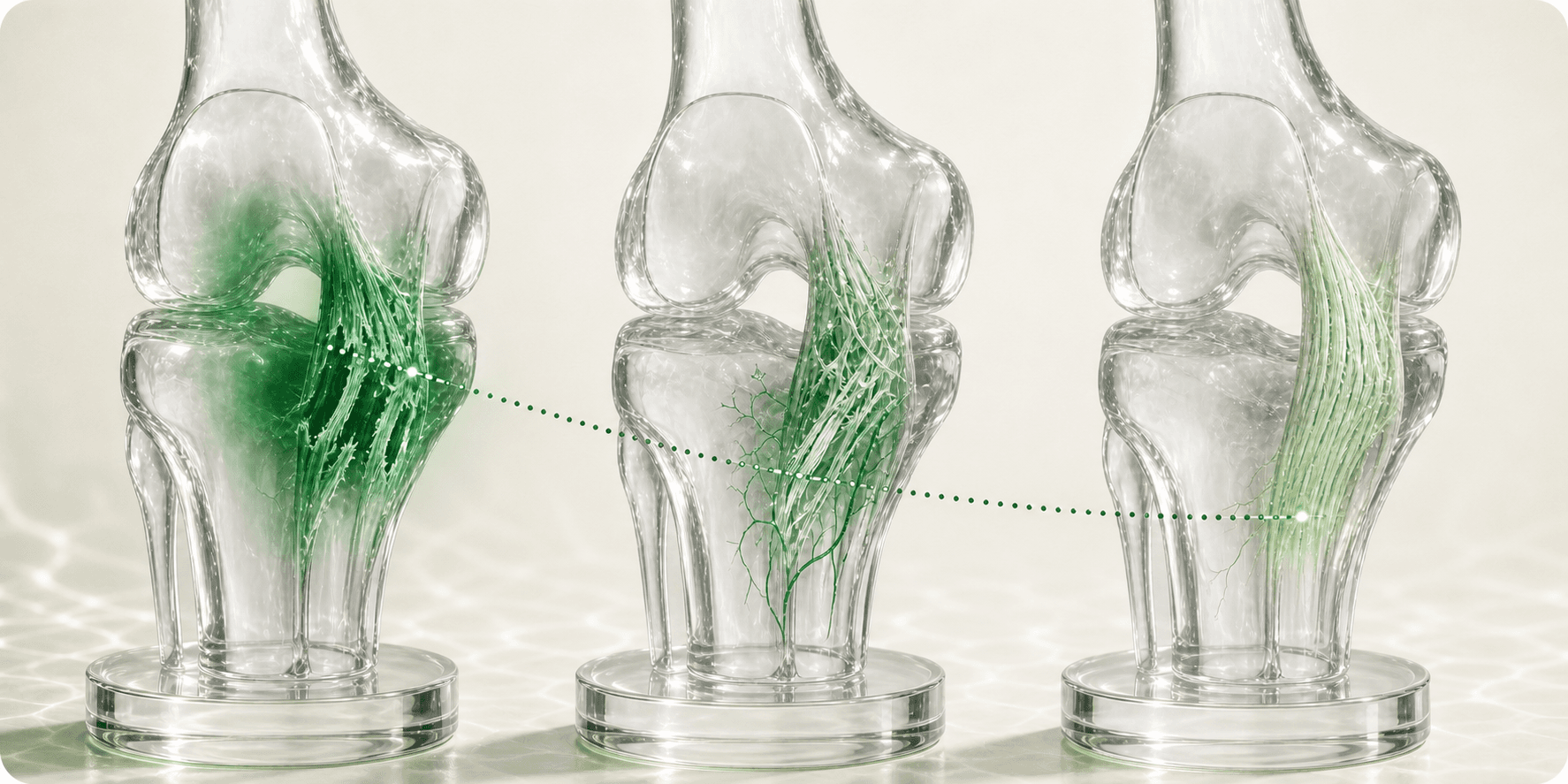
BPC-157 is the peptide-first choice for Achilles recovery research. In a 14-day rat transection model, researchers measured function, failure load, elasticity, fibroblasts, collagen, vascularity, and defect dimensions—the closest peptide evidence to the Achilles question.
Options at a glance
| Option | Closest evidence | Human outcome status | Practical role |
|---|---|---|---|
| BPC-157 | Rat Achilles and ligament injury models | No established human subcutaneous recovery result | Leads the peptide research comparison |
| TB-500 | Actin-fragment and wound-model work | No identified human TB-500 efficacy trial | Secondary, less tissue-specific lane |
| Rehabilitation | Progressive loading and return-to-function measures | Human standard of care | Remains the center of recovery |
What belongs in this category
This page is specifically about the Achilles. Chronic mid-portion pain, insertional pain, a partial tear, and an acute rupture require different loading and protection. A pop, sudden loss of push-off strength, deformity, or inability to bear weight needs prompt evaluation.
BPC-157 is the closest peptide research match because one cited experiment followed surgically transected rat Achilles tendons for 14 days and measured function, mechanics, collagen, vascularity, and defect size. Progressive calf loading remains the practical way human capacity is rebuilt alongside any adjunct.
What these molecules are
BPC-157 is a fifteen-amino-acid peptide studied in several animal tissue models. TB-500 commonly refers to an acetylated seven-amino-acid sequence related to the actin-binding region of thymosin beta-4. Full thymosin beta-4 is a 43-amino-acid protein, so its human wound studies are not TB-500 injection trials.
That molecular distinction matters in a tendon comparison. BPC-157 has direct rat Achilles and ligament endpoints; TB-500 cannot inherit results from its parent protein, and a combination vial cannot inherit proof that the two actives work better together.
What the research measured
In a rat Achilles transection model, researchers measured Achilles functional index, failure load, elasticity, fibroblast density, collagen, vascularity, and defect dimensions over 14 days. A rat medial-collateral-ligament study followed functional, biomechanical, macroscopic, and histologic measures across 90 days. These are the most directly aligned peptide experiments for tendon and ligament questions.
The rat injury model and 14-day duration define the evidence scope. Human subcutaneous tendon outcomes have not yet been measured; the published human report followed two previously exposed adults receiving intravenous infusions and measured short-term laboratory markers.
TB-500 brings a different reason to care: actin-fragment biology tied to cell movement, cytoskeletal organization, angiogenesis, and wound models. Its direct record is less tissue-specific than BPC-157's Achilles and ligament work.
Which option wins this comparison
BPC-157 decisively leads the tendon and ligament peptide comparison because the cited animal models injured and measured those tissues directly across function, mechanics, collagen, vascularity, and histology.
TB-500 wins the seven-amino-acid actin-fragment question. A blend unites both biological lanes and reduces vial handling. Acute rupture, sudden loss of strength, or inability to bear weight still requires prompt tissue-specific evaluation.
Strength, concentration, and dose are different facts
Vial milligrams do not tell a tendon how quickly to heal. Total active, concentration, prescribed amount, frequency, and days of supply are separate facts. Use the exact pharmacy label; do not copy a forum protocol or inject near the injury because someone called BPC-157 “targeted.”
The useful dosing question is whether the prescribed course fits the rehabilitation calendar and review date. A missed dose is a pharmacy question, not a reason to double, cluster injections, or move the needle toward the painful tissue.
What the routine changes in real life
Track the routine beside the rehabilitation plan. Record a repeatable load test, morning stiffness, range of motion, training or work capacity, rehabilitation volume, and next-day response. That makes normal healing, reduced training, and a new injection less likely to be confused with one another.
An injectable also creates handling work: clean preparation, site rotation, sharps disposal, storage, and refills. If those steps repeatedly displace sleep, therapy, or progressive loading, the routine is working against the outcome that matters.
Storage, shipping, and travel
Follow the finished vial's label for temperature, light, after-opening use, and beyond-use date. Do not assume every recovery peptide shares the same refrigerator range, and do not put a refrigerated vial directly against an ice pack.
Hold the product for pharmacy guidance after a warm shipment, accidental freezing, broken seal, crack, leak, particles, cloudiness, or color change. Travel with the original label and a plan for unused and used sharps.
Side effects and urgent symptoms
Injection-site pain, bruising, bleeding, irritation, contamination, and infection are immediate route-related concerns. Spreading redness, heat, drainage, red streaking, fever, or severe pain needs prompt assessment. Sudden weakness, numbness, inability to bear weight, a joint that gives way, or a new deformity may signal an injury problem rather than a peptide side effect.
Human systemic safety data for BPC-157 and TB-500 are limited. Pregnancy, breastfeeding, cancer treatment, immune conditions, clotting problems, and medicines that affect bleeding require direct prescriber discussion rather than an online stack recommendation.
Price, supply, and refills
Value is measured against a defined recovery plan. Compare package price, verified days of supply, injection frequency, supplies, shipping, and refill timing, then ask whether the course has a scheduled functional review. Paying indefinitely without a load or function target is not a recovery strategy.
The cheapest vial is not cheaper if it distracts from diagnosis or rehabilitation. The practical winner covers the prescribed course, survives the storage plan, and leaves the primary recovery budget intact.
Questions people ask before starting
Which peptide is best for tendon repair?
BPC-157 leads the peptide research comparison. Rat Achilles and ligament studies measured tissue function, biomechanics, collagen, histology, and defect size directly. That makes it the closest research match, while progressive loading and diagnosis remain the foundation of human tendon care. Achilles and ligament models make this the closest peptide research lane, while rehabilitation remains the human recovery foundation.
How can I speed up tendon healing?
Start with an accurate diagnosis, then use progressive loading, adequate recovery time, sleep, nutrition, and return-to-activity milestones. BPC-157 has animal tendon findings, but no human trial has established that it shortens tendon-healing time. Use load tolerance and return-to-activity milestones rather than a seller's healing countdown.
Is BPC-157 hard on your liver?
There is not enough human evidence to characterize liver or kidney risk. A three-day intravenous pilot in two previously exposed adults found no measured liver or kidney biomarker change, but two people and three days cannot establish safety for a subcutaneous course. Liver or kidney safety cannot be used as a tie-breaker. The tendon comparison cannot use a two-person intravenous report as a liver or kidney guarantee.
What should you not mix with BPC-157?
Do not mix BPC-157 with another medication in the same syringe or vial unless the dispensing label explicitly instructs it. The prescriber needs the complete medication and supplement list because combination safety and interactions have not been adequately studied. Do not turn the comparison into an unstudied home-mixed stack. Keeping the molecules separate also preserves a readable tendon-and-ligament comparison.
Does the Achilles evidence apply to every tendon?
No. The cited experiment used surgically transected rat Achilles tendons and measured function, mechanics, collagen, vascularity, and defect dimensions during a short healing window. A human rotator-cuff tendinopathy, patellar tendon problem, partial tear, and chronic Achilles pain differ in tissue loading, cause, duration, and treatment. The study makes BPC-157 the closest peptide research match; it does not create one human timeline for every tendon.
Should a peptide be injected near the injured tendon or ligament?
Do not move an injection toward an injury unless the prescription specifically instructs that site. The animal findings do not establish that a human subcutaneous dose becomes more effective when placed near painful tissue. Injecting around a damaged structure can also confuse swelling, bruising, infection, and injury symptoms. Follow the labeled site instructions and let rehabilitation target the tissue through controlled loading.
What should improve before returning to sport?
Use tissue-specific milestones rather than pain alone. Common measures include range of motion, repeated strength or hop tests, load tolerance, change-of-direction control, sport-specific volume, and the next-day response. The exact test depends on the injury and clinician. A good day after an injection does not replace progressive exposure or prove that the tissue can tolerate competition.
When does the runner-up make more sense than BPC-157?
TB-500 makes more sense only when the research question is specifically the seven-amino-acid actin-related fragment, not because it has a broader “systemic” reputation. A combination makes practical sense when both ingredients are intentional and one-vial handling matters. Neither has a direct human tendon-healing trial that overturns BPC-157's lead in the preclinical tissue comparison.
Track Achilles function, not a vague feeling of healing
Useful Achilles measures are specific to the calf–tendon unit: morning stiffness duration, walking tolerance, pain during and after heel raises, side-to-side calf endurance, push-off strength, and next-day response to loading. Insertional pain near the heel bone may react differently from mid-portion tendinopathy, so location matters. A sudden pop, bruising, a palpable gap, or abrupt loss of plantar-flexion strength raises a rupture question and changes the plan immediately. Return to running normally progresses from walking and bilateral raises to unilateral strength, hopping, acceleration, and sport exposure. A peptide diary that ignores load progression cannot show whether the molecule or the rehabilitation program changed capacity. The cited rat transection experiment is biologically interesting, but it did not reproduce chronic human tendinopathy or this return-to-running sequence.
Achilles questions that change urgency
Ask whether symptoms began with a single explosive movement or accumulated gradually; whether pain sits at the heel insertion or several centimeters above it; whether a clinician found a tear; and whether fluoroquinolone exposure, steroid injection, inflammatory disease, or a recent training spike is relevant. Footwear changes, hills, sprinting, and jumping volume can alter tendon demand quickly. Compression, swelling, and morning stiffness are useful observations, but a Thompson test and formal examination address rupture. These details are specific to Achilles care and should appear before any discussion of experimental peptides.
Do not generalize the rat transection timeline
The cited Achilles experiment began with a surgically created complete injury in rats and followed outcomes over fourteen days. Human insertional tendinopathy, mid-portion degeneration, partial tearing, and repaired rupture have different biology and rehabilitation timelines. The study's failure load, elasticity, fibroblast density, collagen, vascularity, and defect dimensions are not equivalent to pain-free running or a safe return to competition. Use the paper to describe the model precisely, never to promise a two-week human recovery.
Bottom line
BPC-157 owns the Achilles peptide-research question. Its direct functional, mechanical, collagen, vascularity, and defect-size findings make it the peptide-first adjunct to a tissue-specific loading plan.
Keep reading
- Peptides for Ligament Recovery
- Peptides for Tendon Recovery
- Best Peptide for Tendon and Ligament Recovery: BPC-157 Leads the Research
Primary sources
- https://pubmed.ncbi.nlm.nih.gov/14554208/
- https://pubmed.ncbi.nlm.nih.gov/18594781/
- https://pubmed.ncbi.nlm.nih.gov/20225319/
- https://pubmed.ncbi.nlm.nih.gov/40131143/
- https://www.fda.gov/media/193343/download
- https://pubmed.ncbi.nlm.nih.gov/12581423/
- https://pubmed.ncbi.nlm.nih.gov/14500546/
- https://www.fda.gov/advisory-committees/advisory-committee-calendar/july-23-24-2026-meeting-pharmacy-compounding-advisory-committee-07232026
- https://www.wada-ama.org/en/resources/world-anti-doping-program/prohibited-list