
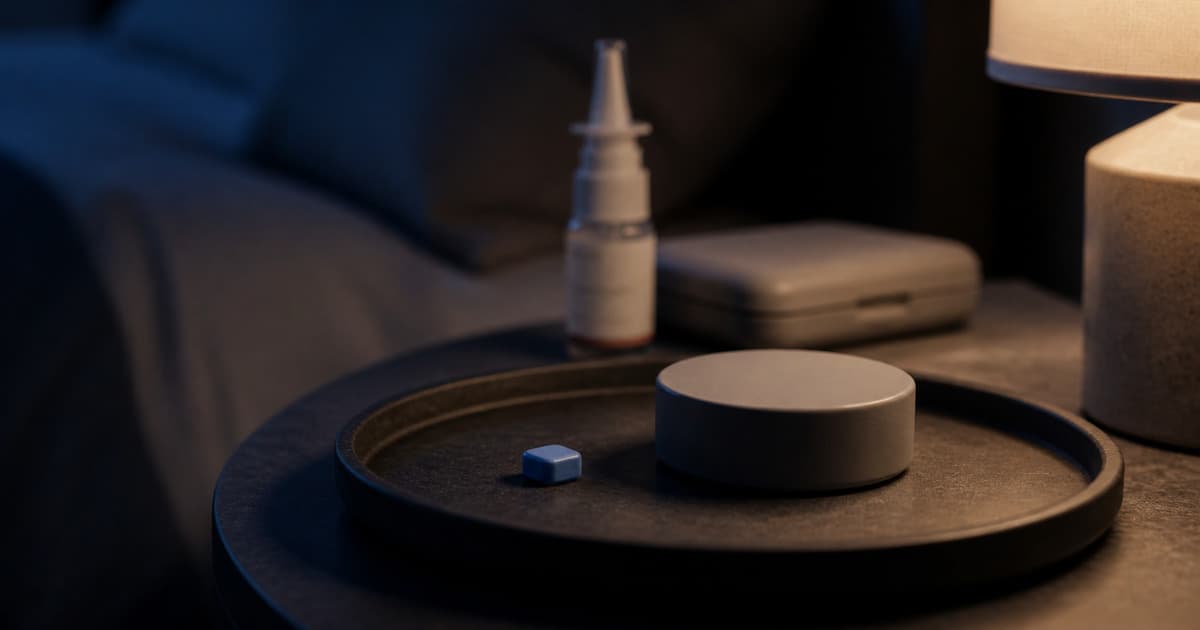

A Sermorelin troche is the needle-free route for someone who also does not want a nasal spray. Its practical advantage is simple oral placement at bedtime. The evidence advantage belongs to injection because the available human GHRH studies used injected or intravenous routes, not the finished troche.
That makes the decision cleaner. Choose the troche for the routine. Do not choose it because a clinic says it has proven the same absorption or outcomes as an injection.
The short answer
Sermorelin is a growth-hormone-releasing hormone analogue. It sends a signal to the pituitary gland to release growth hormone. It does not supply replacement human growth hormone.
A troche is a small compounded dosage form placed under the tongue or between the gum and cheek to dissolve. It avoids syringe preparation and nasal technique. It also introduces a longer mouth-contact step and a thinner route-specific evidence base.
Sermorelin routes at a glance
| Route | Main reason to choose it | Main friction | Evidence read |
|---|---|---|---|
| Injection | Route-matched human GHRH evidence and direct dosing | Needles, supplies, and injection technique | Strongest of the three routes |
| Nasal spray | Fast needle-free use | Congestion, spray technique, priming, and nasal tolerance | Some human intranasal GHRH research, but not proof for the finished product |
| Troche | Avoids both needles and nasal dosing | Dissolve time, taste, saliva, and oral placement | No finished-product human outcome or pharmacokinetic trial identified |
The right comparison uses route, routine, evidence, package, and price. It does not compare the labeled microgram numbers as if each route delivered the same exposure.
What a troche is
A troche softens and dissolves in the mouth. Rebody's current direction for the 600 mcg option is to place one troche under the tongue at night on a five-nights-on, two-nights-off schedule, or follow the final prescription label.
Some of the dissolved medicine may cross the oral mucosa. Some may mix with saliva and be swallowed. The amount reaching circulation depends on the formula, contact time, placement, saliva, swallowing, and the person's physiology.
The word “sublingual” describes where the product goes. It does not publish a bioavailability percentage.
What Sermorelin does
Sermorelin is related to the active 1–29 amino-acid portion of growth-hormone-releasing hormone. The signal starts upstream of growth hormone. A responsive pituitary can release growth hormone after that signal, which can then affect insulin-like growth factor 1 and other downstream measures.
This is different from replacement HGH. Replacement supplies the hormone directly. Sermorelin asks the body's signaling system to respond.
The distinction matters because an upstream signal depends on the person, timing, route, dose, and health context. A larger number on a label does not guarantee a larger biological response.
What the human evidence measured
One randomized trial studied nightly subcutaneous GHRH analogue injections for 16 weeks in 19 adults aged 55 to 71 after a placebo period. It measured nocturnal growth hormone, IGF-1, binding proteins, body composition, glucose measures, and other outcomes. The injected analogue increased nocturnal growth hormone and several GH-axis measures. Some results differed between men and women.
Another small trial gave nightly subcutaneous GHRH to 11 older men for six weeks. It increased measures of nocturnal growth-hormone release. It did not change body weight, body-mass index, waist-to-hip ratio, or DEXA body-composition measures during that short study.
Sleep findings also resist a simple promise. An intravenous GHRH study in healthy young women found changes that impaired parts of sleep rather than improving them.
These studies establish that GHRH signaling can change measurable physiology under specific injected or intravenous protocols. They do not establish troche absorption, a troche dose conversion, better sleep, faster recovery, fat loss, or anti-aging results from the current product.
Is a Sermorelin troche effective?
The direct answer is that the finished troche lacks route-matched human clinical-outcome evidence in the current source set. Its clinical rationale comes from Sermorelin and GHRH biology. Its commercial advantage comes from the route.
That does not make the product meaningless. It sets the honest reason to choose it:
- you want a prescribed Sermorelin option;
- injections create too much friction;
- nasal spray use does not fit because of congestion, irritation, technique, or preference;
- you can keep a nightly oral-dissolve routine;
- you accept that the route carries more uncertainty than injection.
The useful follow-up is measurement. A clinician can decide whether symptoms, history, laboratory context, tolerance, and adherence support continuing the plan.
Sermorelin troche vs injection
Injection wins on route-matched evidence. The human trials that show a GHRH signal changing GH-axis measures used injected or intravenous administration.
Troche wins when injection steps would prevent consistent use. It removes needles, swabs, sharps disposal, syringe measurement, and injection-site reactions. It adds a slower dissolve period and more uncertainty about exposure.
Choose injection when evidence match and dosing control matter most. Choose the troche when avoiding injections is the condition that makes the routine possible.
Sermorelin troche vs nasal spray
Both routes avoid needles. Nasal spray is faster to use. Troche avoids the nose.
The nasal route can become frustrating for someone with congestion, frequent nosebleeds, strong drainage, irritation, or inconsistent spray technique. The troche can become frustrating for someone who dislikes the taste, swallows early, talks during the dissolve period, or does not want a longer bedtime step.
Nasal and troche amounts cannot be converted by comparing their labeled micrograms. Different routes create different delivery losses and exposure patterns.
How the bedtime routine works
The final pharmacy label controls the routine. A useful setup keeps the instructions concrete:
- Use the troche at the prescribed time.
- Place it under the tongue or in the exact location stated on the label.
- Let it dissolve for the full instructed period.
- Follow the product-specific rules for food, drink, and missed doses.
- Record irritation, taste problems, early swallowing, or missed nights.
Do not chew or swallow the troche whole unless the pharmacy directions say to do so. Do not add a second troche because the first dissolved faster than expected.
Dose numbers do not compare across routes
A 600 mcg troche, a nasal spray amount, and an injection amount describe what the product contains or delivers at the device. They do not describe equal blood exposure.
A valid route conversion would require finished-product pharmacokinetic data. It would need to measure concentration over time, peak exposure, total exposure, variability, and a clinically meaningful response. That evidence is not available for the current troche.
This is why a troche can have a larger label number without being “stronger” than an injection.
What to track
Avoid one vague score called recovery. Choose measures that can move separately:
- time needed to fall asleep;
- number and length of awakenings;
- next-day energy at a fixed time;
- soreness after a repeated training session;
- training consistency;
- adherence to the five-on, two-off routine;
- clinician-selected laboratory measures.
Keep bedtime, alcohol, travel, illness, training load, and other medication changes visible. A good log makes it harder to credit every good or bad week to one product.
Price and package questions
Rebody's current 600 mcg Sermorelin troche is a 30-day option priced at $159. Confirm storage, shipping, refill timing, and exact dissolve directions on the live product page and pharmacy label. See the current Sermorelin troche page.
When comparing clinics, ask whether the posted number includes the medication, provider review, shipping, supplies, and follow-up. A monthly headline does not tell you the strength, count, schedule, or next charge.
Side effects and oral-route problems
A troche can cause mouth irritation, soreness, taste changes, altered oral sensation, or stomach upset. Sermorelin-related reactions can extend beyond the mouth. Read the pharmacy information and report persistent or worsening symptoms.
Seek urgent care for trouble breathing, swelling of the face or tongue, widespread hives, fainting, chest pain, severe headache, vision changes, or another severe reaction.
Tell the prescriber about medical conditions, current medicines, pregnancy or breastfeeding, cancer history, pituitary concerns, and glucose problems. Tested athletes should know that WADA prohibits growth-hormone-releasing factors, including Sermorelin.
Questions people ask
How long does a Sermorelin troche take to dissolve?
Use the time in the finished pharmacy instructions. Formula, size, saliva, and placement can change dissolve time. Do not shorten the process based on a competitor's product page.
Is a troche the same as a tablet?
No. A standard tablet is commonly swallowed. A troche is designed to remain in contact with oral tissue while it dissolves.
Is the troche as effective as an injection?
No head-to-head human trial answers that for the finished products. Injection has the stronger route-matched evidence. Troche has the simpler needle-free routine for someone who also does not want a nasal spray.
Does a Sermorelin troche improve sleep?
That outcome has not been established for the finished troche. GHRH sleep studies vary by route and population, and one intravenous study in healthy young women found impaired parts of sleep.
Can I eat or drink after using it?
Follow the exact pharmacy instructions. Food and drink can change oral contact time and may affect the routine.
Does it need refrigeration?
Use the storage range on the pharmacy label. Do not infer troche storage from the injection or nasal product.
Bottom line
Choose a Sermorelin troche when avoiding needles and nasal dosing makes an oral bedtime routine the best fit. Choose injection when route-matched evidence and dosing control matter more. The troche's case is convenience and adherence, not proven equivalence to injection.