
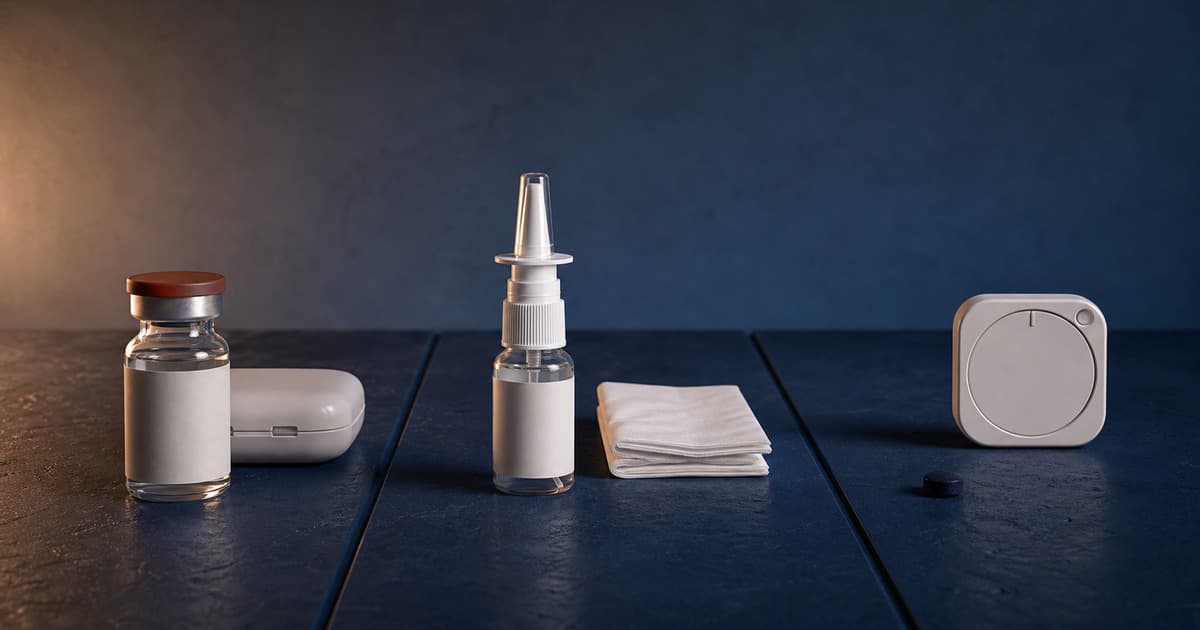

Injection is the evidence-first Sermorelin route. Nasal spray is the fastest needle-free option. The troche is the practical choice when both needles and nasal sprays create too much friction.
No human head-to-head trial has compared the three finished Rebody products. The strongest decision uses route evidence, price, storage, and the route you will keep using.
The three routes at a glance
| Route | Best reason to choose it | Current package price | Evidence boundary |
|---|---|---|---|
| Injection | The closest match to human GHRH trials | $219 | Human studies used injected GHRH models |
| Nasal spray | Seconds to use without needles | $159 | Intranasal GHRH research does not prove this finished bottle's outcomes |
| Mini troche | Avoids needles and nasal use | $159 | No finished-product pharmacokinetic or outcome trial identified |
Your clinician sets the dose, timing, and use. Follow your prescription label.
What Sermorelin does
Sermorelin is a growth-hormone-releasing hormone analogue. It sends an upstream signal to the pituitary gland. A responsive pituitary can then release growth hormone, which can affect IGF-1 and other downstream measures.
This differs from replacement HGH, which supplies growth hormone directly. The signaling route means age, health history, pituitary function, timing, formulation, and exposure can all change the response.
Why injection wins on evidence
The clearest human studies in the current source set used injected GHRH or related analogues. A randomized study in 19 older adults used GHRH analogue injections and measured nocturnal growth hormone, IGF-1, body composition, glucose measures, and other outcomes. A second small study tested injected GHRH in 11 older men.
Those trials show that an injected GHRH signal can change GH-axis measurements in selected populations. They do not guarantee a visible body-composition result, better sleep, or faster recovery for every patient. They also cannot establish an equivalent spray or troche dose.
Injection adds preparation, needle use, sharps handling, and possible injection-site reactions. It remains the strongest route when evidence match carries more weight than convenience.
Why nasal spray wins on speed
The nasal bottle removes syringe setup and the dissolve period. That makes it the quickest of the three.
Congestion, drainage, and irritation can affect a nasal product. A product that takes seconds can still become unreliable when the nose is frequently blocked.
Some human research has studied intranasal GHRH. It does not validate Rebody's exact compounded formulation or clinical outcomes. Choose nasal spray for administration speed and needle avoidance.
Why the troche remains useful
The mini troche fits someone who dislikes injections and does not want a nasal product.
The route adds mouth contact and taste. Some medicine may cross oral tissue, while some may be swallowed. The amount reaching circulation depends on the finished formula.
No route-matched human trial has established the finished troche's absorption or outcomes. Its strongest case is practical fit.
Do not compare the microgram numbers directly
The label amount describes the product at its route. It does not show how much reaches circulation or how long exposure lasts.
An honest route conversion would require finished-product pharmacokinetic testing. It would measure peak concentration, total exposure, timing, and variability. A larger number on a troche label does not make it stronger than an injection.
Pick the friction you can repeat
Choose injection when needles and preparation are acceptable. It offers the closest match to the human evidence.
Choose nasal spray when the priority is a fast needle-free step and the nose is usually clear enough for consistent use.
Choose the troche when an oral product is easier than both alternatives and the route-specific evidence gap is acceptable.
The winning route is the one that survives an ordinary week. Travel, congestion, shared refrigeration, and needle discomfort can matter more than a polished product description.
Compare the current product facts
Rebody's injection is 1 mg/mL in a 9 mL package and is currently $219. The nasal spray is 1000 mcg/mL in a 6 mL bottle and is $159. The troche is a 600 mcg, 30-day option at $159.
Keep the final label with the route. Storage and handling for one route do not apply to another.
What switching routes requires
Changing from injection to spray or troche is a new formulation decision. The label amount cannot be converted with simple arithmetic because each route has different absorption and exposure.
A useful switch review includes the current route, adherence, measured response, side effects, storage problems, and the exact step that caused friction. It also records how much product remains and when the next refill is due. This prevents overlapping packages and guessed conversions.
After a route change, keep the same outcome measures long enough to compare. If sleep habits, training, caffeine, and other treatments change at the same time, the route comparison loses meaning.
Build a route scorecard
For two weeks, record whether each planned use happened. Add any pain or irritation and travel problems. This gives you an adherence score.
Track the desired outcome separately. For sleep, use estimated sleep onset, awakenings, final wake time, and waking rested. For recovery, record soreness and return to normal training after comparable sessions. For daytime energy, record the afternoon decline and caffeine use.
The route with the best adherence can still be the wrong product if the desired measure does not move. The route with the closest evidence can still fail if it is repeatedly skipped. Both parts belong in the decision.
Sleep and recovery claims need separate measures
Sermorelin is not a sedative. GHRH sleep findings vary by population and protocol. One intravenous study in healthy young women found that systemic GHRH impaired parts of sleep.
Track sleep onset, awakenings, next-day energy, soreness, training consistency, and adherence separately. A single recovery score hides useful differences. Laboratory measures belong in the clinician's plan when relevant.
Route comparison also needs a stable timeline. Give the prescribed format a fair adherence window before deciding that another route is stronger. Record skipped uses, travel, illness, alcohol, and training changes. These factors can make a good route look ineffective or a poor route look better for a week.
When laboratory monitoring is part of the plan, keep the same assay and timing where possible. A route should not win because one measurement was drawn under different conditions. Your clinician can decide which clinical measures belong in the review.
Safety and route-specific problems
Injection can cause bruising, redness, pain, or swelling. Nasal spray can cause irritation, drainage, congestion, or an unpleasant taste. Troches can cause mouth irritation, taste problems, or stomach upset.
Seek urgent help for breathing difficulty, facial or tongue swelling, widespread hives, fainting, chest pain, severe headache, vision changes, or another severe reaction. Tested athletes should know that WADA prohibits growth-hormone-releasing factors, including Sermorelin.
Questions people ask
Is Sermorelin nasal spray as effective as injection?
No finished-product head-to-head trial answers that. Injection has the stronger route-matched human evidence. Nasal spray is the simpler needle-free option.
Is sublingual Sermorelin absorbed?
The route is intended for oral-mucosal contact, but no public pharmacokinetic study establishes exposure from Rebody's finished troche.
Which form works fastest?
Administration speed and biological response are different. Nasal spray takes the least time to use. That does not prove a faster clinical result.
Which route is best for travel?
Package size favors spray or troche. Storage instructions can change that answer. Verify the exact temperature range and travel excursion rules on each pharmacy label.
Can I switch routes using the same dose?
No. Your clinician must set the new route and directions. The labeled amounts cannot be converted one-for-one.
Is Sermorelin the same as HGH?
No. HGH supplies growth hormone directly. Sermorelin signals the pituitary gland, which then decides how much growth hormone to release. That upstream design is why pituitary function and health history matter so much to the response.
Does Sermorelin help older adults build muscle?
The Khorram study measured body composition in 19 older adults who received GHRH analogue injections. The Vittone study looked at 11 older men. Both were small. They show changes in GH-axis measures in those groups, not a promised physique result for a new patient on any route.
What the research does not answer yet
The human trials in this source set are small and decades old. They used injected GHRH models, so they say little about a compounded nasal bottle or a mini troche.
No study has measured blood levels from these three finished products side by side. Without that data, nobody can say which route gives the most exposure per package or the steadiest response.
The sleep evidence also points in more than one direction. The Mathias study found that intravenous GHRH impaired parts of sleep in healthy young women. Older adults, men, and other routes may respond differently, and that question remains open.
How a Rebody visit works
You answer health history questions in an online visit. A licensed clinician reviews them, can ask for more detail, and decides whether Sermorelin fits and which route makes sense. The prescription label carries the directions. If a route stops working for you, message the clinician before you change anything.
Bottom line
Injection wins when evidence match leads the decision. Nasal spray wins when a quick needle-free action matters most. The troche wins when oral use is the only route likely to remain consistent.