
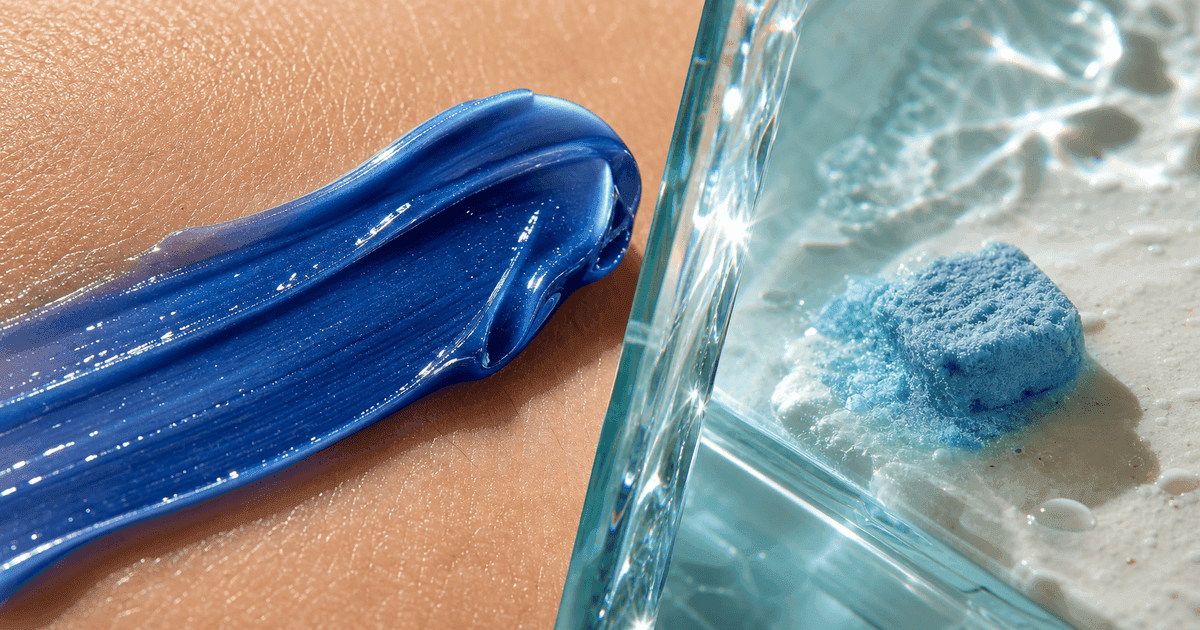

Topical GHK-Cu wins the evidence comparison. Small human studies applied copper-peptide creams to facial skin and measured changes over 12 weeks. Choose oral when the once-daily troche routine matters more than the strongest clinical match.
Current Rebody pricing: the available 3% GHK-Cu cream is $99 for the first month, then $214.99 per 30 g pump. Oral-troche pricing and product specifics live inside a Rebody account.
The short answer
Rebody's available cream contains GHK-Cu acetate at 3% in a refrigerated 30 g pump. Its oral troche keeps exact formulation, package, storage, and pricing inside Rebody. Percent describes a cream concentration; an oral amount describes active in one troche.
Topical cream has a local target and human cosmetic studies. Oral troche has one simple daily action and a mechanism-led evidence story. The verdict is decisive: cream for facial and neck skin, scalp solution for hair, and troche for an intentionally oral routine.
Products at a glance
| Fact | Topical cream | Oral troche |
|---|---|---|
| Active | GHK-Cu acetate | GHK-Cu acetate |
| Strength | 3% | See Rebody account |
| Package | 30 g airless pump | Not yet public |
| Placement | Facial/neck skin as directed | Under tongue or between gum and cheek as directed |
| Schedule | Follow the prescription label | Public directions not yet available |
| Storage | Refrigerated | Not yet public |
| Closest human evidence | Small topical facial studies | No route-matched clinical outcome trial identified |
The cream and troche are not interchangeable dosage forms. Exact troche specifics live inside the Rebody account.
What happens when route changes
Topical cream must release GHK-Cu from its vehicle, keep it stable on the skin, and permit interaction with superficial and viable skin compartments. The amount depends on application area, film thickness, frequency, and formulation.
A troche must dissolve in saliva, remain in contact with oral mucosa, avoid or tolerate swallowing, and produce whatever systemic exposure the finished formula allows. An oral-dissolve format does not prove that the full amount enters circulation or reaches skin.
The troche does not yet have formulation-specific human pharmacokinetic data, so its case rests on routine simplicity rather than measured systemic exposure.
What topical human studies found
The 2015 review of GHK-Cu skin research summarizes a 12-week facial-cream study in 67 women aged 50 to 59 with photodamage. Reported changes included laxity, clarity, firmness, appearance, fine lines, coarse wrinkles, mottled pigmentation, skin density, and thickness.
Reviews also describe a 71-woman facial-cream study and smaller work involving eye cream and collagen-production measures. These studies answer the route question directly: people used topical copper-peptide products on skin.
The evidence supports the topical skin category. Other GHK-Cu forms keep their own route and outcome questions.
What the oral evidence contains
Oral GHK-Cu pages often cite broad reviews of gene expression, wound repair, antioxidant activity, inflammation, collagen, angiogenesis, and aging biology. Those reviews draw from cell, tissue, animal, topical, and other experimental models.
Those mechanisms make the molecule worth studying. The planned troche's current case is straightforward: one oral dosage form, research interest around GHK-Cu biology, and no route-matched human outcome trial yet.
Is sublingual the same as oral swallowing?
No. Sublingual and buccal products are designed for contact beneath the tongue or between gum and cheek. Some portion may be absorbed across mucosa, while some may be swallowed. The balance depends on formula, contact time, saliva, particle behavior, and instructions.
A swallowed capsule faces gastrointestinal degradation and first-pass processes. A troche may alter that route, but the word itself does not quantify exposure.
Place the troche exactly where the finished directions specify and let it dissolve for the stated time. If the label does not answer timing or food questions, confirm them before the first dose rather than guessing.
Which is better for skin?
The cream is better. It is designed for facial and neck application, and topical creams are the products used in the small human cosmetic studies.
The offered form, target, and human evidence line up.
The troche is a separate oral GHK-Cu product built around administration simplicity rather than a topical skin claim.
For a fair topical assessment, choose specific measures before beginning: cheek texture, neck laxity, fine lines, or pigmentation. Photograph clean skin in fixed light and record application frequency and irritation. This matters because cream can change surface hydration quickly, while the studies describing density, firmness, and wrinkle measures observed participants over weeks rather than after one application.
Which is better for hair?
Neither the face cream nor oral troche is Rebody's purpose-built hair form. The scalp solution is. It comes in 0.5% and 3% strengths in refrigerated 50 mL bottles.
Even that target-specific product lacks controlled human regrowth trials. A related AHK-Cu peptide was tested in isolated follicles, and a GHK-Cu delivery system was tested in mice.
For hair, the dedicated scalp solution remains the target-specific GHK-Cu form. The troche is the oral-routine choice.
Which is better for recovery or longevity?
Neither product has route-matched human clinical evidence establishing recovery or longevity outcomes. Broad GHK-Cu reviews discuss wound biology, inflammatory pathways, gene expression, and aging-related mechanisms across experimental models.
Those findings can be stated with their model. They cannot support “faster recovery,” “reverse aging,” or longer life from a daily troche.
For recovery or longevity, oral GHK-Cu is the mechanism-led route; topical cream remains the strongest route-matched choice for visible skin goals.
Practical routine comparison
Cream requires a refrigerator trip, skin application, compatibility with other skincare, and return to storage. It can produce residue or pilling but has an obvious target.
Troche requires oral placement and dissolve time. It removes pumps, coverage, and skin layering. Depending on final storage, it may or may not simplify travel.
Someone who already uses nightly skincare may find cream easier. Someone who refuses topical routines may find a troche easier. Adherence comes down to the actual day: refrigeration and skin application for cream, or oral placement and dissolve time for troche.
The comparison should also include what happens after application. Cream must coexist with moisturizer, sunscreen, makeup, and other actives. Troche use must coexist with its final food, drink, and dissolve instructions. A routine is not finished when the package opens; it is finished when the product has been used correctly and the next ordinary part of the day can continue.
Why cream percentage and oral amount are different numbers
Three percent describes concentration within cream. An oral-troche amount uses a different unit and route. Without cream application mass, skin area, frequency, and absorption, no dose comparison is possible; exact oral-product specifics are available inside Rebody.
Likewise, the amount placed in the mouth does not equal the amount in circulation. A valid comparison would need pharmacokinetic data, exposure curves, and clinically meaningful endpoints.
Do not create a conversion chart, stack both routes to reach an imagined target, or assume the troche is “stronger” because milligrams look concrete.
Storage and travel
The cream is refrigerated. Keep it in its labeled airless pump, avoid freezing and direct gel-pack contact, and ask about permitted room-temperature excursions before travel.
Troche storage is not confirmed. Do not call it room-temperature or refrigerated until written directions exist. Its smaller package can still be physically easier to carry, but temperature could alter the verdict.
A damaged pump, leaked cream, wet troche, broken seal, separation, or major appearance change needs product-specific guidance.
Side effects and route-specific problems
Cream can cause redness, burning, itching, dryness, swelling, hives, acne-like bumps, or dermatitis. Avoid broken or freshly treated skin unless directions allow it.
Troche can introduce mouth irritation, taste, altered oral sensation, or gastrointestinal concerns. Systemic safety and interaction questions cannot be answered from topical studies.
Seek prompt help for breathing trouble, facial or tongue swelling, spreading hives, blistering, severe eye exposure, or infection signs. Pregnancy, breastfeeding, copper disorders, and other medications require finished-product guidance.
Can topical and oral be combined?
No human study shows a skin advantage from stacking the oral troche with 3% cream. Combination also makes side effects and cost harder to interpret.
If both are prescribed, each should keep its own directions and target. There is no validated conversion between topical percentage and oral milligrams.
Start one meaningful product at a time when possible. That creates a cleaner answer about tolerance and value.
Combination also creates a dose-interpretation problem: there is no validated exposure target that combines topical GHK-Cu with oral GHK-Cu. Use both only when each form has its own clear target.
Price, supply, and value
The cream is $99 first month, then $214.99 per 30 g pump. Its label determines days of supply. Troche price, package, and refill specifics live inside the Rebody account.
When final, compare package price, prescribed duration, shipping, storage, refill timing, and the evidence attached to the desired outcome. A simple troche can cost more than cream while carrying less relevant evidence.
Value is not milligrams per dollar across routes. It is the cost of a repeatable product aligned with the goal and evidence.
Questions people ask
Is oral GHK-Cu absorbed?
No formulation-specific human pharmacokinetic study was identified for the finished oral troche. Oral placement suggests a delivery strategy, not a measured percentage.
Does oral GHK-Cu improve skin?
That clinical outcome has not been established. The human cosmetic studies used topical products.
Is cream only local?
The cream is designed for topical use. Do not infer systemic outcomes without product-specific exposure research.
Can a troche replace cream?
Not on current evidence. Choose troche for administration preference, not as an evidence-equivalent substitute.
Which form has fewer side effects?
No head-to-head trial answers that. The routes create different local and systemic questions.
Which is more convenient?
Troche would have fewer application steps. Cream has confirmed refrigeration and a direct skin target. Troche storage is not public.
Bottom line
Topical GHK-Cu wins because human cosmetic studies used topical creams and measured skin. The oral troche wins on a simpler daily routine. Choose the 3% cream for facial and neck skin, the dedicated solution for scalp, and the troche when oral GHK-Cu itself is the goal.
Keep reading
- Daily GHK-Cu Formats for Home: Troche, Cream, or Scalp Bottle
- GHK-Cu by Route: Oral Troche, Skin Cream, and Scalp Solution
- Needle-Free GHK-Cu: Cream, Scalp Solution, and Oral Troche
Primary sources
- Pickart L, Vasquez-Soltero JM, Margolina A. GHK peptide in skin regeneration. 2015
- Pickart L, Margolina A. Regenerative and protective actions of GHK-Cu. 2018
- Dou Y, Lee A, Zhu L, Morton J, Ladiges W. The potential of GHK as an anti-aging peptide. 2020
- Topically applied GHK as an anti-wrinkle peptide: advantages, problems, and prospects