
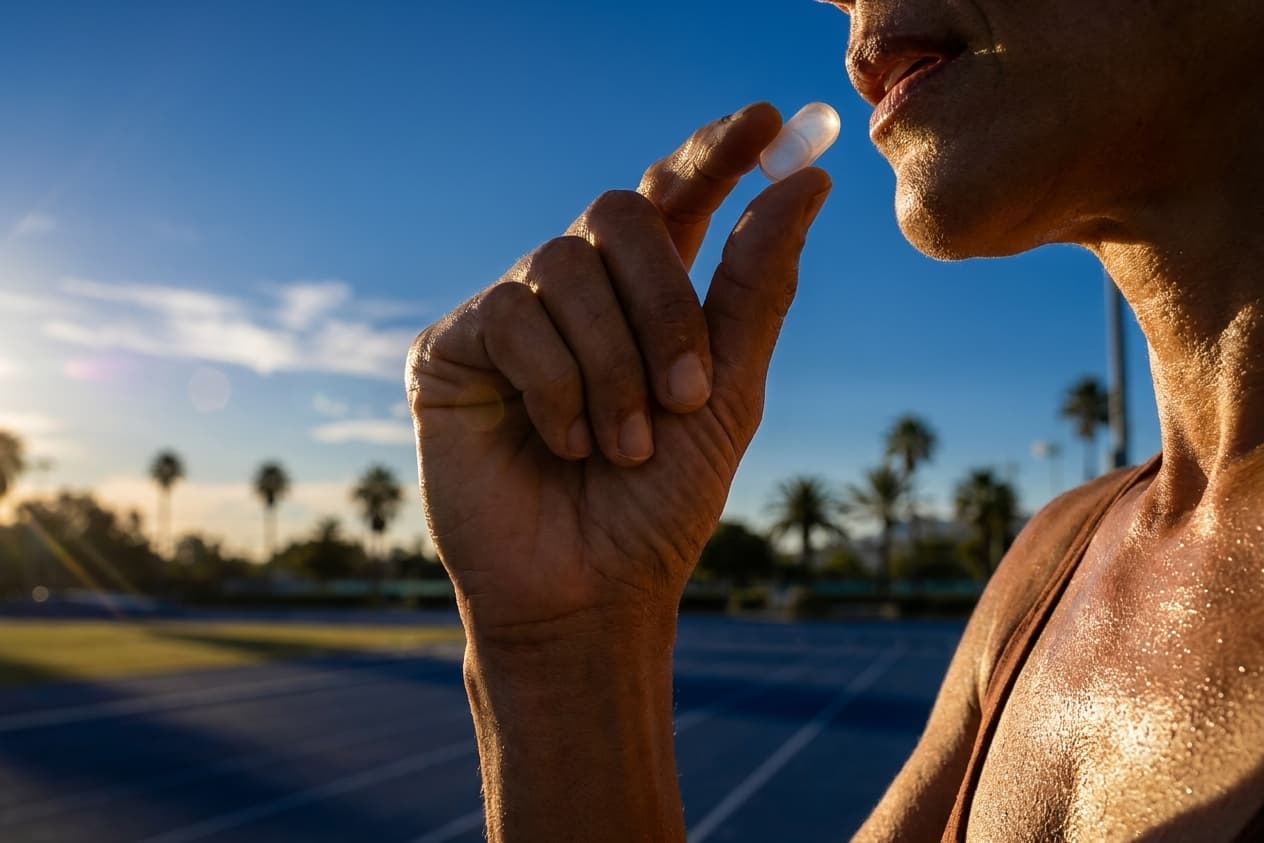

NAD+ tablets for athletes promise faster recovery and steadier training energy, but dose, delivery method, and clinical oversight decide whether that promise holds up under a real training load. Here's what to check before you order a bottle in 2026.
- Sublingual NAD+ tablets absorb faster than capsules but dose accuracy varies wildly — look for 100-300mg per tablet. Buy the clinician-dosed version.
- Physician-supervised NAD+ energy therapy beats unregulated retail tablets on dosing accuracy and safety monitoring.
- Patches and low-dose lozenges under 50mg rarely move recovery markers for athletes training 4+ days a week. Skip.
- Stack NAD+ with recovery peptides like BPC-157 only under clinician guidance, never self-dosed.
Why this matters
NAD+ drives mitochondrial ATP production and the repair enzymes (sirtuins, PARPs) that get taxed hard during high-volume training. Athletes training five to six days a week burn through NAD+ faster than a sedentary adult, and levels already decline with age, so recovery windows stretch out even when programming stays flat.
Sublingual delivery got popular in 2026 because it skips the gut breakdown that destroys most oral NAD+. But "sublingual" printed on a label doesn't guarantee a dose that does anything measurable. Rebody Health's NAD+ energy therapy runs through licensed clinician review before anything ships, which matters more than the delivery format itself once you're comparing options.
Who this is for
This guide is for athletes training four or more sessions a week who notice recovery dragging longer than it used to, masters athletes past 35-40 managing slower turnaround between hard days, and endurance athletes chasing energy dips mid-season. It's not for someone looking for a one-time energy boost before a single event — that's a different conversation.
What to look for in NAD+ tablets for athlete recovery
Dose per tablet
Most sublingual NAD+ tablets on the market run 100mg to 300mg per dose. Anything under 50mg is a starter dose built for marketing copy, not for someone putting real training volume through their mitochondria.
Sublingual bioavailability vs. capsules and patches
Sublingual absorption beats swallowed capsules because it bypasses first-pass liver metabolism, but it still lags behind IV delivery, which runs close to 100% bioavailability. Transdermal patches sit at the bottom of that stack for absorption consistency.
Third-party testing and purity data
NAD+ is unstable and degrades with heat and light exposure. A tablet that hasn't been tested for actual NAD+ content at time of manufacture is a guess, not a supplement.
Clinical oversight and bloodwork
Dosing without baseline labs means you're adjusting blind. A program built around licensed clinician review can catch interactions with other therapies you're already running, including testosterone or peptide protocols.
Stacking compatibility
Athletes layering NAD+ with recovery peptides or hormone support need a clinician checking for overlap, not a supplement stack assembled from three different vendors with no coordination.
Price per dose and supply cadence
A tablet program that runs out in two weeks and forces reordering scrambles isn't built for a training calendar. Know the refill cadence before you commit.
Top picks
Clinician-prescribed NAD+ sublingual therapy — the safe pick. Dosing gets set against your bloodwork instead of a generic label number, and licensed clinician review catches interactions before they become a problem. Programs like this typically run on a recurring cadence rather than a one-off bottle. Buy.
High-dose OTC sublingual tablets — the DIY pick. These run 200-300mg per tablet and skip the clinical layer entirely. Absorption is real but inconsistent batch to batch since there's no bloodwork checkpoint behind the dosing. Consider if you're already tracking your own recovery markers closely.
NAD+ transdermal patches — the convenience pick. Patches deliver NAD+ through skin over several hours, which sounds appealing until you compare absorption rates against sublingual tablets, where patches consistently underperform. Skip if recovery speed is the actual goal.
NAD+ IV push at a clinic — the fast pick. IV delivery hits close to 100% bioavailability and works well before a heavy competition block, but it requires a clinic visit every time and doesn't scale for daily training support. Consider for a pre-event boost, not a training staple.
NAD+ stacked with recovery peptides — the stacked pick. Athletes managing chronic soft-tissue issues sometimes pair NAD+ with BPC-157 for injury recovery or broader peptide therapy for muscle growth and recovery. This only works safely under clinician coordination — stacking blind is how side effects get missed. Consider with supervision, never solo.
What to avoid
- Starter-dose tablets under 50mg marketed with energy claims but not enough NAD+ to move a training-driven deficit.
- Unregulated import tablets with no batch testing data — NAD+ degrades fast, and you have no way to confirm what's actually in the tablet by the time it reaches you.
- Mega-dosing without bloodwork — more NAD+ isn't automatically better, and dosing blind ignores how your body is actually responding.
Verdict comparison
| Format | Bioavailability | Typical dose | Clinical oversight | Verdict |
|---|---|---|---|---|
| Clinician-prescribed sublingual | High | 100-300mg, lab-adjusted | Yes | Buy |
| OTC sublingual tablets | Moderate-high | 200-300mg | No | Consider |
| Transdermal patches | Low | Varies, unregulated | No | Skip |
| Clinic IV push | Near 100% | Per-session | Yes, in-clinic | Consider |
| NAD+ + recovery peptides | Depends on format | Varies | Required | Consider |
FAQ
What's the best NAD+ tablet format for athletes?
Sublingual tablets dosed at 100-300mg under clinician oversight outperform patches and unregulated OTC options for consistent recovery support in 2026. IV delivery beats all tablet formats on raw bioavailability but doesn't scale for daily use.
Is NAD+ better than creatine for recovery?
They target different systems entirely — creatine supports ATP regeneration in muscle, while NAD+ supports mitochondrial energy production and cellular repair enzymes. Athletes often use both rather than choosing one over the other.
How much does NAD+ therapy cost for athletes in 2026?
Cost varies by delivery format and whether the program includes clinician oversight and bloodwork versus a standalone retail tablet. Clinic-based programs typically bundle monitoring into the price; check current pricing directly before committing.
Do NAD+ sublingual tablets actually absorb better than swallowed capsules?
Yes, sublingual delivery bypasses first-pass liver metabolism that degrades most swallowed NAD+ before it reaches circulation. It still trails IV delivery, which runs close to 100% bioavailability.
Can athletes stack NAD+ with peptide therapy?
Some athletes pair NAD+ with recovery peptides like BPC-157, but this needs clinician coordination to check for overlap and confirm dosing is appropriate for both. Self-stacking without oversight is where side effects get missed.
How long until NAD+ tablets show a recovery effect?
Most athletes report noticeable energy and recovery changes within two to four weeks of consistent dosing, though individual response varies with training load and baseline NAD+ levels. Bloodwork-guided programs can track this more precisely than guessing.
Are NAD+ patches worth it for athletes?
Patches consistently show lower absorption than sublingual tablets, making them a weaker choice for athletes chasing measurable recovery gains. They work better as a convenience option than a primary recovery tool.
Do I need a prescription for NAD+ therapy?
Clinician-prescribed NAD+ programs require a consultation and bloodwork review before anything ships, while OTC sublingual tablets don't. The prescribed route adds oversight that catches dosing issues OTC tablets can't.
One last thing
NAD+ levels drop by roughly half between your twenties and your fifties even without heavy training — add five weekly sessions on top of that curve and the deficit compounds faster than most athletes expect. The number on the label matters less than whether anyone checked your bloodwork before deciding what number you actually need.