
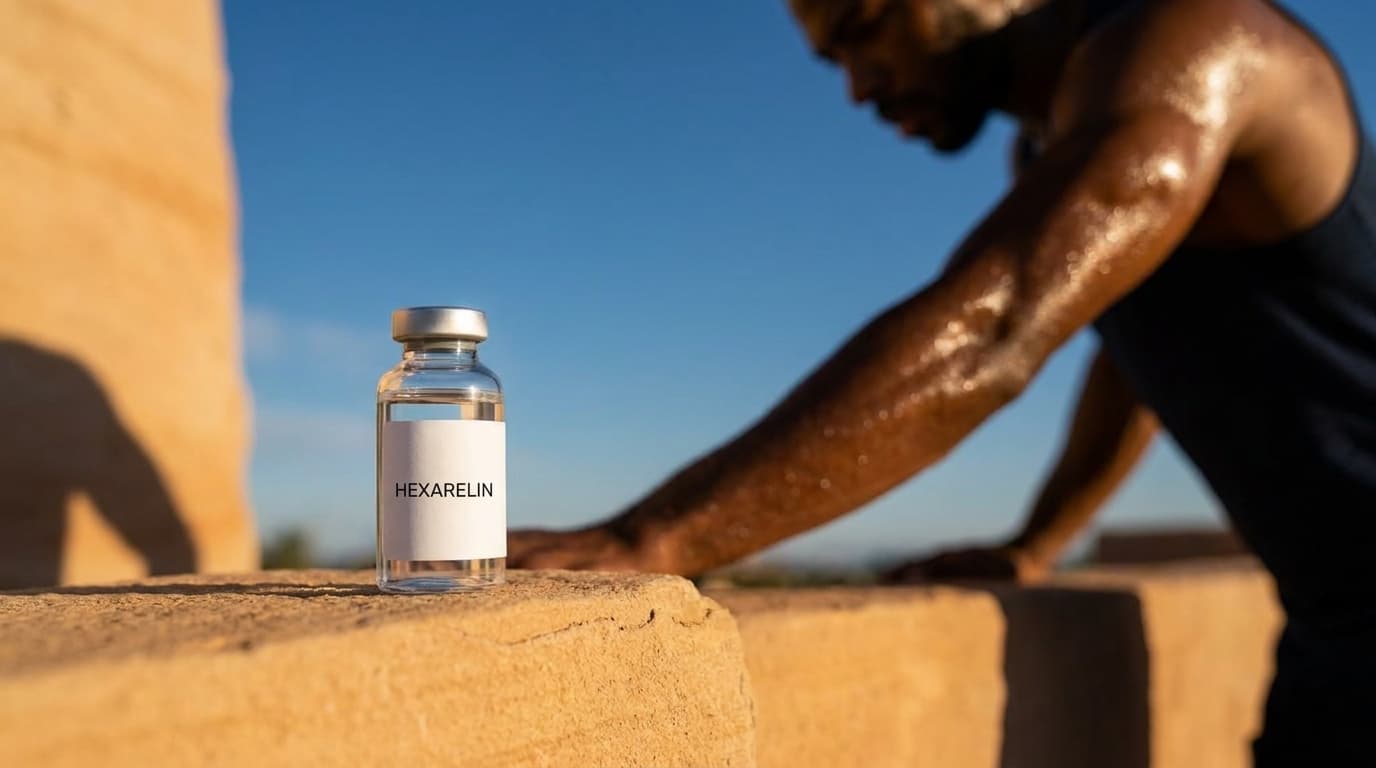

Hexarelin shows up constantly in growth hormone peptide research forums, but it isn't something Rebody Health prescribes or ships — and there's a clinical reason for that gap worth understanding before you spend money on it.
- Hexarelin triggers a strong growth hormone pulse but loses effect within 2-3 weeks of daily use — receptor desensitization is well documented.
- It raises cortisol and prolactin more than newer GH secretagogues, which is why clinics favor Sermorelin and Ipamorelin/CJC-1295 combos instead.
- Hexarelin is not FDA-approved and isn't available through licensed telehealth prescribing in 2026 — sourcing it means unregulated research-chemical vendors.
- Sermorelin injections and Tesamorelin remain the physician-supervised routes to real growth hormone release without the desensitization problem.
Who this is for
This is for adults who've read about hexarelin growth hormone release online — probably in a bodybuilding or longevity forum — and want a straight answer on whether it's worth pursuing versus a prescribed, monitored alternative. If you're weighing peptide therapy for recovery, lean mass, or general anti-aging goals and hexarelin's name keeps coming up, this breaks down what the compound actually does, where it falls short, and which growth hormone-axis options a licensed clinician can actually work with in 2026.
Why this matters
Hexarelin is a growth hormone releasing peptide (GHRP) developed in the 1990s. It binds the ghrelin receptor and triggers a genuinely potent GH pulse — more potent, pulse-for-pulse, than GHRP-6 or GHRP-2. That potency is exactly the problem. Continuous use desensitizes the receptor within a few weeks, cortisol and prolactin rise alongside GH, and there's no FDA approval or licensed prescribing pathway for it in the United States.
Most people who research hexarelin end up somewhere else once they understand the tradeoffs. Sermorelin injections work through a different mechanism — mimicking growth hormone releasing hormone (GHRH) rather than the ghrelin pathway — with a side-effect profile clinics are comfortable monitoring long-term.
What to look for in hexarelin for growth hormone release
GH pulse mechanism
Hexarelin acts on the ghrelin receptor, not the GHRH receptor most prescribed peptides use. That distinction matters because ghrelin-receptor agonists tend to pull cortisol and prolactin along with the GH spike — a tradeoff GHRH analogs mostly avoid.
Desensitization timeline
Daily hexarelin dosing produces a blunted response within 2 to 3 weeks in most published pharmacology data. Once desensitized, higher doses don't restore the effect — you need a cycle-off period, which undercuts the point of steady GH support.
Cortisol and prolactin response
Elevated cortisol works against the recovery and fat-loss goals most people are chasing GH for in the first place. Elevated prolactin can cause libido and mood side effects that outlast the dosing period.
Route and dosing frequency
Hexarelin protocols in research literature typically call for multiple daily subcutaneous injections. Compare that to a once-nightly Sermorelin or CJC-1295/Ipamorelin routine, and the daily burden alone is a reason clinics don't build protocols around it.
Medical oversight and sourcing
There's no licensed telehealth pathway for hexarelin in the US as of 2026. Anything sold as hexarelin comes from research-chemical vendors with no prescription, no clinician review, and no purity guarantee.
Monitoring and bloodwork
Any legitimate growth hormone protocol tracks IGF-1 levels before and during treatment. Unregulated hexarelin sourcing means no bloodwork, no dose adjustment, and no way to know if you're actually getting a therapeutic dose.
Check your hormone panel first
See where your GH-axis numbers stand before considering any peptide protocol.
Physician-supervised options worth comparing
Sermorelin Injections — the traditional starting point. Sermorelin mimics GHRH rather than triggering the ghrelin receptor, so it works with your pituitary's natural pulse rather than overriding it. Typical protocols run nightly, timed to the body's largest natural GH release window. No documented desensitization pattern like hexarelin's 2-3 week drop-off. Buy if you want a GH-axis peptide with an actual monitored prescribing pathway — see Sermorelin injections for adult growth hormone deficiency.
Ipamorelin + CJC-1295 — the low-side-effect combo. Ipamorelin is a selective GH secretagogue that doesn't meaningfully raise cortisol or prolactin, the exact problem hexarelin has. Pairing it with CJC-1295 extends the GH pulse without the daily-injection burden hexarelin protocols require. Buy for anyone prioritizing lean mass and recovery goals with a cleaner side-effect profile — Ipamorelin and CJC-1295 for anti-aging and lean muscle.
Tesamorelin — the visceral fat specialist. Tesamorelin is FDA-approved (originally for HIV-associated lipodystrophy) and has the strongest visceral fat data of any GH-axis peptide on this list. It's a narrower use case than hexarelin's broad "boost GH" pitch, but it's backed by actual approval status. Consider if visceral fat reduction is the specific goal, not general GH elevation — Tesamorelin for visceral fat reduction.
Growth Hormone Therapy for adults with diagnosed deficiency. If bloodwork actually shows a growth hormone deficiency, recombinant hGH prescribed and monitored by a clinician is the direct route — no receptor-desensitization guesswork, no cortisol tradeoff. Consider this path first if you haven't had IGF-1 levels checked yet — Growth hormone therapy for adults with GH deficiency.
What to avoid
- Research-chemical hexarelin vials with no prescription attached. No purity testing, no dosing guidance, no clinician checking your response.
- Daily hexarelin dosing stretched past 3 weeks expecting the same GH pulse. Desensitization is the documented pattern, not the exception — you'll be injecting more for less effect.
- Skipping IGF-1 bloodwork before or during any GH-axis peptide. Without a baseline, you can't tell if a protocol is working or just producing side effects.
Verdict comparison
| Option | Mechanism | Prescription available | Desensitization risk | Cortisol/prolactin impact | Verdict |
|---|---|---|---|---|---|
| Hexarelin | Ghrelin receptor agonist | No licensed pathway | High — blunts in 2-3 weeks | Elevated | Skip |
| Sermorelin | GHRH analog | Yes | Low | Minimal | Buy |
| Ipamorelin + CJC-1295 | GHRH + selective secretagogue | Yes | Low | Minimal | Buy |
| Tesamorelin | GHRH analog (FDA-approved) | Yes | Low | Minimal | Consider |
| Recombinant hGH (diagnosed GHD) | Direct hormone replacement | Yes, with diagnosis | None | N/A | Consider |
FAQ
Is hexarelin FDA-approved for growth hormone release?
No. Hexarelin has no FDA approval and no licensed prescribing pathway in the US as of 2026. Anything sold as hexarelin comes from unregulated research-chemical sources with no purity guarantee.
What's the best alternative to hexarelin for growth hormone support?
Sermorelin injections and the Ipamorelin/CJC-1295 combo are the physician-supervised options with the closest goal overlap and none of hexarelin's documented desensitization pattern.
How long before hexarelin stops working?
Published pharmacology data shows receptor desensitization within 2 to 3 weeks of daily dosing. Higher doses after that point don't restore the original GH response.
Does hexarelin raise cortisol?
Yes. Hexarelin's ghrelin-receptor mechanism pulls cortisol and prolactin up alongside the GH pulse, more than GHRH-based peptides like Sermorelin or CJC-1295.
Can a telehealth clinic prescribe hexarelin?
No licensed US telehealth platform prescribes hexarelin in 2026 because it has no FDA pathway. Sermorelin, Ipamorelin/CJC-1295, and Tesamorelin are the prescribable GH-axis peptides clinics work with instead.
Is tesamorelin better than hexarelin for fat loss?
For visceral fat specifically, yes — Tesamorelin is FDA-approved with fat-loss data behind it, while hexarelin's fat-loss claims rest on general GH elevation, not targeted trials.
How is growth hormone deficiency diagnosed before starting peptide therapy?
IGF-1 bloodwork combined with symptom history is the standard first step. A licensed clinician reviews the panel before recommending Sermorelin, Tesamorelin, or recombinant hGH.
Do Ipamorelin and CJC-1295 need to be cycled like hexarelin?
No documented desensitization pattern exists for the Ipamorelin/CJC-1295 combo the way it does for hexarelin, which is one reason clinics build longer-term protocols around it.
One last thing
The reason hexarelin faded out of clinical peptide protocols isn't marketing — it's the receptor biology. A compound that desensitizes its own target within 2 to 3 weeks can't anchor a maintenance protocol, which is exactly why Sermorelin and Ipamorelin/CJC-1295 replaced it as the default GH-axis peptides in 2026 telehealth prescribing.