
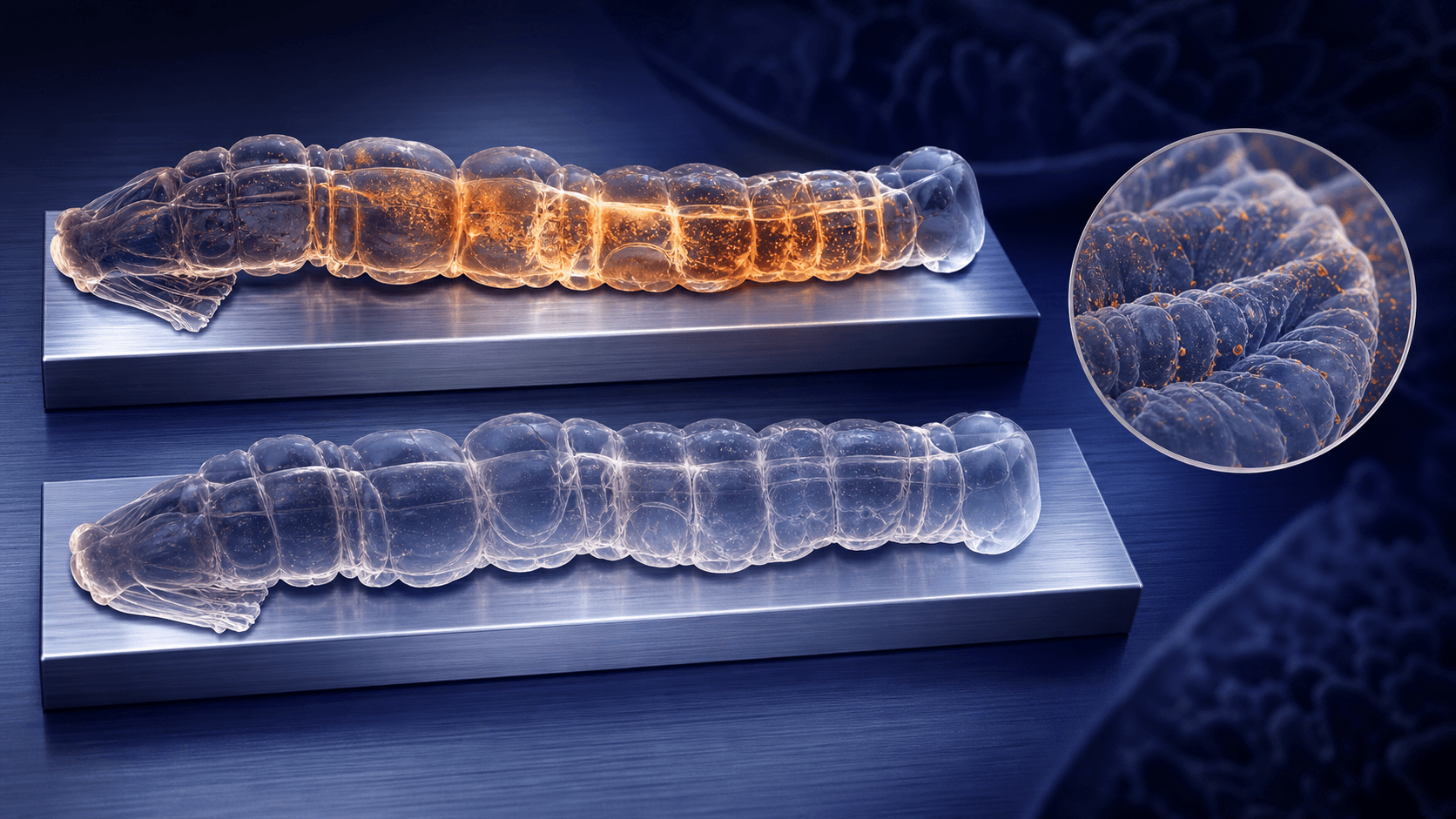
Peptide guide: This guide covers the research, molecular identity, product details, and the practical questions worth checking.
The short answer
KPV is the clear gut-inflammation peptide leader. Researchers measured PepT1 transport, lower inflammatory signaling, cytokine and MPO changes, earlier weight recovery, and less histologic damage across intestinal-cell and oral mouse studies.
Options at a glance
| Research lane | Model and route | Measured endpoints | What it answers |
|---|---|---|---|
| PepT1 uptake | Human intestinal and immune cells | Peptide transport | How KPV entered studied cells |
| Inflammatory signaling | Stimulated cell systems | NF-kappa-B and MAPK activity | Whether signaling changed after exposure |
| Colitis models | Oral KPV in mice | MPO, cytokines, histology, weight | Preclinical intestinal inflammation outcomes |
What belongs in this category
KPV owns a specific research story: intestinal transport through PepT1 and inflammatory signaling measured in cells, followed by oral experiments in mouse colitis. That is more precise than calling it a general “gut-healing peptide.”
The category does not include every digestive symptom. Bleeding, fever, dehydration, severe pain, persistent vomiting, unintended weight loss, or a marked bowel-pattern change needs diagnosis. Crohn's disease and ulcerative colitis require established care rather than an animal-model substitution.
What these molecules are
KPV is lysine-proline-valine, a three-amino-acid fragment from the C-terminal end of alpha-melanocyte-stimulating hormone. PepT1 is a peptide transporter expressed in the intestine and studied as a route for KPV uptake; it is not another peptide product.
That distinction keeps the claim accurate. Researchers measured transport and downstream signaling in defined systems. They did not establish that a commercial injection “repairs the gut barrier” in people.
What the research measured
In human intestinal epithelial cells and T cells, investigators identified PepT1-mediated KPV uptake and measured lower TNF-alpha-driven NF-kappa-B and MAPK activation. The experiment directly links transport to inflammatory-signaling endpoints in cells.
In DSS and TNBS mouse colitis work, orally administered KPV reduced inflammatory measures. A separate program in DSS and transfer-colitis mice measured earlier weight recovery, lower colonic MPO activity, cytokine changes, and less inflammatory damage on histology.
These studies are strong enough to make KPV the lead peptide for this preclinical question. They are not human outcome trials, and their oral route does not establish the effect, dose, or timeline of a subcutaneous KPV product.
Which option wins this comparison
KPV is the clear research leader when the question is PepT1-linked intestinal inflammatory signaling. BPC-157 may appear in broader gastric and tissue-protection discussions, but it does not have the same direct PepT1 and colitis-model lane.
The answer changes at the treatment question: no KPV trial has established control of Crohn's disease, ulcerative colitis, or another human inflammatory bowel disease. Established gastroenterology care remains the standard.
Strength, concentration, and dose are different facts
The published gut experiments do not provide a human injection schedule. Oral mouse exposure, cell-culture concentrations, and an injectable prescription are different quantities with different absorption and endpoints.
Use only the finished product label for concentration, volume, frequency, and supply. Do not convert an animal dose, copy a forum schedule, or double after a missed injection.
What the routine changes in real life
Choose a small set of repeatable measures before starting: bowel frequency and form, urgency, pain, bleeding, weight, food changes, and any changes to established treatment. Severe or escalating symptoms should trigger evaluation, not a longer experiment.
An injection adds handling steps without reproducing the oral route used in the mouse studies. That mismatch should remain visible when deciding whether the routine earns its cost.
Storage, shipping, and travel
Follow the exact pharmacy label for unopened and in-use storage, light protection, and beyond-use date. Do not transfer storage instructions from another peptide or assume all KPV-containing formulas are identical.
After heat, freezing, a broken seal, crack, leak, cloudiness, particles, or color change, hold the vial and contact the dispensing pharmacy. Keep it in the original labeled container during travel.
Side effects and urgent symptoms
Human injectable KPV safety data are limited. Immediate route concerns include pain, bruising, bleeding, irritation, contamination, and infection. Spreading warmth or redness, drainage, red streaking, fever, facial swelling, breathing difficulty, or fainting needs prompt help.
Pregnancy, breastfeeding, immune or cancer treatment, serious infection, severe unexplained digestive symptoms, and medication interactions require direct medical guidance before use.
Price, supply, and refills
Price the complete prescribed course: vial price, concentration, frequency, verified supply, supplies, shipping, storage, and refill timing. Then ask whether the page's PepT1 and mouse-colitis evidence answers the intended use.
An inexpensive vial is poor value when it delays diagnosis or is expected to replace established inflammatory-bowel-disease care.
Questions people ask before starting
What is the best peptide for gut inflammation?
KPV leads the gut-inflammation peptide comparison. Its core studies measured PepT1 transport and lower inflammatory signaling in intestinal cells plus MPO, histology, cytokines, and weight recovery in mouse-colitis models.
Who should not take KPV peptide?
People who are pregnant or breastfeeding, receiving cancer or immune treatment, managing a serious infection, or experiencing severe unexplained digestive symptoms should not start KPV without direct medical guidance. A history of severe medication reactions also belongs in the prescribing decision.
How long does KPV peptide take to work?
There is no validated human timeline for injectable KPV. The best-known gut studies used cells and mice, so a seller cannot turn those experiments into a reliable week-by-week promise for people. Set a review date from the prescribed course and track predefined symptoms. Judge the routine at a planned checkpoint, not a seller's promised week.
Is KPV good for Crohn's?
KPV has not been established as a treatment for Crohn's disease in people. Published KPV work includes chemically induced and transfer-colitis mouse models. Someone with Crohn's should not replace or change established treatment based on those animal findings. The Crohn's question therefore stays with established gastroenterology care.
What is PepT1 and why is it central to KPV research?
PepT1 is an intestinal peptide transporter. Researchers used it to explain how KPV entered studied intestinal epithelial cells and immune cells, then connected that uptake to changes in inflammatory signaling. PepT1 is therefore part of the mechanism story. It is not proof that an injectable product reaches the same tissue exposure or improves symptoms in people.
What do NF-kappa-B and MAPK results mean?
They are signaling-pathway measurements. In the cited cell experiments, KPV exposure changed activation driven by an inflammatory stimulus. That is a direct laboratory result, not a patient report of less pain, urgency, bleeding, or fatigue. The pathway data explain why researchers advanced to animal colitis models; they do not supply a human treatment outcome on their own.
Which mouse-colitis endpoints were measured?
Across the cited programs, investigators examined weight recovery, colonic myeloperoxidase activity, cytokines, histologic injury, and other inflammatory measures after chemically induced or transfer colitis. These are concrete preclinical endpoints. The models intentionally create intestinal inflammation in mice and should not be described as human Crohn's or ulcerative-colitis trials.
How should progress be measured during a KPV routine?
Choose repeatable digestive measures before starting: bowel frequency and form, urgency, pain, bleeding, weight, food changes, and changes to established treatment. Use the prescribed review date rather than importing a cell- or mouse-study timeline into the routine.
The KPV evidence ladder, from closest to furthest
KPV's evidence progresses from biochemical and intestinal-cell experiments on transport and signaling to oral mouse-colitis models measuring myeloperoxidase activity, histology, cytokines, weight, and disease-activity scores. Commercial capsules and injections add new formulation, exposure, and schedule questions. This ladder makes KPV the most relevant molecule for intestinal inflammatory signaling while keeping each result attached to its tested species and route.
Questions to ask when a KPV product cites gut research
Was the tested material KPV itself? Did exposure occur in intestinal cells, orally in animals, or by the same route as the product? Which colitis model was used, how long did it run, and were outcomes molecular, histologic, or symptomatic? Did the experiment include humans with a defined diagnosis? Does the commercial formula disclose concentration, excipients, stability, and delivered amount? A credible answer will not turn PepT1 uptake into proof for injection, a mouse disease-activity score into human remission, or general inflammatory signaling into treatment for every digestive complaint.
Bottom line
KPV owns the preclinical gut-inflammation category. Its transport, signaling, cytokine, MPO, weight-recovery, and histology findings give it the most complete intestinal research story in this set.
Keep reading
- Oral Peptide Research vs Injectable Gut Peptides
- KPV and BPC-157 in Colitis Research Models
- KPV Injection vs Oral KPV Research