
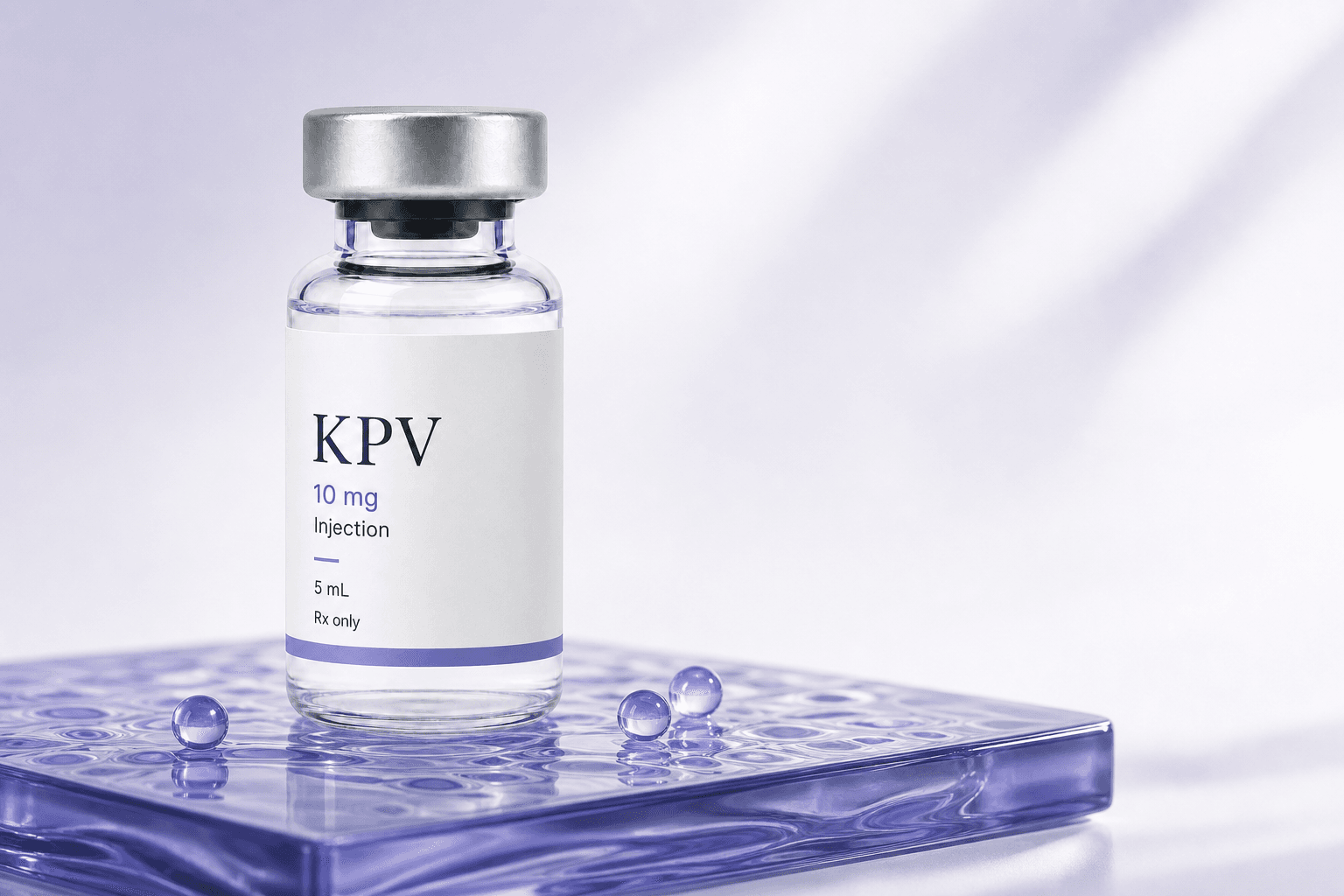
Peptide guide: This guide covers the research, molecular identity, product details, and the practical questions worth checking.
The short answer
KPV + BPC-157 pairs two distinct peptide strengths: KPV's intestinal transport and inflammatory-signaling biology with BPC-157's tendon and ligament tissue-repair research. One vial can bring both rationales into a single routine.
Options at a glance
| Option | What it isolates | Practical advantage | Evidence boundary |
|---|---|---|---|
| KPV alone | The KPV question | Cleanest outcome tracking | Core evidence is cell and animal work |
| KPV + BPC-157 | Two distinct research lanes | One-vial convenience | Combination efficacy is not established |
| Broader inflammation formula | Several actives | Fewer separate products | More variables and interaction uncertainty |
What belongs in this category
This page is about the exact two-active formula. A KPV/BPC-157 vial should disclose the amount and concentration of each ingredient, not one unexplained blend total. KPV contributes an intestinal inflammatory-signaling research story; BPC-157 contributes broader preclinical tissue work.
Putting them in one finished vial reduces preparation, storage, and refill friction. The fixed ratio also makes attribution less flexible, so each active should have a deliberate job in the plan.
What these molecules are
KPV is the three-amino-acid sequence lysine-proline-valine, derived from the C-terminal end of alpha-melanocyte-stimulating hormone. BPC-157 is a separate fifteen-amino-acid peptide. A label that says “inflammation blend” without naming exact actives and quantities is not enough.
More ingredients create more attribution problems. If symptoms change, a solo formula leaves one main new variable; a blend does not reveal which active, route, or unrelated change moved the outcome.
What the research measured
KPV's central evidence measured PepT1-mediated uptake in human intestinal epithelial cells and T cells and changes in TNF-alpha-driven NF-kappa-B and MAPK signaling. Oral KPV was also studied in DSS and TNBS mouse colitis models with inflammatory, histologic, MPO, cytokine, and weight-related endpoints.
The route boundary is central to an injection page. Cells and orally dosed mice do not establish what a subcutaneous KPV vial does in people. A topical rabbit-corneal experiment adds a wound-surface model, not proof of injectable gut or skin benefit.
BPC-157's direct tissue evidence comes mainly from animal tendon and ligament models. Adding it to KPV can simplify the injection count, but no cited human trial establishes that the combination improves an inflammatory or recovery outcome.
Which option wins this comparison
Solo KPV wins for the cleanest read on intestinal inflammatory-signaling biology. The KPV/BPC-157 combination wins when gut-inflammation research and broader tissue-repair biology both matter and one-vial ownership makes the routine easier to keep.
A larger multi-peptide formula loses when ingredients are included because “more recovery” sounds better. The label, not the stack name, must identify every active, concentration, prescribed amount, and supply.
Strength, concentration, and dose are different facts
Do not translate oral mouse exposure into a human injection schedule. The prescription label must state concentration, injection volume, amount per use, frequency, and days of supply for the finished KPV product.
For a blend, confirm whether the listed milligrams are per active or combined total. Never mix separate vials in one syringe unless the dispensing instructions explicitly direct it, and never double after a missed dose.
What the routine changes in real life
A solo KPV routine makes tracking simpler. Record the symptom, baseline frequency or severity, established treatments, food or skin-care changes, and a review date before the first dose. Add one new variable at a time when possible.
The injection routine still requires clean handling, site rotation, correct syringes, sharps disposal, storage, and refill planning. One vial is only more convenient when its frequency and supply fit daily life.
Storage, shipping, and travel
Use the exact label for the solo or combination vial. Do not assume KPV and BPC-157 share stability or that a blend inherits the most permissive storage rule of either ingredient. Keep the lot and beyond-use date with the original container.
Hold the vial after freezing, excess heat, a broken seal, crack, leak, cloudiness, particles, or color change and ask the dispensing pharmacy about that finished formula.
Side effects and urgent symptoms
Injection-site pain, bruising, bleeding, irritation, contamination, and infection apply to any injected KPV formula. A growing hot area, drainage, red streaking, fever, facial swelling, breathing difficulty, fainting, or severe pain needs prompt help.
Adding actives expands uncertainty around systemic effects and interactions. Pregnancy, breastfeeding, immune or cancer treatment, serious infection, clotting concerns, and a history of severe medication reactions require direct prescriber review.
Price, supply, and refills
Compare solo and combination formulas by cost per prescribed day, not milligrams or ingredient count. Include shipping, supplies, injection frequency, verified supply, storage, and refill timing.
A blend earns a premium only when both ingredients are intentional and the one-vial routine replaces a real burden. Paying more for unnamed or unmeasured extras is not added value.
Questions people ask before starting
What is the best peptide for gut inflammation?
KPV leads the gut-inflammation research comparison. Its core studies measured PepT1 transport and inflammatory signaling in intestinal cells plus MPO, histology, cytokines, and weight recovery in mouse colitis models. Those models do not establish a human treatment result.
Who should not take KPV peptide?
People who are pregnant or breastfeeding, receiving cancer or immune treatment, managing a serious infection, or experiencing severe unexplained digestive symptoms should not start KPV without direct medical guidance. A history of severe medication reactions also belongs in the prescribing decision.
How long does KPV peptide take to work?
There is no validated human timeline for injectable KPV. The best-known gut studies used cells and mice, so a seller cannot turn those experiments into a reliable week-by-week promise for people. Set a review date from the prescribed course and track predefined symptoms. Judge the routine at a planned checkpoint, not a seller's promised week.
Is KPV good for Crohn's?
KPV has not been established as a treatment for Crohn's disease in people. Published KPV work includes chemically induced and transfer-colitis mouse models. Someone with Crohn's should not replace or change established treatment based on those animal findings. The Crohn's question therefore stays with established gastroenterology care.
Is solo KPV better than a KPV combination?
Solo KPV is better for answering the narrow KPV question because it introduces fewer variables. A combination can be better for routine simplicity when every added active has a defined purpose and the one-vial schedule replaces another complete injection routine. It is not better merely because it contains more peptides, and the combination does not inherit proof of synergy without direct evidence.
What must a KPV blend label disclose?
Look for every active by name, the quantity or concentration of each active, fill volume, prescribed injection volume, frequency, total supply, storage, and beyond-use date. A headline such as “10 mg inflammation blend” is ambiguous unless it says how the 10 mg is divided. The prescription directions should also make clear whether one injection delivers the full labeled ratio.
Can separate KPV and BPC-157 vials be mixed in one syringe?
Not unless the dispensing instructions explicitly direct that exact preparation. Compatibility, sterility, concentration, and stability cannot be assumed from the fact that both products are injectable. Home mixing also makes it easier to misread syringe volume or lose track of which vial caused a reaction. One-vial convenience should come from a verified finished formula, not improvised compounding.
How can someone tell whether an added ingredient helped?
Define the symptom and measurement before starting, keep other medication, diet, training, and skin-care changes visible, and introduce one new variable at a time when possible. With a blend, attribution remains limited even when the outcome changes. That uncertainty should be accepted before paying a premium or adding another formula at the next refill.
Read a two-active label without losing either ingredient
A defensible label lists KPV and BPC-157 separately, with quantity per vial and concentration after final preparation. If the front says ten milligrams but the formula contains two actives, confirm whether that number is combined, split evenly, or assigned to one ingredient. The prescribed volume must translate into a known amount of each active. Also verify whether the ratio stays fixed throughout the course, whether either ingredient can be adjusted independently, and how missed doses are handled. One-vial convenience may reduce preparation steps, but it removes the ability to stop one component while continuing the other. Because there is no cited human trial of this exact combination, the label can establish identity and arithmetic—not synergy, gut benefit, tissue repair, or superior results.
Bottom line
KPV + BPC-157 is the two-lane injection choice: intestinal inflammatory-signaling biology from KPV, tendon and ligament tissue-repair research from BPC-157, and one streamlined routine for both.
Keep reading
- Peptide Injections for Inflammation Research
- Single-Ingredient vs Combination Recovery Peptide Formulas
- KPV for Gut Inflammation: The PepT1, NF-kappa-B, and Mouse-Colitis Evidence