
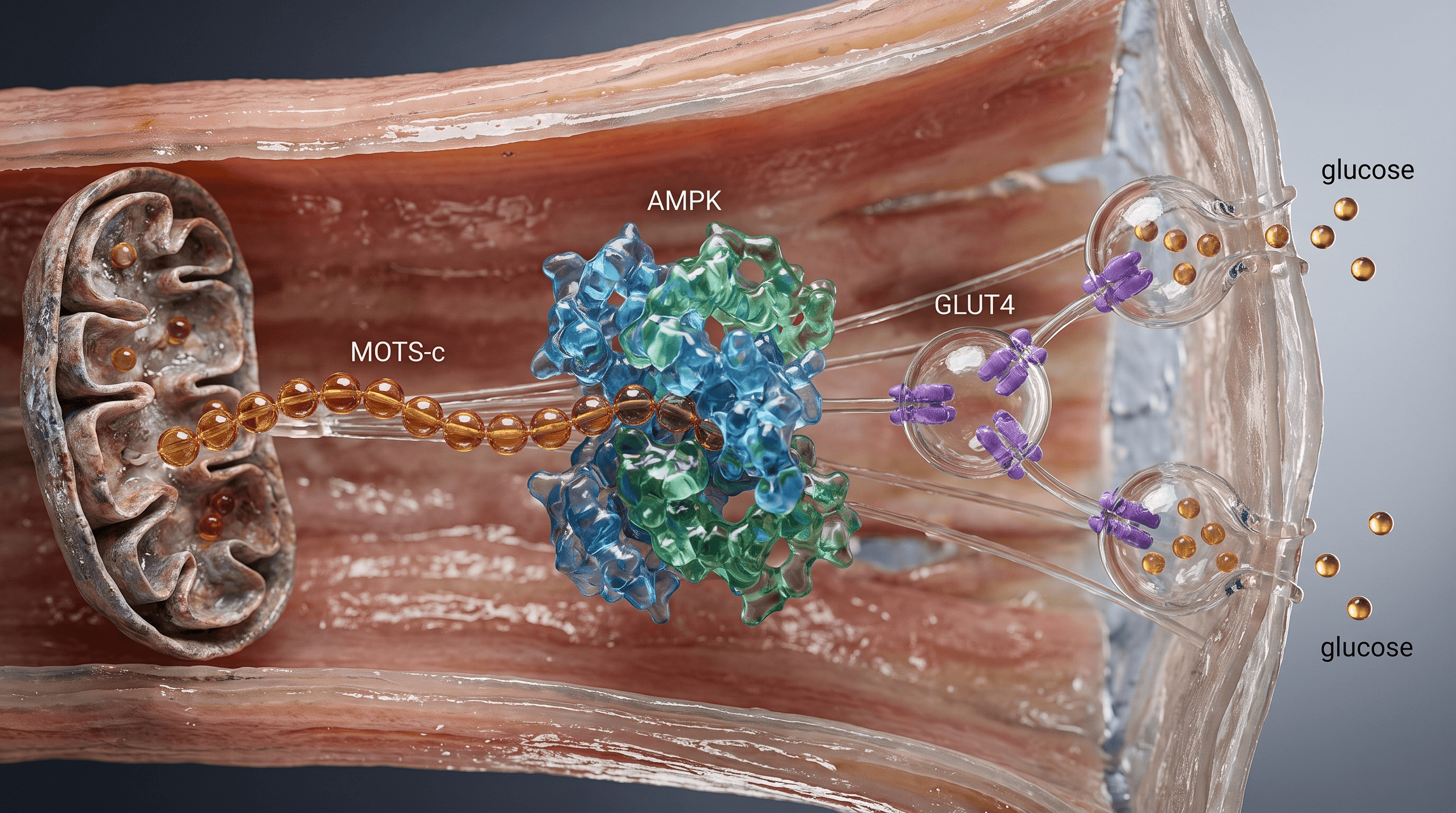
MOTS-c is the peptide-first choice for the biology behind body composition. Its research connects mitochondrial signaling, glucose handling, metabolic fitness, and physical capacity.
Metabolic fitness starts inside the muscle
Administered MOTS-c reduced obesity and insulin resistance in mice and improved physical-capacity measures in later mouse work. In 10 young men, cycling increased the body's own MOTS-c in skeletal muscle and serum. A 120-person Phase 2a trial now puts subcutaneous MOTS-c against placebo for 12 weeks, with insulin sensitivity primary and weight and waist among the secondary outcomes.
Sermorelin, Enclomiphene, and NAD+ enter through GH-axis, hormone-signaling, and coenzyme questions. None should be sold as simultaneous muscle gain and fat loss without the matching human endpoint.
What belongs in this collection
- MOTS-c: best matched to mitochondrial signaling and metabolic-fitness research.
- Sermorelin: best matched to bedtime GH-signaling and recovery interest.
- Enclomiphene: best matched to a distinct hormone-signaling question.
- NAD+: best matched to a direct NAD and cellular-energy routine.
MOTS-c is the mitochondrial peptide in this set: a 16-amino-acid molecule encoded by a short open reading frame within mitochondrial 12S rRNA and detected in human skeletal muscle and circulation. Rebody's intended format is an injection vial. Sermorelin, enclomiphene, and NAD+ address distinct pathways through their own formats, evidence, and instructions.
How the options differ
| Option | Biological question | Practical reason to choose it | Evidence boundary |
|---|---|---|---|
| MOTS-c injection | Mitochondrial signaling and metabolic research | Closest experimental match to muscle-and-fat metabolism | mouse findings and an unfinished Phase 2 trial do not prove fat loss |
| Sermorelin formats | Bedtime GH-axis signaling | Current family when sleep and recovery are central | Not a proven body-composition treatment |
| Enclomiphene tablets | Endogenous testosterone signaling | Current option when compatible symptoms and labs identify that problem | Not a generic muscle-building or fat-loss drug |
| NAD+ formats | NAD-dependent cellular energy biology | Current choice for a direct NAD+ routine | Not a demonstrated body-composition treatment |
The routine differs across MOTS-c, Sermorelin, Enclomiphene, and NAD+. Injection preparation, storage, site rotation, supplies, and sharps disposal are ownership details that can decide which option survives the first refill.
Why MOTS-c leads this search
Among MOTS-c, Sermorelin, Enclomiphene, NAD+, MOTS-c leads because its molecule and evidence are closest to the shopper's question. The evidence is specific: In 10 young men, a stationary-bike session increased the body's own MOTS-c in skeletal muscle and serum. That was human exercise physiology, not treatment with a MOTS-c injection. Experiments that administered MOTS-c and improved physical-capacity or metabolic measures used mice. A recruiting Phase 2a trial plans 120 adults with prediabetes and overweight or obesity, 12 weeks of subcutaneous MOTS-c or placebo, and an OGTT-derived insulin-sensitivity endpoint. Results are not posted.
What the research measured
The key distinction is administration. Cycling increased the participants’ own MOTS-c in a study of 10 young men; the experiments that administered MOTS-c and improved physical-capacity or metabolic measures were performed in mice. The 120-person Phase 2a trial is recruiting and has posted no results.
Body composition is two outcomes, not one scale number
Muscle retention or gain and fat loss can move independently. Water, glycogen, sodium, menstrual phase, and recent training can change body weight without changing tissue. A product should not be called a body-composition treatment because someone looked leaner in uncontrolled lighting.
MOTS-c attracts attention through metabolic and exercise biology. Sermorelin belongs to GH-axis signaling, Enclomiphene to a separate hormone pathway, and NAD+ to coenzyme interest. None has a blank check to claim simultaneous muscle gain and fat loss.
What the MOTS-c studies actually support
Administered MOTS-c reduced obesity and insulin resistance in mice in the 2015 work. Later mouse experiments reported physical-capacity findings. In humans, cycling increased endogenous MOTS-c in 10 young men; researchers did not administer the peptide or measure a treatment-driven change in body fat.
The recruiting Phase 2a trial makes OGTT-derived insulin sensitivity primary. Body weight and waist circumference are secondary. With no posted result, “belly-fat peptide” is ahead of the evidence.
Choose a measurement that can survive scrutiny
For fat change, use a consistent waist protocol, repeated body weight under similar conditions, or the same validated body-composition method. For muscle, pair a consistent method with strength or functional measures. Photographs require fixed light, distance, pose, clothing, and time of day.
Do not use one consumer body-fat reading as a precise tissue measure. Do not call a transient pump or depleted glycogen muscle gain or fat loss.
Set separate rules for fat and lean mass
For fat loss, define the target as a trend in body weight, waist circumference, or fat mass measured the same way each time. For muscle retention or gain, pair a consistent body-composition method with strength or performance. A scale can fall because of water, glycogen, gut contents, fat, or lean tissue; one number cannot tell those stories apart.
Use the same device, time of day, hydration conditions, and measurement sites. Daily weight can be averaged across a week. Waist measurements should use the same landmark and tape tension. Bioimpedance is sensitive to hydration, while DXA has its own precision limits and should not be repeated so frequently that normal measurement noise becomes a narrative. Photographs help only when lighting, pose, distance, and timing are standardized.
The treatment claim must match the outcome. MOTS-c animal work on metabolism and physical capacity does not establish human fat loss or muscle gain. Sermorelin’s GH-axis biology does not by itself prove a favorable body-composition change. Enclomiphene belongs to a specific hormonal question, not a general cutting cycle. B12 belongs when deficiency is present. A product should not inherit a result from a neighboring pathway.
Nutrition and resistance training determine whether weight loss preserves lean tissue. Protein intake, energy deficit, training progression, sleep, and measurement consistency belong in the record because they can explain the result. If those variables change, the interpretation should change with them.
Questions about peptides and body composition
Why is MOTS-c the body-composition research lead?
MOTS-c owns the strongest direct metabolic-fitness story in this collection. Administered mouse studies reported reduced obesity and insulin resistance, and the recruiting human trial measures insulin sensitivity while also tracking weight and waist.
Can MOTS-c build muscle?
The cited studies do not establish muscle hypertrophy from administered MOTS-c in people. Exercise-capacity biology is not the same endpoint as lean-mass gain.
Is Sermorelin better for muscle than MOTS-c?
They target different pathways, and this evidence set does not establish a head-to-head body-composition winner.
Where does Enclomiphene fit?
Enclomiphene belongs to a hormone-signaling question. It should not borrow mitochondrial, GH-axis, or NAD+ claims, and a hormone change is not automatically a visible body-composition result.
How long should body-composition tracking run?
Long enough to distinguish tissue change from daily water and glycogen shifts, using repeated standardized measurements. The 12-week MOTS-c trial is a research duration, not a personal protocol.
Food, training, and recovery remain the denominator
Energy intake, protein, resistance training, aerobic activity, sleep, alcohol, and medication can outweigh any small product effect. Keep those variables visible when judging whether body composition actually changed.
If the actual goal is weight treatment, use evidence-based weight-care options rather than relabeling a mitochondrial research peptide. If the goal is strength, program and measure strength.
Access, price, and sport
The MOTS-c guide keeps the intended vial, schedule, supply, storage, and price in one place. NAD+ and Sermorelin are separate products. Enclomiphene belongs to its own clinical question.
MOTS-c is prohibited under the 2026 WADA list. Athletes cannot treat body-composition intent as an exception.
Choose MOTS-c for metabolic-fitness biology
MOTS-c is the standout peptide for shoppers interested in the intersection of muscle, mitochondrial signaling, glucose handling, and body composition. Track fat and lean mass separately, then watch the 120-person human trial for the next major step in its metabolic story.
Keep reading
- Peptides for Insulin Sensitivity and Glucose Metabolism
- Peptides for Metabolic Health After 40
- MOTS-C for Insulin Sensitivity and Weight Loss: What Phase 2 Is Testing