
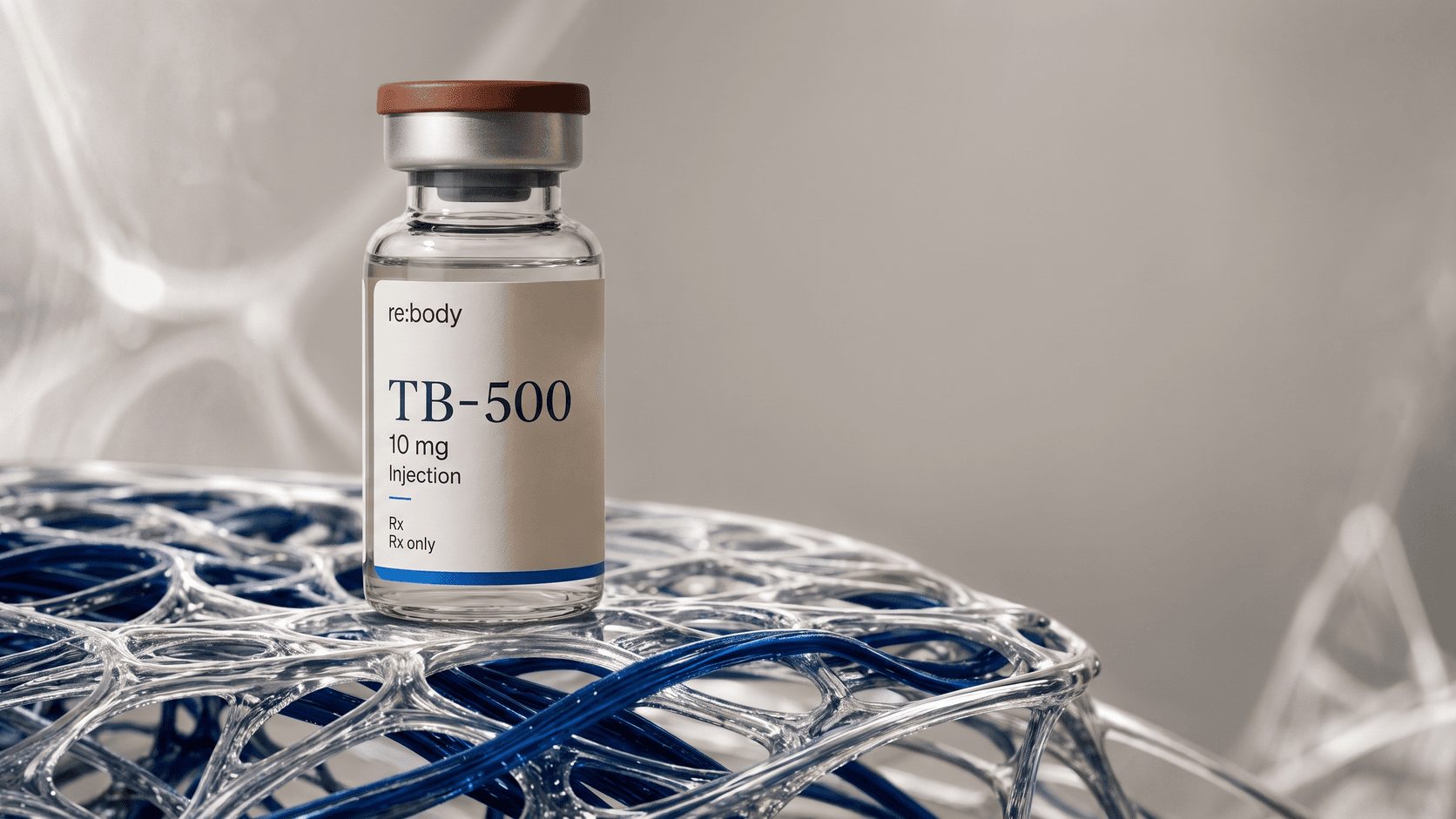
Peptide guide: This guide covers the research, molecular identity, product details, and the practical questions worth checking.
The short answer
TB-500 is the actin-fragment specialist. Its research lane centers on the actin-binding region tied to cell movement, cytoskeletal organization, angiogenesis, and wound repair.
Options at a glance
| Substance | Identity | Closest evidence | Critical boundary |
|---|---|---|---|
| TB-500 | Acetylated seven-amino-acid fragment | Direct fragment identity and actin-related laboratory work | Human outcome studies are the next evidence step |
| LKKTETQ fragment | Non-acetylated seven-amino-acid sequence | Migration and aged-mouse wound work | Not automatically the finished TB-500 substance |
| Thymosin beta-4 | 43-amino-acid parent protein | Wound, migration, and human development programs | Human results cannot be assigned to TB-500 |
What belongs in this category
Actin signaling is what makes this peptide family compelling. Cell migration, cytoskeletal organization, angiogenesis, and wound closure are distinct parts of repair biology, and the first useful comparison is molecular identity: seven amino acids, acetylation state, or the full 43-amino-acid parent protein.
TB-500 belongs here because it isolates a short sequence related to thymosin beta-4's actin-binding region. That gives it a distinctive recovery-research identity without requiring it to borrow every result from the 43-amino-acid parent protein.
What these molecules are
TB-500 commonly refers to an acetylated seven-amino-acid sequence related to residues 17–23 of thymosin beta-4. Thymosin beta-4 itself contains 43 amino acids. Published fragment work may use non-acetylated LKKTETQ, adding another identity difference.
Parent protein, fragment, and finished vial must remain separate in every claim. A study belongs to the substance actually tested, at the route and concentration actually used.
What the research measured
Aged-mouse wound research tested full thymosin beta-4 and a non-acetylated LKKTETQ fragment, with wound closure and tissue measures. Other laboratory programs examined cell migration, actin-related behavior, or angiogenic responses. These studies explain the mechanism category.
The direct record is mixed and specific. A fibroblast scratch assay at the tested condition found no significant wound-closure difference from vehicle, while related fragment and parent-protein programs measured migration, actin behavior, angiogenic responses, and wound outcomes. FDA's review identified no human exposure, pharmacokinetic, safety, or efficacy study for TB-500.
Human thymosin beta-4 wound studies answer questions about the 43-amino-acid protein and their specific route. They are not human trials of an acetylated seven-amino-acid TB-500 injection.
Which option wins this comparison
TB-500 wins the exact actin-fragment question when its identity is verified. Full thymosin beta-4 owns the broader parent-protein development record. Keeping them separate makes TB-500's distinctive fragment biology clearer, not weaker.
The useful standard is precise: name the substance, model, route, duration, and endpoint. If the finished vial cannot be tied to that identity, it does not earn the evidence.
Strength, concentration, and dose are different facts
Cell-culture concentrations, animal wound protocols, and a human injection prescription cannot be converted by matching milligrams. Molecular form, absorption, route, and endpoint all differ.
Use only the final label for concentration, injection volume, amount per use, and frequency. Do not derive a TB-500 schedule from a thymosin beta-4 paper or a non-acetylated fragment experiment.
What the routine changes in real life
A mechanism does not tell someone how often to inject. The routine must come from the finished prescription and include clean handling, site rotation, sharps disposal, storage, travel, and refill timing.
Track a concrete functional or wound outcome rather than “systemic healing.” Photographs, surface area, drainage, pain, load tolerance, and clinician-defined milestones are more interpretable than a broad recovery score.
Storage, shipping, and travel
Stability belongs to the finished substance and formulation. Do not assign full thymosin beta-4 storage instructions to TB-500 or assume an acetylated and non-acetylated fragment behave identically.
Follow the label, keep the lot and beyond-use date, avoid freezing and excess heat, and hold any cracked, leaking, cloudy, particulate, or discolored vial for pharmacy guidance.
Side effects and urgent symptoms
The lack of identified human TB-500 exposure data means systemic risks are not characterized. Injection adds pain, bruising, bleeding, contamination, and infection risks. A hot spreading area, drainage, red streaking, fever, facial swelling, trouble breathing, or fainting needs prompt help.
Human safety observations for full thymosin beta-4 cannot be transferred wholesale to a different fragment. Tested athletes must also account for current anti-doping rules.
Price, supply, and refills
Do not pay a premium for a parent-protein claim attached to a fragment vial. Value begins with verified molecular identity, concentration, prescribed supply, storage, and a measured outcome.
The least expensive product is still poor value when its label is ambiguous or its marketing depends on studies of a different substance.
Questions people ask before starting
Can I take BPC-157 and TB-500 every day?
Use TB-500 or BPC-157 only on the exact schedule printed on the prescription label. The compounds have different identities and historical schedules, and an online daily stack does not establish a safe or effective course. Do not turn the comparison into an unstudied home-mixed stack. A schedule cannot be derived from parent-protein or fragment mechanism experiments.
What are the risks of taking TB-500?
No human TB-500 exposure, pharmacokinetic, safety, or efficacy study was identified in FDA's review. That leaves systemic risks undefined in addition to ordinary injection risks such as pain, bruising, contamination, and infection. TB-500 is also prohibited for tested athletes. Human thymosin beta-4 observations cannot characterize safety for the seven-amino-acid TB-500 substance.
Is TB-500 the same as thymosin beta-4?
No. TB-500 commonly refers to a seven-amino-acid fragment related to residues 17–23 of thymosin beta-4. Thymosin beta-4 is a 43-amino-acid protein, so its human wound studies cannot be presented as TB-500 trials. Keeping 7 and 43 amino acids separate is the central evidence rule for this cluster.
What changes between 5 mg and 10 mg vials?
Five and ten milligrams usually describe total active in the vial, not the amount used at one time. Compare concentration, prescribed dose, frequency, days of supply, price per day, and refill timing before deciding which package is more practical. That arithmetic decides which package is more practical. Milligram comparisons remain secondary to exact molecular identity.
Why are TB-500 and thymosin beta-4 not interchangeable?
They differ in size and identity. TB-500 commonly refers to an acetylated seven-amino-acid fragment related to residues 17–23 of thymosin beta-4; the parent protein has 43 amino acids. Fragment studies may also use non-acetylated LKKTETQ. Acetylation, length, formulation, and route can change stability and biological behavior, so results remain attached to the substance tested.
What does the actin-binding region have to do with recovery claims?
It explains the research interest in cell movement, cytoskeletal behavior, angiogenesis, and wound models. Those mechanisms can be measured in cells or animals without proving that a person heals faster after an injection. A claim such as “systemic healing” omits the model, route, duration, comparator, and endpoint needed to evaluate it.
Is there direct human TB-500 evidence?
FDA's review identified no human exposure, pharmacokinetic, safety, or efficacy study for TB-500 by any route. Human development involving full thymosin beta-4 cannot fill that gap because it tested a different molecule. The absence of direct human data affects both efficacy and systemic safety claims.
What would a convincing TB-500 study need to report?
It would identify the exact seven-amino-acid substance and formulation, enroll a defined human population, use a stated route and schedule, include a meaningful comparator, and measure prespecified clinical outcomes over a clear duration. Pharmacokinetics and adverse events would also matter. A mechanism assay or parent-protein trial cannot answer all of those questions.
Keep the actin vocabulary tied to the tested substance
Actin polymerization helps cells change shape and move. Migration assays, endothelial sprouting, cytoskeletal organization, and wound closure in a laboratory dish can probe parts of that biology. They do not all measure the same process, and none alone demonstrates faster human recovery. Full thymosin beta-4 can bind actin through a region that includes LKKTETQ; TB-500 commonly refers to a shorter, acetylated fragment related to that region. Acetylation and sequence length affect identity, while formulation and route affect exposure. When reading a paper, record whether investigators tested the parent protein, an unacetylated fragment, an acetylated fragment, or a commercial vial. If that first column is wrong, every downstream conclusion about angiogenesis, repair, migration, or dosing is assigned to the wrong molecule.
Bottom line
TB-500 is the peptide to examine when the question is actin-fragment biology in recovery. Its distinctive case is cell movement, cytoskeletal organization, angiogenesis, and wound-repair research tied to a verified seven-amino-acid identity.
Keep reading
- Prescription Peptide Injections vs Research-Use-Only Vials
- Peptides Studied in Wound-Repair Models
- TB-500 vs Thymosin Beta-4: 7 Amino Acids Are Not the Same as 43
Primary sources
- https://pubmed.ncbi.nlm.nih.gov/12581423/
- https://pubmed.ncbi.nlm.nih.gov/14500546/
- https://www.fda.gov/advisory-committees/advisory-committee-calendar/july-23-24-2026-meeting-pharmacy-compounding-advisory-committee-07232026
- https://www.wada-ama.org/en/resources/world-anti-doping-program/prohibited-list