
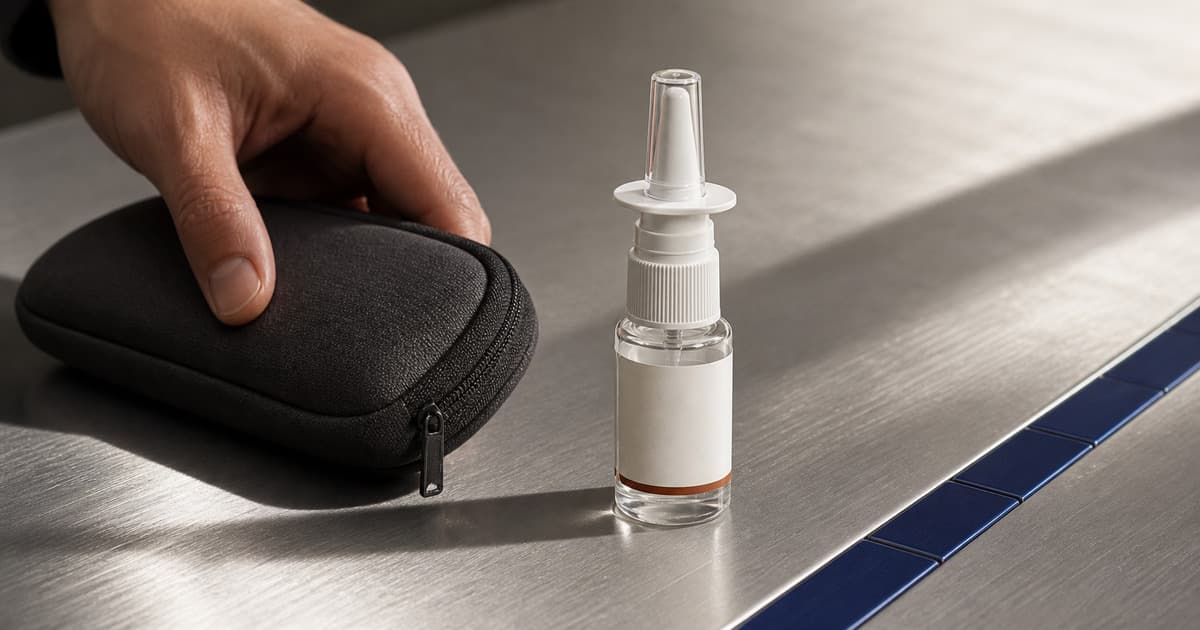

NAD+ nasal spray is Rebody's simplest and lowest-priced direct-NAD+ format. It takes seconds, avoids needles, is labeled for room-temperature storage, and currently costs $119 for a 30-day bottle. Its practical case is strong. Clinical-outcome evidence for the finished spray remains thin.
Choose it because the route fits. Do not treat broad NAD+ biology as proof that this bottle improves energy, focus, recovery, weight, or longevity.
The short answer
NAD+ is a coenzyme involved in cellular energy metabolism and many enzyme systems. A nasal spray delivers compounded NAD+ through a metered pump.
The route may appeal to someone who wants direct NAD+ without injections or a dissolving tablet. No published trial has established the clinical outcomes of Rebody's exact 300 mg/mL, 12 mL product.
Current product at a glance
| Fact | Rebody NAD+ nasal spray |
|---|---|
| Form | Prescription nasal spray |
| Concentration | 300 mg/mL |
| Bottle | 12 mL |
| Supply | 30 days |
| Storage | Room temperature, as labeled |
| Price | $119 |
Your clinician sets the dose, timing, and use. Follow your prescription label.
What NAD+ does in the body
NAD+ participates in redox reactions that help cells transfer energy from nutrients. Enzymes also consume it in processes related to signaling and cellular maintenance.
This makes NAD+ biologically important. It does not mean that adding NAD+ through any route produces the same outcome. Molecule, route, exposure, population, duration, and measured endpoint all matter.
What the human evidence shows
A 2026 systematic review found 33 human intervention studies across NAD-related strategies. Most human research involved oral precursors such as nicotinamide riboside or nicotinamide mononucleotide. Those products often changed NAD-related biomarkers, while functional and healthspan outcomes were mixed, null, or specific to the endpoint.
The review found no eligible clinical-outcome trial of direct intravenous or injected NAD+ for anti-aging or wellness. A small intravenous NAD+ pilot measured pharmacokinetics and metabolites rather than energy, cognition, recovery, or longevity.
Neither source establishes the effect of a direct NAD+ nasal spray. Precursor evidence and IV pharmacokinetics cannot fill that route gap.
Does nasal delivery reach the brain faster?
Google results often describe nasal NAD+ as fast-absorbing or brain-directed. The nose can provide local and systemic delivery pathways for some medicines. That general fact does not establish nose-to-brain exposure for this finished formula.
A defensible claim would require product-specific pharmacokinetic or imaging data. Without it, "fast to use" is supported. "Fast to the brain" is not.
NAD+ nasal spray vs injection
Nasal spray wins on convenience, storage, and current price. It avoids syringes and takes a few seconds.
Injection wins when a patient and clinician prefer an injection plan and direct measured administration. It adds needle use, supply handling, cold storage, and a higher package price.
No head-to-head clinical trial shows that either finished Rebody route produces better energy or cognition. Choose by route fit rather than an invented efficacy ranking.
NAD+ nasal spray vs sublingual tablets
Both routes avoid needles. Spray is faster and currently costs less. Tablets avoid nasal congestion, irritation, and a pump.
Neither route inherits outcome evidence from oral NR or NMN studies.
Read concentration and bottle size separately
The current bottle is labeled 300 mg/mL and contains 12 mL. Those facts describe the liquid. They do not tell you how many milligrams leave the pump with one actuation. That number depends on the device's metered output.
This distinction is useful when comparing clinics. A higher concentration can come with a smaller bottle or a different actuation volume. Ask for the concentration, fill volume, metered amount, and days of supply together.
Build a fair 30-day test
Choose one reason for using the spray before it arrives. Daytime energy, concentration, exercise recovery, and sleep are separate outcomes. Record a simple baseline for one or two weeks when possible. Keep caffeine, training, and sleep habits stable enough to interpret the next month.
For energy, record the time of the usual afternoon drop and whether another coffee was needed. For focus, use a repeatable work block rather than a general feeling. For recovery, record soreness and return to normal training after comparable sessions. A better month can still come from improved sleep, reduced alcohol, or a changed workout plan, so keep those changes visible.
The route also needs its own tracking. Note burning, congestion, drainage, unpleasant taste, nosebleeds, and whether the pump stayed clean and consistent. A fast format only creates value if it remains easy to use.
Compare direct NAD+ with precursor supplements
Nicotinamide riboside and nicotinamide mononucleotide are oral precursors. They enter NAD metabolism through different steps from a nasal product that contains NAD+ itself. Human precursor studies can inform biomarker questions, but they cannot supply the absorption or outcome for the nasal bottle.
The practical comparison is also different. A precursor is usually a swallowed supplement. This product is a prescription nasal spray with a metered device, a 30-day fill, and a $119 package price. Compare route and product facts before broad promises about raising NAD.
How to judge whether it is worth $119
Set a reason for the trial and a measurement window. Track a few concrete outcomes, such as afternoon energy at a fixed time, completion of planned work, training consistency, or another clinician-approved measure.
Keep sleep, caffeine, travel, illness, and other treatments visible. A good week after starting a spray is useful to notice, but it is not controlled proof.
The package value includes the bottle, prescription review, supply duration, storage, shipping, and the next charge. See the current NAD+ nasal spray page before buying.
Side effects and nasal problems
Nasal products can cause irritation, dryness, sneezing, drainage, congestion, nosebleeds, or an unpleasant taste. Stop and contact the care team about persistent bleeding, severe pain, major swelling, or worsening symptoms.
Seek urgent help for breathing difficulty, facial or tongue swelling, widespread hives, fainting, chest pain, or another severe reaction.
Questions to ask before the refill
Confirm that the bottle remained usable through the full 30-day period. Note pump clogs, leakage, lost caps, and congestion. Those details show whether the nasal route delivered the convenience it promised.
Review the chosen outcome beside the baseline. A lower afternoon slump, more completed work blocks, or steadier training can be meaningful when it repeats. One unusually good day cannot carry the decision. If the outcome did not move, ask your clinician whether the route, measurement, or underlying problem needs another look.
Price belongs in the same review. The current $119 package is Rebody's lowest-priced direct-NAD+ format. Compare the ongoing charge, shipping terms, bottle size, and next refill with the injection and sublingual options. A cheaper monthly route loses its advantage if nasal irritation makes it hard to use.
Bring persistent nosebleeds, pain, major congestion, or a change in smell to the care team.
Questions people ask
Does NAD+ nasal spray work?
The route delivers a compounded product according to its label. No clinical-outcome trial proves energy, cognition, recovery, or longevity results from Rebody's finished spray.
Is it faster than an injection?
It is faster to administer. No head-to-head pharmacokinetic or outcome study establishes a faster biological result.
Who decides how to use it?
Your clinician sets the dose, timing, and use. Follow your prescription label.
Does NAD+ nasal spray need refrigeration?
The current product is labeled for room-temperature storage. Check your pharmacy label before travel.
How much does it cost?
The current price is $119 for the 30-day bottle. Confirm the current promotion, shipping, and refill charge at checkout.
Is NAD+ nasal spray the same as an NMN or NR supplement?
No. NMN and NR are precursors that the body converts through several steps. The spray contains NAD+ itself and is a prescription product. Most of the human data in the 2026 review came from those oral precursors, so their results do not transfer to the nasal bottle.
What the research does not answer yet
Nobody has published blood or tissue levels after use of a direct NAD+ nasal spray like this one. The IV pilot study measured what happens after an infusion, which is a different route with different exposure.
The 2026 review also found no eligible outcome trial of direct NAD+ for wellness or anti-aging. That leaves energy, focus, recovery, and longevity as open questions for every direct-NAD+ format, not only the spray.
Long-term nasal use is another gap. The published work does not describe what months of repeated nasal contact with a 300 mg/mL solution does to the lining of the nose.
Who this fits
The spray fits an adult who wants a direct-NAD+ product, prefers no needles, and has a clear nose most days. It also suits someone who values room-temperature storage and the lowest package price in the NAD+ range.
It fits less well for a person with frequent congestion, nosebleeds, or nasal surgery history. Sublingual tablets or the injection may be easier in those cases, and a clinician can help sort that out.
How a Rebody visit works
You fill in an online visit with your health history. A licensed clinician reviews it and decides whether NAD+ nasal spray suits you. If it does, your prescription label carries the directions, and you can message the clinician with questions after the bottle arrives.
Bottom line
NAD+ nasal spray is the practical winner for a shopper who wants the least complicated direct-NAD+ route. Its value comes from speed, needle avoidance, room-temperature storage, and price. Treat energy, cognition, recovery, and longevity as open outcome questions.